Sarah Reidell is head of the lab charged with the care of the millions of physical objects in the Penn Libraries collection.
5 min. read
Sarah Reidell is starting her 10th year as head of the Penn Libraries’ Steven Miller Conservation Laboratory, which she helped launch in 2016. Today, she leads and manages a team of five conservators and technicians who care for the nearly 8 million objects in the Libraries physical collections.
As an undergraduate anthropology student at Bryn Mawr College, Sarah Reidell took archaeology classes at the University of Pennsylvania and volunteered at the Penn Museum, which led to a paying position shelving books in the Museum’s library.
“The melding of scholarship and librarianship came together. It was another way of being close to research and being close to materials,” Reidell says. “I’ve always been interested in the combination of studio art, science, history, and languages, and it all came together for me in conservation.”
Pivoting to graduate degrees in library and information science, and advanced study in library and archival preservation and conservation, she pursued a career as a conservator.
And that journey brought her back to Penn, as the inaugural head of the Penn Libraries’ Steven Miller Conservation Laboratory, which she helped establish in 2016.
Now in her 10th year, Reidell, the Margy E. Meyerson Head of Conservation, leads a team of five conservators and technicians who preserve, treat, house, exhibit, and monitor the Libraries’ vast physical collections. The lab is responsible for the long-term stability of objects including books, journals, zines, maps, art-on-paper prints, photographs, parchment, manuscripts, archival documents, and artifacts.
Jess Ortegon, preventive conservation librarian, is cleaning and stabilizing atlases of Philadelphia neighborhood maps from the early 1900s. They are in the Fisher Fine Arts Library and are heavily used by faculty. This one is "Sanborn Insurance Maps Philadelphia (volume 10, Philadelphia County)."
Reidell says that in conservation and librarianship “there’s a new thing to encounter and to help with every single day. You never know what questions are going to come your way.” The team, she says, safeguards the items for the long term. She considers “how people access this information, where they get to it, and thinking about how the University and the Libraries create those opportunities for sharing scholarship and doing it in ways that allow for open access.”
“It takes a great depth of expertise and experience to find ways to conserve and preserve objects so they can persist and continue to serve their purpose, for education, for learning, for research,” says Andy Hart, the MacDonald Director of Preservation at the Libraries.
Every object that has content has a lifespan and is fragile in some way, he says, vulnerable to the environment and handling, even during normal use. “We don’t preserve things just to preserve them,” Hart says. “We preserve things to be used, and that actually takes work.”
Behind the intricate, scientific, skilled hand work of the conservation staff, “much of the backbone of conservation is decision-making, and that is the core of what we are leaning on Sarah for,” Hart says, “thinking about the ways that we can get the most benefit for our users.”
‘Astounding materials’
Born and raised in State College, Pennsylvania, Reidell says that it was as an undergraduate on a semester abroad at University College Dublinthat she realized that she wanted to work with archival materials and illuminated manuscripts. Reidell went on to earn a dual master’s degree in library and information science at the University of Texas at Austin with a certificate of advanced study in library and archival preservation and conservation.
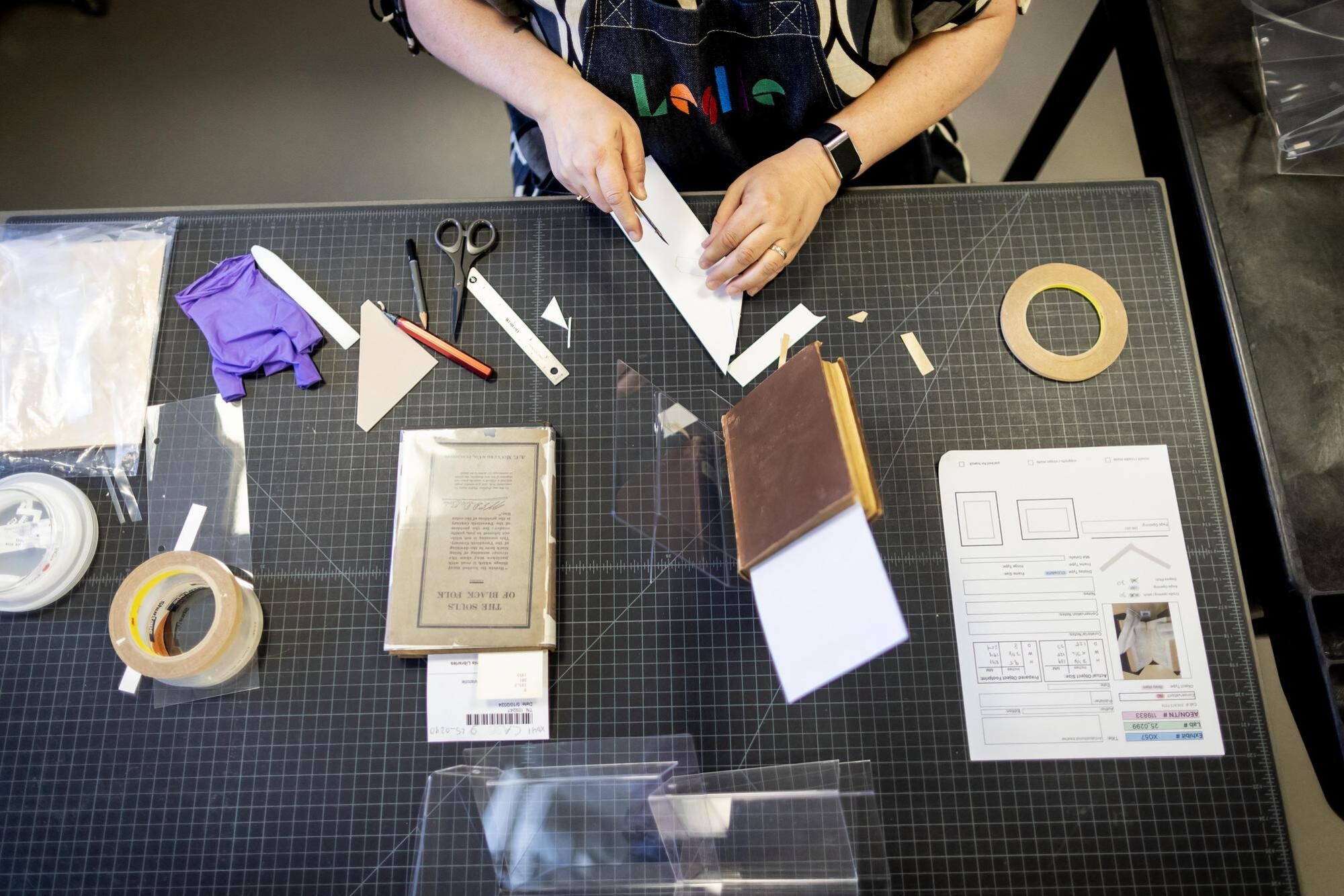
Leslie Goldman, senior conservation technician for exhibits, fabricates mounts for books chosen for the upcoming exhibit "Reinventing Aristotle" that opens in early October in the Libraries' Goldstein Gallery.
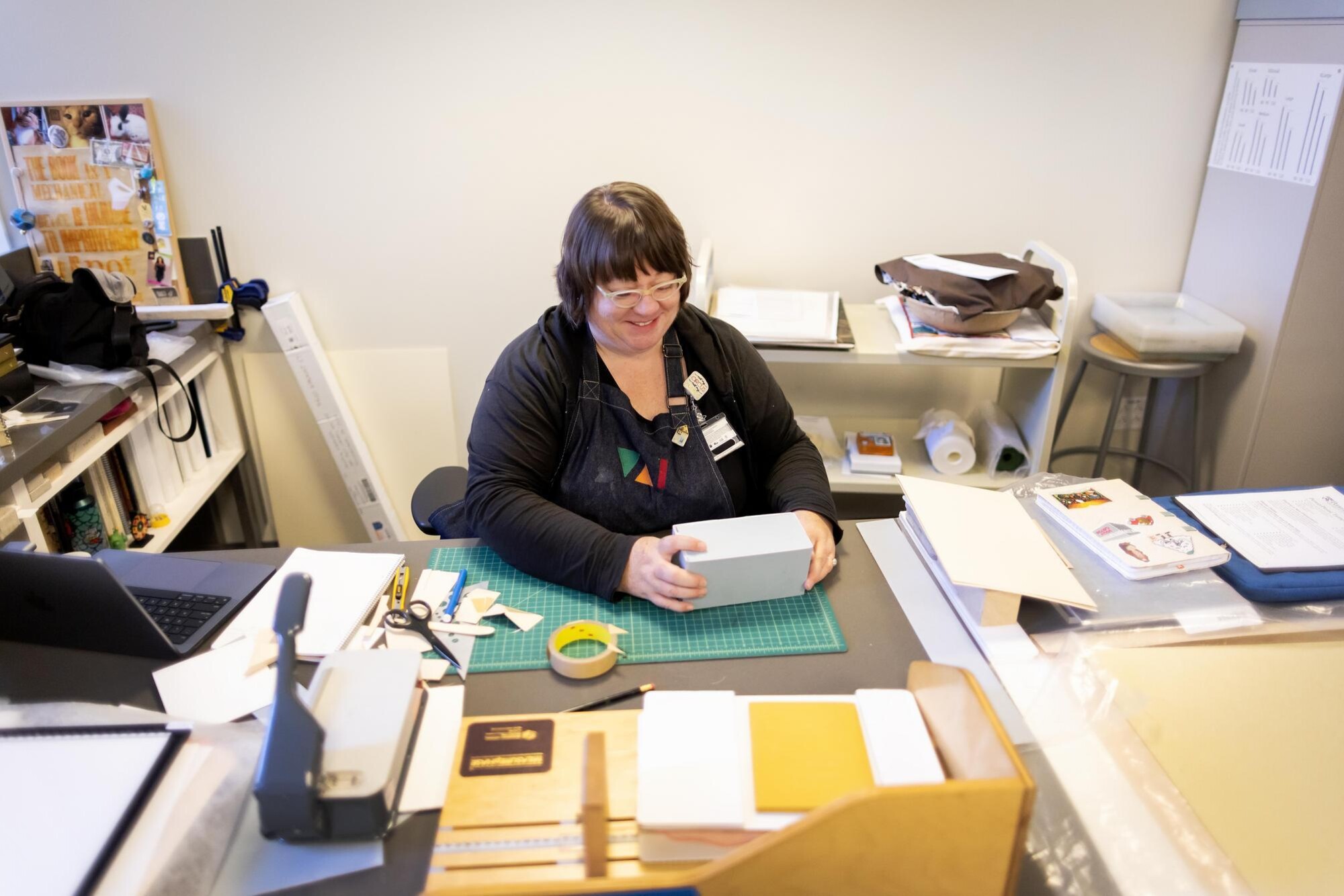
Valeria Kremser, senior conservation technician for books, fabricates new custom housings for unique artists books, including these new acquisitions in the Kislak Center.
“The need to stabilize these kinds of special collection materials, unfold things, and stabilize friable pigments and paints was just fantastic work,” she says. The collaborations at Harvard “set me up for working at scale and scope and thinking about things from a project management perspective.”
Following her studies, and before coming to Penn, she spent a decade at the New York Public Library as a rare book and paper conservator. “I worked on just astounding materials,” she says. One of her favorites turned into a research project, which she presented and published, on ephemera from the East India Company, gouache paintings on clear mica sheets that were sold at markets like postcards.
‘Ready to work on anything’
The painters were practically still at work when Reidell walked into the Penn Libraries conservation lab on her first day as the inaugural director. The large lab tables were waiting to be placed, and specialized equipment to be installed.
“It was just dive in and put the lab together,” she says, noting that she had set up labs at Harvard and at the New York Public Library. “Thinking about the layout of a laboratory facility, the service areas and opportunities for growth, working with the staff and senior leadership, it was fun.”
The 3,200-square-foot lab is equipped with specialized tools and flexible workspaces that support a wide range of conservation, like a fume-extraction system, a vacuum suction table, bookbinding presses and sewing frames, ultrasonic and heat welders, computerized cutting tools, full spectrum photographic equipment, and analytical tools for X-ray fluorescence.
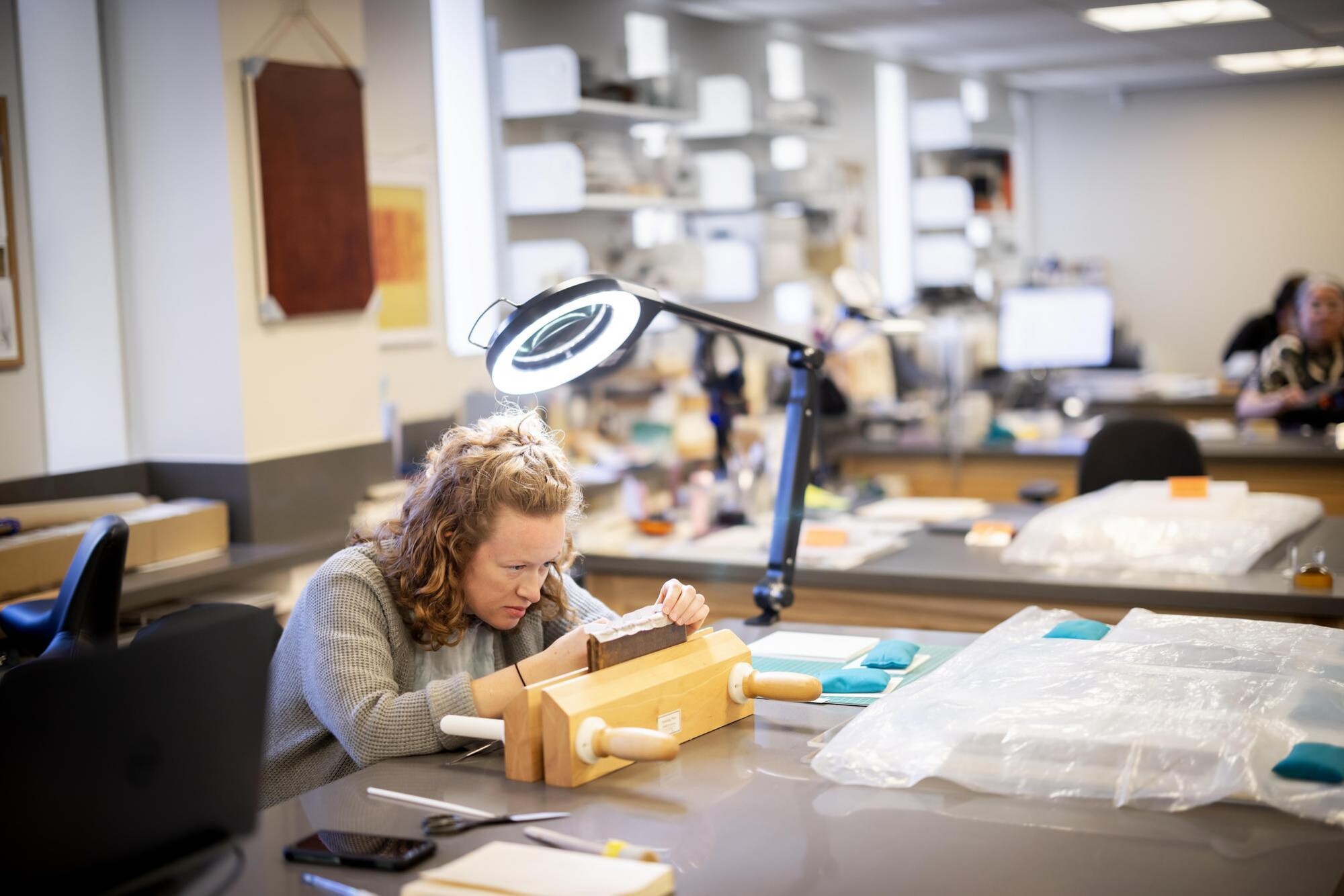
On a recent July afternoon, each team member was taking on a different challenge. Tessa Gadomski, conservation librarian, was treating the leather spine of a 16th-century book; Leslie Goldman, senior conservation technician for exhibits, was fabricating mounts for books chosen for an upcoming Libraries exhibit on Aristotle; Valeria Kremser, senior conservation technician for books, was fabricating new custom housings for unique artists books; and Jess Ortegon, preventive conservation librarian, was cleaning and stabilizing atlases of Philadelphia neighborhood maps from the early 1900s. Sibylla Shekerdjiska-Benatova, senior conservation technician for paper, away that afternoon, is working on a large South Asian manuscript that was recently digitized.
Reidell manages the lab but “she never forgets for a moment that it’s really that whole team that makes the magic happen; they’re incredibly skilled and talented,” Hart says.
“Sarah is curious, and I value that a great deal,” Hart says. “She displays over and over again an interest in what this work means to researchers and also an interest in how to connect to the rest of the Libraries.”
Tessa Gadomski, conservation librarian, is treating the leather spine of the book "Narratio Regionvm Indicarvm Per Hispanos qvosdam deuastatarum verissima" by Bartolomé de las Casas (1484-1566) from the Kislak Center.
The lab fabricates custom mounts for to display objects in exhibitions.
As director, Reidell manages a budget and monitors workflows and purchases supplies but also is a leader on policies that are very specific to preservation or conservation, like set points for temperature and humidity, and that require collaboration throughout the Libraries and across campus.
The Conservation team members each rotate as representatives to engage with the Green Labs Sustainability Committee, part of Penn’s Climate Action Plan. “It’s something we integrate into everything we do,” Reidell says. She detailed the lab’s “green protocol” for museum couriering and loaning, in a Libraries blog post.
Reidell also was recently featured in a Penn Global Discovery Series discussion this spring along with faculty Zachary Lesser and Whitney Trettien of the English Department about Shakespearean objects in the collection.
As the world becomes increasingly digital, Hart says conservation of physical objects is of growing importance. “I think that the world is going to expect of us and value that we’re taking care of objects that represent our time and our culture and bear information that cannot be expressed purely in digital form,” he says.
The Libraries collections are continually growing and so are the opportunities for the lab to contribute to their care, Reidell says. “With this expert team, we’re meeting the needs of the collections and tapping into the expertise and potential of our conservation program.”
Penn physicists led by Bo Zhen have created hybrid light-matter particles that interact strongly enough to compute, pointing toward ultrafast, low-energy optical AI hardware.
Penn’s newest supercomputer is transforming research
Penn’s first campus-wide HPC and AI cluster, “Betty,” is expanding access to powerful computing, enabling groundbreaking projects, and fostering new collaborations across disciplines.
A bioengineered bean gum from the lab of Penn Dental’s Henry Daniell is found to reduce the levels of three microbes associated with head and neck squamous cell cancer to almost zero, without affecting the beneficial bacteria normally found in the mouth.
Fighting oral cancer with bioengineered chewing gum
Research led by Penn Dental’s Henry Daniell shows that antiviral and antibacterial chewing gums reduce the levels of three microbes linked to worse outcomes in oral cancers, paving the way for more effective and affordable therapies.
The performing arts at Penn: Process, practice, and purpose
In the vivid tapestry of performing arts groups at Penn, students prepare for their performances while simultaneously enriching their college experience.