Advanced robotic imaging helps Rusty the therapy horse avoid surgery
When Rusty, a 20-year-old therapy Quarter Horse, developed lameness in his right hind leg, his diagnosis required advanced imaging. Unlike traditional CT scanners, New Bolton Center’s robotic imaging was key to Rusty’s diagnosis and treatment when he developed lameness in his leg.
2 min. read
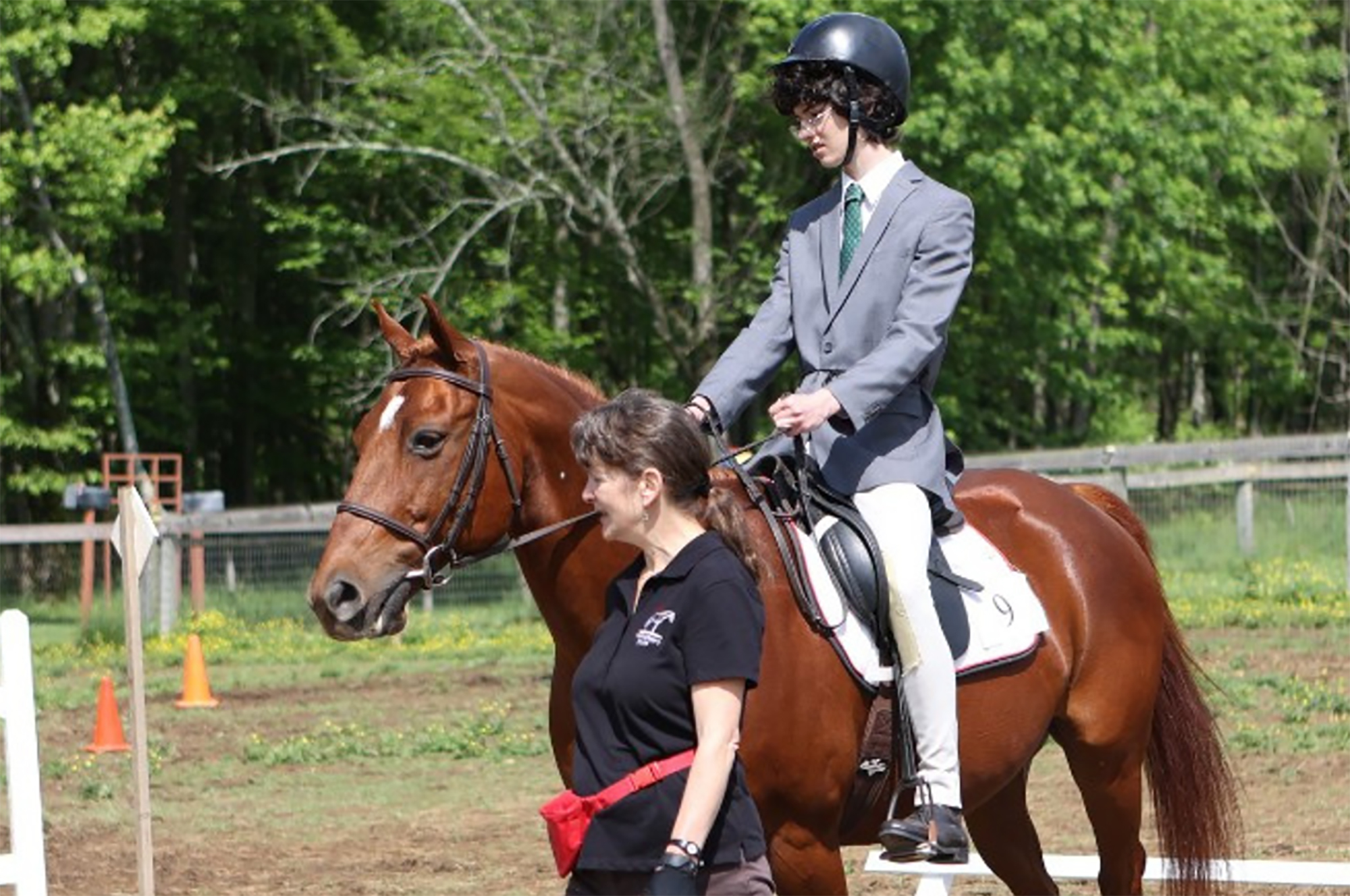
Since 2018, Rusty has been a steady, trusted partner at Thorncroft Equestrian Center, a leader in adaptive riding and equine-assisted services. The 20-year-old Quarter Horse helps riders with physical and cognitive disabilities build strength, confidence, and independence.
But when Rusty developed lameness in his right hind leg, his future as an adaptive riding horse became uncertain. The initial diagnosis was suspected suspensory desmitis, a common ligament injury in horses; Rusty was referred to Penn Vet’s New Bolton Center for further evaluation and possible surgery.
At the Kennett Square campus, David Levine, associate professor of clinical large animal surgery at Penn’s School of Veterinary Medicine, and Rusty’s care team performed an ultrasound. The results showed a mild enlargement of two areas—the suspensory and the inferior check ligaments, findings that didn’t correlate with the severity of Rusty’s lameness.
Rusty, a 20-year-old Quarter Horse, helps riders with physical and cognitive disabilities build strength, confidence, and independence Thorncroft Equestrian Center. State-of-the-art robotic imaging at Penn’s New Bolton Center was key to Rusty’s diagnosis and treatment when he developed lameness in his leg.
(Image: Ryan Sansom)
The team first performed a series of nerve blocks on the limb to help identify the region causing discomfort. Rusty showed marked improvement when they reached the two nerves that target structures in the tarsus or hock, akin to an ankle in humans.
“Following this block Rusty was nearly sound. This localization strongly suggested the source of pain was within the tarsus,” says Levine.
With this information, Levine then used New Bolton Center’s state-of-the-art Robotic CT to quickly and safely pinpoint the root cause of his lameness. Unlike traditional CT scanners, New Bolton Center’s robotic system allows horses to remain awake and standing, eliminating the need for general anesthesia and reducing risk and cost.
The scans, interpreted in real time by New Bolton Center’s board-certified radiologists, provided Rusty’s team with high-quality, multiplanar reconstructions and 3D images, offering a level of detail not achievable with ultrasound alone.
“If we had gone straight to surgery, we wouldn’t have addressed the source of the problem. Instead, advanced imaging allowed us to see what was happening with Rusty and develop a treatment plan tailored to his condition,” says Levine.
In the end, surgery was unnecessary. Rusty received an injection of corticosteroids to reduce inflammation and pain. He was also prescribed medication to treat pain and inflammation and placed on a strict stall rest regimen with limited hand-walking.
“With proper rest and ongoing joint therapy, Rusty will likely return to work,” Levine says.
In Senegal, the ambitious Dakar Greenbelt project seeks to create an extensive network of ecological infrastructure in and around the city to sustainably address environmental concerns and enhance urban life. With support from David Gouverneur and Ellen Neises, Ph.D. candidate Rob Levinthal in the Weitzman School of Design led two courses that included a field trip to Dakar, that culminated in students presenting their visions for parts of the Greenbelt.
From a desert to an oasis: Penn engages in ambitious greening effort in the Sahel
Students from the Weitzman School of Design journeyed to Senegal to help with a massive ecological and infrastructural greening effort as part of their coursework. The Dakar Greenbelt aims to combat desertification and promote sustainable urban growth.
As part of an undergraduate course, Penn faculty and students curated an Arthur Ross Gallery exhibition of works from the Neumann family’s extensive collection of modern and contemporary art.
The University’s nexus for technology transfer supports researchers in their innovative efforts, from CAR T to mRNA advancements that have dramatically reshaped the world.