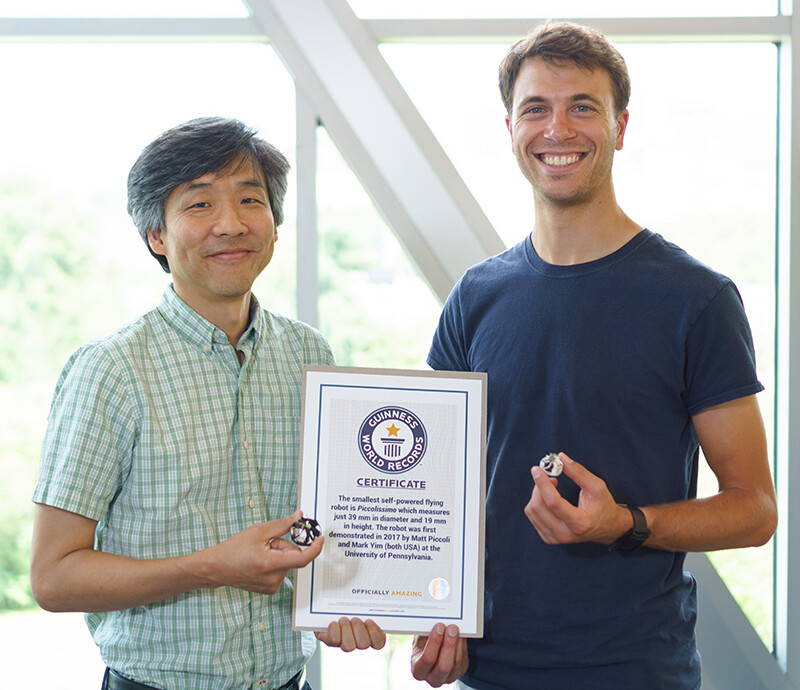
Professor Mark Yim and graduate student Matt Piccoli, creators of Piccolissimo.
Italian for “tiniest,” Piccolissimo is the brainchild of Matt Piccoli, a graduate student in professor Mark Yim’s ModLab. The robot comes in two sizes; the smaller weighs less than 2.5 grams and is about the width of a quarter, while the larger, steerable version is about 2 grams heavier and a centimeter wider.
The string of adjectives qualifying Piccolissimo as the “smallest” is necessary due to the concerted effort in miniaturizing flying robots. Harvard’s RoboBee, for example, is a few millimeters smaller than the steerable Piccolissimo, but is tethered to a terrestrial power source, limiting its range of motion.
Enabling directional control on such a tiny frame is an equally big challenge, but one that the ModLab is particularly equipped to address. One of the lab’s specialties is “underactuated” robots, ones that achieve the greatest range of motion with the fewest motors possible.
Novel plant-based approach to a better, cheaper GLP-1 delivery system
Research led by Penn Dental’s Henry Daniell investigates the use of a lettuce-based, plant-encapsulated delivery platform as a new oral delivery of two GLP-1 drugs previously approved by the FDA in injectable form.
No brain, no gain: Neuronal activity enhances benefits of exercise
Research led by Penn neuroscientist J. Nicholas Betley and collaborators finds that hypothalamic neurons are essential for translating physical exertion into endurance, potentially opening the door to exercise-mimicking therapies.
In honor of Valentine's Day, and as a way of fostering community in her Shakespeare in Love course, Becky Friedman took her students to the University Club for lunch one class period. They talked about the movie "Shakespeare in Love," as part of a broader conversation on how Shakespeare's works are adapted.
In Becky Friedman’s English course Shakespeare in Love, undergraduate students analyze language, genre, and adaptation in the Bard’s plays through the lens of love.
Beating the heat: Designing cooling for bodies in motion
Dorit Aviv, director of Weitzman’s Thermal Architecture Lab, studies how humans, technology, and design intersect, paving the way for the development of novel approaches to cooling people efficiently.