The importance and power of undergraduate research
Ann Vernon-Grey connects hundreds of students to research opportunities with faculty.
4 min. read
Ann Vernon-Grey is the director of undergraduate research for Penn’s Center for Undergraduate Research and Fellowships.
As a new student at the University of Tulsa, Ann Vernon-Grey was asked by a biology professor to be a research assistant in the lab. She was surprised, not realizing research was a possibility for undergraduates, but she jumped at the opportunity.
“It completely changed the trajectory of my life when I stumbled upon undergraduate research,” says Vernon-Grey, now the director of undergraduate research at Penn’s Center for Undergraduate Research and Fellowships (CURF).
Many students come to Penn with the idea of doing research but don’t know what that actually means, and Vernon-Grey helps them find their way. “I think of CURF as an advising office at its heart,” she says. “One of my favorite things to do is to talk with students about their research journey.”
Student research experiences
Vernon-Grey and her CURF colleagues have helped more than 500 undergraduates find research opportunities this year. Among the programs Vernon-Grey manages is the Penn Undergraduate Research Mentoring Program, which connects rising second- and third-year students—250 this summer—with faculty to conduct research and provides financial support.
She and the CURF team organize several events, such as group information sessions and faculty panels. The largest are the Fall Research Expo and the Spring Symposium, where hundreds of students present posters and talk about their research. The team also manages the CURF Research Peer Advisor program, including 75 volunteer students trained to help other students.
“Our motto is that research is for everyone,” Vernon-Grey says. “Not everyone’s going to love it like I did or want to do it moving forward, but the worst thing to me is if a student counts themselves out. It’s my mission to make sure that anybody who wants to have an opportunity to pursue research is able to do that.”
Jane Morris, CURF executive director, says that Vernon-Grey “believes deeply in the idea that all students should have the opportunity to pursue a research experience,” which aligns directly with CURF’s mission. “She puts that belief into action through her outreach and advising to students from all backgrounds and academic disciplines, encouraging participation in the process of intellectual exploration,” Morris says.
Research is a “high-impact practice,” that offers students “a chance to be an intellectual risk-taker,” says Vernon-Grey, who describes herself as a "data-driven and evidence-based” person.
“Students who participate in research as undergraduates have a greater sense of belonging at the University as learners," she says, “and they have greater ownership over the field that they’re interested in and a greater sense of achievement.” She adds that employers want to see the self-starting skills researchers develop, such as “time management, teamwork, and the ability to formulate complicated questions and devise an approach to answer them.”
Finding her own path
Vernon-Grey grew up in rural Arkansas and chose biology as her major in college since she loved animals and the outdoors. After that first research experience with the biology professor, a classmate approached her about a grant-funded project involving the emerging worldwide web.
She researched how to electronically transfer medical records data securely from one hospital to another using what is now known as the internet. The case study was on breast cancer, and she worked with physicians to understand the standards needed.
“I had this ‘aha’ moment: You can do research for a living?” she says. “That was my first scientific introduction to breast cancer, which then became a thread for the rest of my academic life.”
On a dare she applied for a Marshall Scholarship, which covers the cost of going to a university in the United Kingdom, to pursue a Ph.D. in developmental cancer biology. She got the scholarship and attended the University of Cambridge in England. While there she met her husband, Cam Grey, professor of classical studies in the School of Arts & Sciences.
And it was there that she was mentored by faculty members who lived in college houses. The couple decided that when they returned to the U.S. they would go to a university with that system. They chose the University of Chicago, where Grey was on faculty for three years while Vernon-Grey was on a postdoctoral fellowship at Northwestern University.
Grey landed a faculty position at Penn, which brought the couple to Philadelphia in 2006. For 10 years they were faculty fellows living in Kings Court English College House, and in 2016 Grey became the inaugural faculty director of what is now Lauder College House. The couple still lives there, with their two children and basset hound.
When they came to Penn, Vernon-Grey was a postdoctoral fellow studying breast cancer at Penn Medicine in the Cancer Biology Department. “I had several undergraduates working with me in the lab,” she says. “I loved teaching and mentoring in a laboratory setting.”
The experience led her to CURF, where she pitched herself as a scientist-consultant and started as associate director for undergraduate research in 2014. “And it turned out I loved it,” she says, especially the capacity to “advise students about what undergraduate research can be and what impact it can have on the trajectory of your life.”
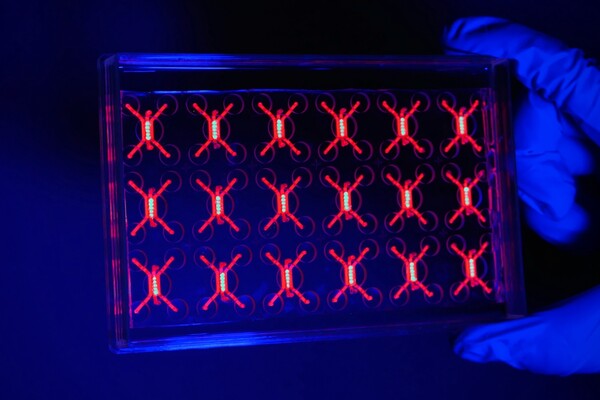
Penn engineers and collaborators have developed a transparent, micro-engineered device that houses a living, vascularized model of human lung cancer—a “tumor on a chip”—and show that the diabetes drug vildagliptin helps more CAR T cells break through the tumor’s defenses and attack it effectively.
Tumor-on-a-chip offers insight into cancer-fighting cells in immunotherapy
Penn engineers and collaborators have built a living tumor on a chip to expose how cancers block immune attacks, and how one existing drug could make immunotherapy like CAR T more effective against solid tumors.
Professor of city and regional planning Erick Guerra recently published a book exploring the economic and societal impacts of American highways. He explains some of the pitfalls associated with an ever-expansive highway system, arguing that spending more on highways might not be the solution to the country’s transportation issues.
Penn urban planner Erick Guerra’s new book, “Overbuilt,” argues that additional spending on building more highways might not be the solution to the country’s transportation issues. In a Q&A, Guerra shares his insights.
Xin Sun prepares samples collected from the Eastern Tropical North Pacific aboard a research vessel. By adding stable isotope tracers to these vials, Sun and her team can track how different microbial groups convert nitrogen compounds into nitrous oxide, revealing how subtle shifts in oxygen and organic matter change the ocean’s chemistry.
Can tiny ocean organisms offer the key to better climate modeling?
In the shadowy layers of the Pacific, microbes decide how much nitrous oxide—a potent greenhouse gas—rises skyward. New research from Penn’s Xin Sun offers an improved understanding of microbial ecology and geochemistry—key to forecasting global emissions in response to natural and man-made climate change.
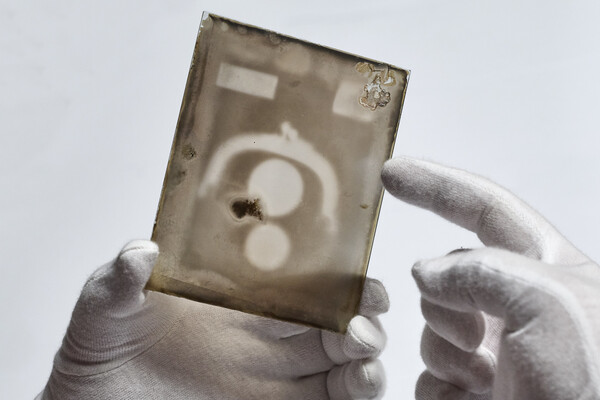
Two X-ray plates from Arthur Goodspeed, believed to have created the world’s first X-ray image, were donated by his family to Penn’s University Archives.