Using a newly developed laboratory model of three types of brain cells, Penn and CHOP scientists reveal how HIV infection—as well as the drugs that treat it—can take a toll on the central nervous system.
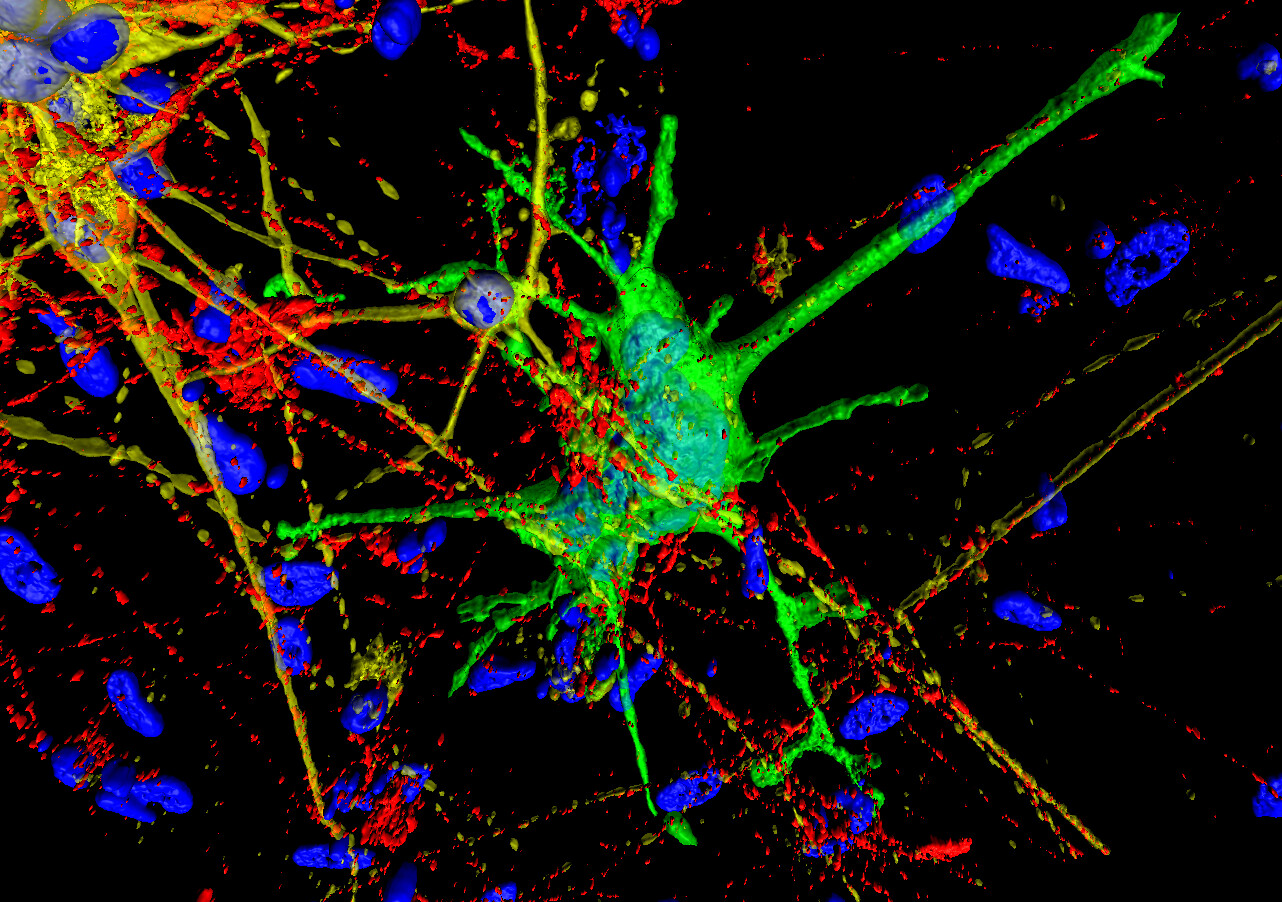
By culturing astrocytes, microglia, and neurons—all derived from human-induced pluripotent stem cells—in one dish, researchers have created an effective model to study the cognitive impacts of HIV and other diseases. (Image: Sean Ryan)
Though many negative repercussions of human immunodeficiency virus infection can be mitigated with the use of antiretroviral therapy (ART), one area where medical advances haven’t made as much progress is in the reduction of cognitive impacts. Half of HIV patients have HIV-associated neurocognitive disorders (HAND), which can manifest in a variety of ways, from forgetfulness and confusion to behavior changes and motor deficiencies.
To better understand the mechanisms underlying HAND, researchers from Penn’s School of Dental Medicine and Perelman School of Medicine and from the Children’s Hospital of Philadelphia (CHOP) brought together their complementary expertise to create a laboratory model system using three of the types of brain cells thought to be involved. Led by doctoral student Sean Ryan, who was co-mentored by Kelly Jordan-Sciutto of Penn Dental Medicine and Stewart Anderson of CHOP and Penn Medicine, the model recapitulates important features of how HIV infection and ART affect the brain.
“Frankly the models we generally use in the HIV field have a lot of weaknesses,” says Jordan-Sciutto, co-corresponding author on the paper, which appears in the journal Stem Cell Reports. “The power of this system is it allows us to look at the interaction between different cell types of human origin in a way that is more relevant to patients than other models.”
In addition to studying HIV, members of the team plan to use the same model to shed light on the neurological mechanisms that underlie other conditions, such as schizophrenia, Alzheimer’s, and even normal aging.
“We’re collaborating with a variety of colleagues to use this system to study Alzheimer’s disease as well as schizophrenia,” says Anderson, co-corresponding author on the paper. “We have the components in a dish that we know are interacting in these diseases, and this gives us a new mix-and-match way to understand how certain cells are contributing to neuronal damage.”
Indeed, the impetus to create the model grew not out of HIV research but work that Ryan was pursuing in Anderson’s lab on schizophrenia.
“We had been looking at the role of microglia, the resident immune cells of the central nervous system,” says Ryan, first author on the work. “We wanted to see if we could see the mechanistic changes that occur with microglia in schizophrenia.”
To do so, Ryan and Anderson were interested in using human-induced pluripotent stem cells—adult cells that are reprogrammed to resemble embryonic stem cells—which can be coaxed into differentiating into a variety of different cell types.
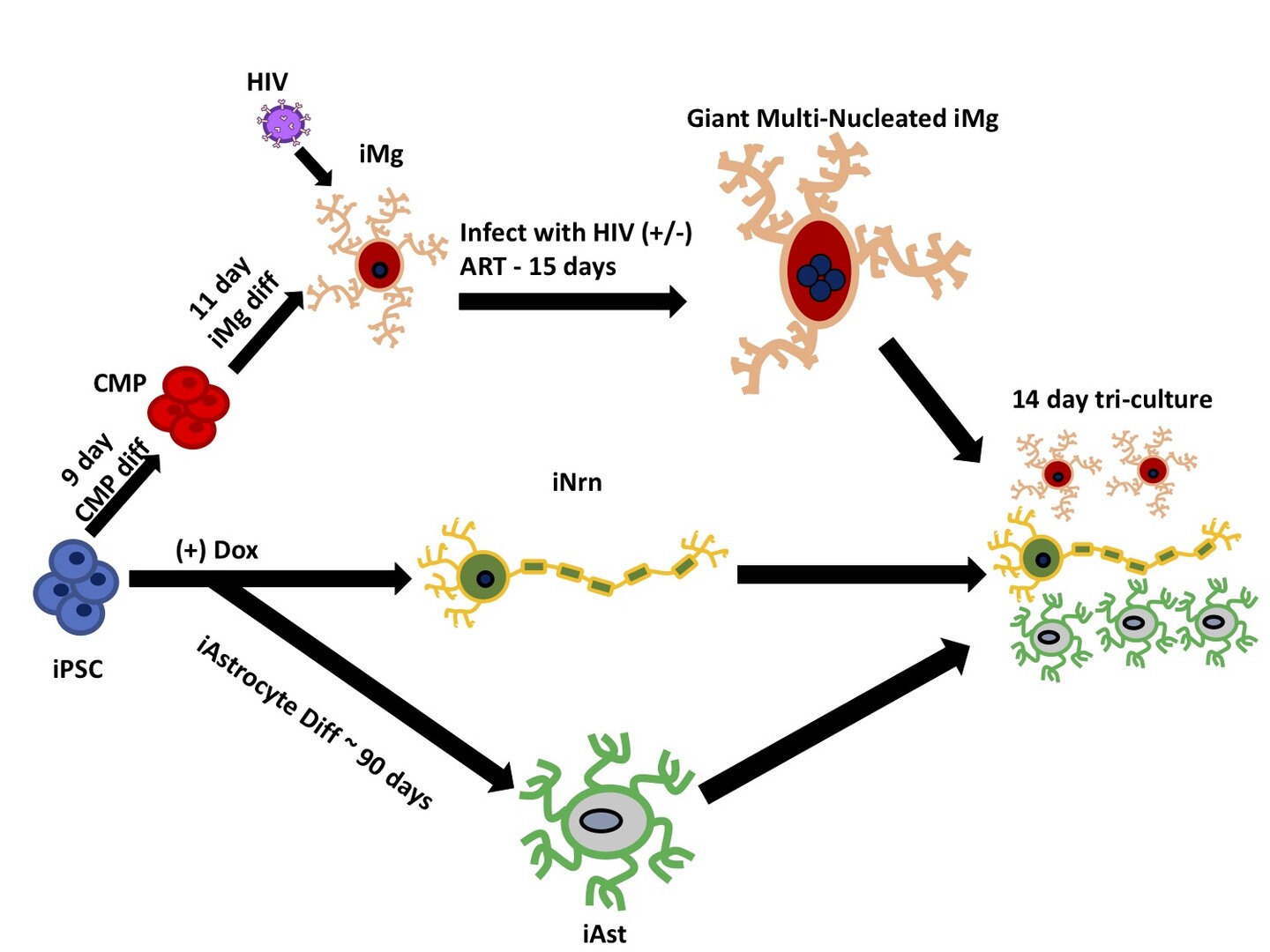
Infecting microglia with HIV, then adding those cells to astrocytes and neurons, the team discovered the model system recapitulated key features of the damage seen in the brain during HIV infection, with or without antiretrovial therapy. (Image: Sean Ryan)
But schizophrenia is a complicated disease with a variety of contributing genetic and environmental factors and a broad spectrum of presentations. Rather than looking at something complex, they sought to apply their new system to a disease that likewise causes neurological damage but does so in a more dramatic way and in which microglia are also implicated: HIV/AIDS infection.
They reached out to Jordan-Sciutto, who has deep experience investigating the mechanisms of HAND and was eager for the opportunity to develop a model superior to those currently available. Together, the scientists identified the three cell types they were most interested in studying: neurons, astrocytes, and microglia.
Neurons aren’t directly infected by HIV but are known to be damaged during infection. Meanwhile astrocytes are believed to interact with neurons, causing damage by sending pro-inflammatory factors into the spaces between cells, called synapses. And microglia, which are responsible for maintaining a healthy environment in the absence of disease, are seen to expand and contribute to inflammation during HIV infection.
After nailing the technical challenge of creating this tractable model in which each cell type is generated independently and then mixed together, the team used it to probe how HIV infection and ART impact the cells, both alone and in combination.
“A lot of people are taking PreEP [pre-exposure prophylaxis] if they’re in a situation where their risk of contracting HIV is heightened,” says Ryan. “Just as we want to understand the cognitive impacts of HIV, we also want to see whether these drugs alone are impacting the brain health of otherwise healthy people.”
The researchers looked at RNA expression in their cultures to get a sense of what proteins and signaling pathways were becoming activated in each scenario. During infection, they saw inflammatory pathways that had previously been implicated in HIV in earlier research. When they introduced the antiretroviral drug EFZ, which is not in common use in the United States but remains a frontline therapy in many other areas of the world, with an infection, the activity of most of these pathways was reduced.
“But this scenario involved its own unique response,” says Ryan. Certain pathways associated with inflammation and damage remained despite the introduction of EFZ.
“EFZ treatment of the tricultures that included HIV-infected microglia reduces inflammation by around 70%,” Ryan says. Interestingly, EFZ by itself also triggered inflammation, though to a lesser extent than infection.
“It seems a combination of infection and ART is creating its own unique response that is different from the sum of its parts,” Ryan says. “Knowing what pathways are still active due to ART could help us appropriately target additional therapies so patients don’t develop HAND.”
Many features of infection seen in the three-cell culture mirror what is known from HIV infection and ART treatment in people, giving the researchers confidence in the reliability of their model.
“Just looking at the microglia,” says Anderson, “we see in our system that they are taking on both of their normal roles in keeping key signaling systems balanced during their normal state and activating and causing damage when they’re fighting infection. We’re able to model normality and abnormality in a way we haven’t been able to before.”
For Jordan-Sciutto, the new system “is really going to change the way my lab operates going into the future.” She’s hopeful many other HIV scientists will take it up to further their studies as she also explores more aspects of HIV’s impact on the brain, such as how it navigates through the blood-brain barrier that normally protects the central nervous system from inflammation and infection.
The study authors give credit to the collaborative environment at Penn for this cross-disciplinary project. “Tentacles of this project extend from CHOP to the dental school to the vet school to the medical school,” says Anderson. “Penn is a very special place where people seem to be more likely to share their technologies around and let other people work with and develop them. This project is a great example of that.”
Jordan-Sciutto, Anderson, and Ryan’s coauthors on the study were CHOP’s Michael V. Gonzalez, James P. Garifallou, Nathaniel P. Sotuyo, Kieona Cook, and Hakon Hakonarson; Penn Medicine’s Frederick C. Bennett and Eugene Mironets; and Spelman College’s Kimberly S. Williams.
Novel plant-based approach to a better, cheaper GLP-1 delivery system
Research led by Penn Dental’s Henry Daniell investigates the use of a lettuce-based, plant-encapsulated delivery platform as a new oral delivery of two GLP-1 drugs previously approved by the FDA in injectable form.
No brain, no gain: Neuronal activity enhances benefits of exercise
Research led by Penn neuroscientist J. Nicholas Betley and collaborators finds that hypothalamic neurons are essential for translating physical exertion into endurance, potentially opening the door to exercise-mimicking therapies.
In honor of Valentine's Day, and as a way of fostering community in her Shakespeare in Love course, Becky Friedman took her students to the University Club for lunch one class period. They talked about the movie "Shakespeare in Love," as part of a broader conversation on how Shakespeare's works are adapted.
In Becky Friedman’s English course Shakespeare in Love, undergraduate students analyze language, genre, and adaptation in the Bard’s plays through the lens of love.
Beating the heat: Designing cooling for bodies in motion
Dorit Aviv, director of Weitzman’s Thermal Architecture Lab, studies how humans, technology, and design intersect, paving the way for the development of novel approaches to cooling people efficiently.