Vanessa Chan bridges the gap between innovation and the market
The Jonathan and Linda Brassington Practice Professor in Materials Science and Engineering is the inaugural vice dean of innovation and entrepreneurship at Penn Engineering.
Vanessa Chan, Jonathan and Linda Brassington Practice Professor in Materials Science and Engineering, brings a wealth of experience and a passion for innovation to her new role as the inaugural vice dean of innovation and entrepreneurship at Penn’s School of Engineering and Applied Science.
Vanessa Chan has been appointed the inaugural vice dean of innovation and entrepreneurship at Penn Engineering.
(Image: Penn Engineering Today)
With a career that spans co-leading McKinsey’s innovation practice, founding her own company, re.design, and serving as the U.S. Department of Energy’s Chief Commercialization Officer, Chan has a unique perspective on bridging the gap between groundbreaking ideas and real-world impact.“Across all the organizations I’ve worked with—whether it’s a large company, a startup, an academic research lab, or the federal government—I’ve realized that we don’t do enough to teach people how to bring technologies to market. We focus heavily on the hard science and the technology itself, but we don’t always address the equally critical skills needed to commercialize those innovations.”
Chan highlights the importance of teaching engineers these skills. “Engineering education focuses heavily on understanding the fundamental science—math, physics and the laws of nature. That’s crucial because science is at the core of all technology, and a deep understanding of these fundamentals is essential.”
“However,” she adds, “what we’re not doing enough of is teaching engineers about the real-world problems they need to solve. Inventing something is hard, but it is equally as hard to bring a technology that fundamentally works to market: You have to understand if you can scale it economically, there are often regulatory hurdles to overcome and you need to understand the value chain decision-makers that you need to navigate to bring the technology to market.”
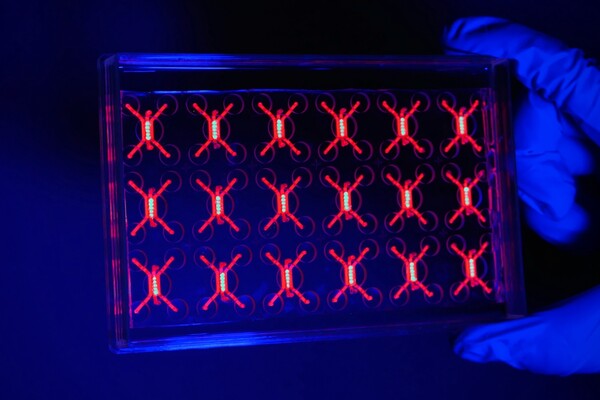
Penn engineers and collaborators have developed a transparent, micro-engineered device that houses a living, vascularized model of human lung cancer—a “tumor on a chip”—and show that the diabetes drug vildagliptin helps more CAR T cells break through the tumor’s defenses and attack it effectively.
Tumor-on-a-chip offers insight into cancer-fighting cells in immunotherapy
Penn engineers and collaborators have built a living tumor on a chip to expose how cancers block immune attacks, and how one existing drug could make immunotherapy like CAR T more effective against solid tumors.
Professor of city and regional planning Erick Guerra recently published a book exploring the economic and societal impacts of American highways. He explains some of the pitfalls associated with an ever-expansive highway system, arguing that spending more on highways might not be the solution to the country’s transportation issues.
Penn urban planner Erick Guerra’s new book, “Overbuilt,” argues that additional spending on building more highways might not be the solution to the country’s transportation issues. In a Q&A, Guerra shares his insights.
Xin Sun prepares samples collected from the Eastern Tropical North Pacific aboard a research vessel. By adding stable isotope tracers to these vials, Sun and her team can track how different microbial groups convert nitrogen compounds into nitrous oxide, revealing how subtle shifts in oxygen and organic matter change the ocean’s chemistry.
Can tiny ocean organisms offer the key to better climate modeling?
In the shadowy layers of the Pacific, microbes decide how much nitrous oxide—a potent greenhouse gas—rises skyward. New research from Penn’s Xin Sun offers an improved understanding of microbial ecology and geochemistry—key to forecasting global emissions in response to natural and man-made climate change.
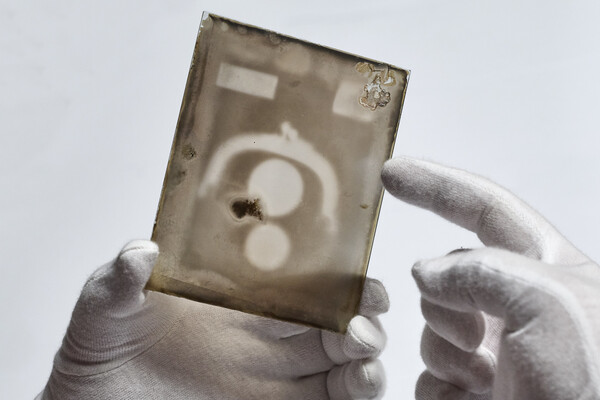
Two X-ray plates from Arthur Goodspeed, believed to have created the world’s first X-ray image, were donated by his family to Penn’s University Archives.