A new Penn Medicine CAREs grant will make accessibility updates to a grief garden at the Philly Goat Project.
2 min. read
A group of more than a dozen friendly goats live in a busy Germantown neighborhood, cared for by the Philly Goat Project since its founding in 2018.
In addition to “typical” goat jobs, like chomping invasive plant species and weeds, the goats are part of community events and school programs. They are also part of a relatively new garden space meant to help people process grief. That “grief garden” is about to benefit from accessibility updates, thanks to a Penn Medicine nurse who moonlights as a volunteer at the Awbury Arboretum.
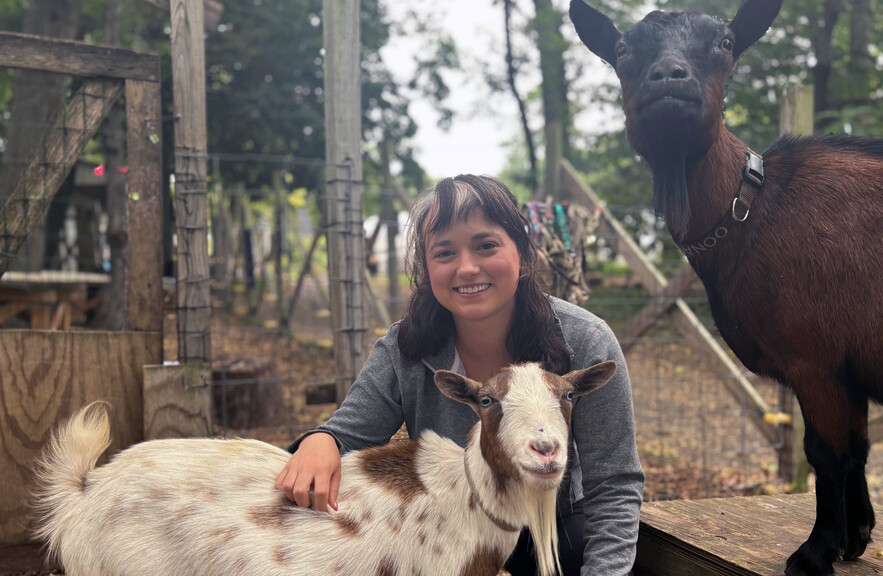
Grace Freund, an oncology nurse at the Hospital of the University of Pennsylvania, with a goat from the Philly Goat Project.
(Image: Courtesy of Penn Medicine News)
In 2022, Grace Freund began volunteering with the Philly Goat Project while she was working with Penn Medicine Hospice, and has since become an oncology nurse at the Hospital of the University of Pennsylvania. In the years since, she received two Penn Medicine CAREs grants to support the Philly Goat Project, including the most recent one, to make their “grief garden” more accessible. Penn Medicine CAREs grants fund community volunteer efforts by employees and students since 2012.
“It’s a space that allows people to really process grief and loss in their own way, and includes a few tangible ways to do so,” said Bethany Weed, a Philly Goat Project representative who manages programming in the space.
The Penn Medicine CAREs funding will go toward clearer wayfinding and signage to identify the garden entrance, as well as railings to help make the path more accessible—for both two legs or four.
“Philly Goat Project has really tapped into a lot of unacknowledged or unprocessed grief within the communities they serve,” Freund said. “In addition to the physical garden, they have walks with the goats that are focused specifically on grief.”
Novel plant-based approach to a better, cheaper GLP-1 delivery system
Research led by Penn Dental’s Henry Daniell investigates the use of a lettuce-based, plant-encapsulated delivery platform as a new oral delivery of two GLP-1 drugs previously approved by the FDA in injectable form.
No brain, no gain: Neuronal activity enhances benefits of exercise
Research led by Penn neuroscientist J. Nicholas Betley and collaborators finds that hypothalamic neurons are essential for translating physical exertion into endurance, potentially opening the door to exercise-mimicking therapies.
In honor of Valentine's Day, and as a way of fostering community in her Shakespeare in Love course, Becky Friedman took her students to the University Club for lunch one class period. They talked about the movie "Shakespeare in Love," as part of a broader conversation on how Shakespeare's works are adapted.
In Becky Friedman’s English course Shakespeare in Love, undergraduate students analyze language, genre, and adaptation in the Bard’s plays through the lens of love.
Beating the heat: Designing cooling for bodies in motion
Dorit Aviv, director of Weitzman’s Thermal Architecture Lab, studies how humans, technology, and design intersect, paving the way for the development of novel approaches to cooling people efficiently.