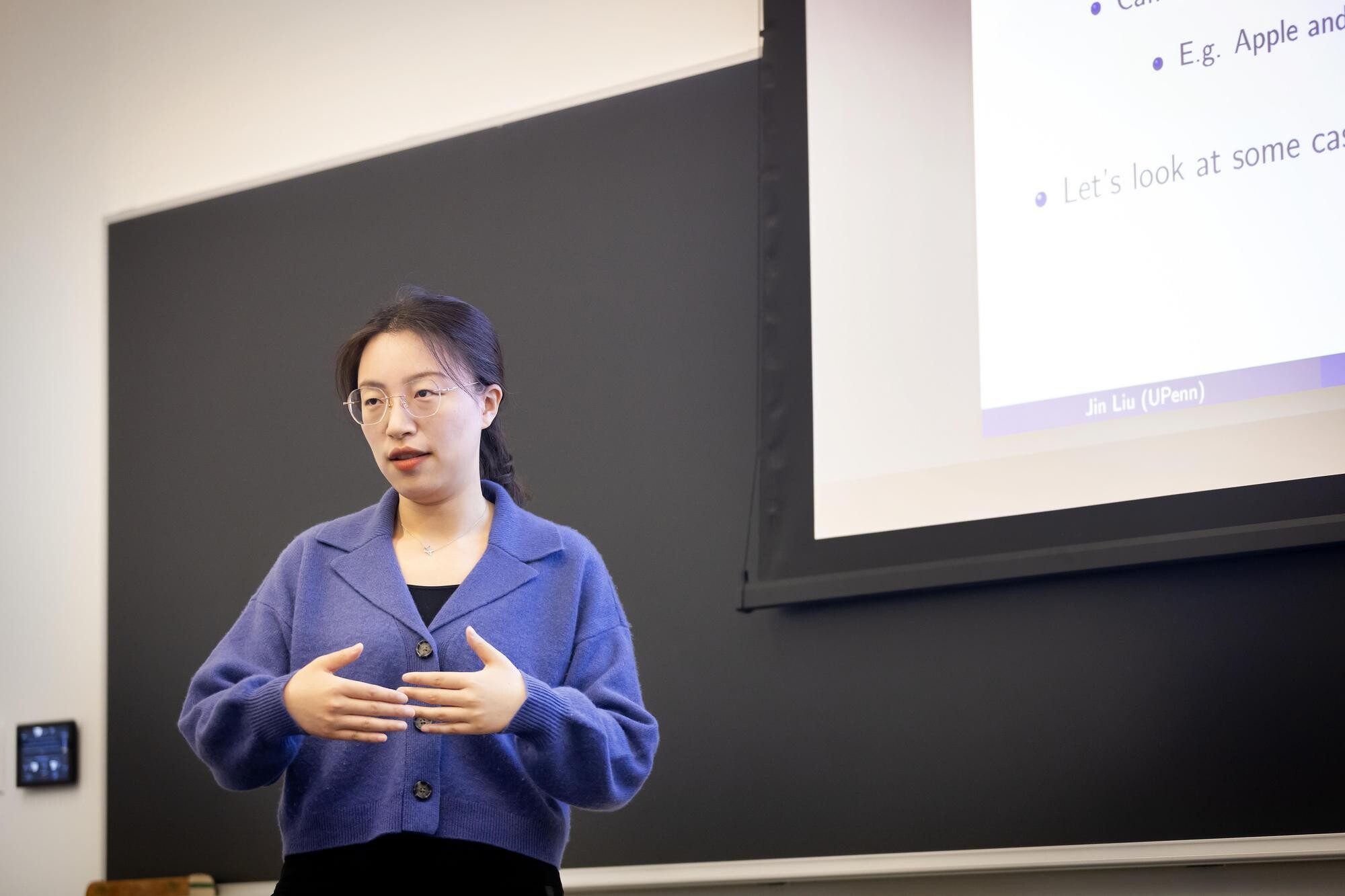
Economics is ‘a unique way of thinking’ to see through the mystery of daily life
Economist Jin Liu focuses on international trade and industrial organization in her research.
2 min. read
Jin Liu, Penn’s newest economics faculty member, specializes in international trade.
How do companies make decisions in how they trade globally? How do they work with suppliers in the face of tariffs? And what are the frictions in that process?
These are a few of the questions that School of Arts & ScienceseconomistJin Liu is tackling in her research. Liu specializes in international trade and industrial organization, looking at it from a variety of models: trade, industrial organization, and macroeconomics.
She says economics is a way to look at the world. “It’s a unique way of thinking, a system of concepts that you can use to see through the mystery of daily life,” Liu says. “If you don’t know any economic thinking, you may think it’s so vague, that there are no connections between things.” But, she says, with some understanding of economic rules, “you have a better view of what’s going on.”
One of her projects involves looking at the Chinese film industry and the impact of exposing more people to domestically produced movies. More investment in cultural products, Liu says, could create a positive feedback loop “that could be a novel motivation for a protectionism policy.”
At its broadest point, she is examining how firms make investment and trade-relationship decisions in the face of general uncertainty. That involves understanding those choices at the micro, or firm level, and then aggregating them together to explain larger macro issues. “How would all of those microlevel frictions determine the impact of some macro policies, such as tariffs?” she asks rhetorically.
Liu praises Penn’s academic atmosphere, with a collegial economics department and the opportunity to co-author research with her colleagues. “A lot of my office neighbors here are doing research on empirical micro and macro stuff that I like,” she says. She’s also enjoyed exploring Philadelphia’s restaurants and historic sites.
This semester, she is teaching an undergraduate course in international trade and a graduate course in advanced topics in trade and industrial organization, and she is enjoying the different approaches to both levels. “For Ph.D. students, what you need to teach them is how to think critically about other peoples’ research and how to form their own research ideas,” she says.
Novel plant-based approach to a better, cheaper GLP-1 delivery system
Research led by Penn Dental’s Henry Daniell investigates the use of a lettuce-based, plant-encapsulated delivery platform as a new oral delivery of two GLP-1 drugs previously approved by the FDA in injectable form.
No brain, no gain: Neuronal activity enhances benefits of exercise
Research led by Penn neuroscientist J. Nicholas Betley and collaborators finds that hypothalamic neurons are essential for translating physical exertion into endurance, potentially opening the door to exercise-mimicking therapies.
In honor of Valentine's Day, and as a way of fostering community in her Shakespeare in Love course, Becky Friedman took her students to the University Club for lunch one class period. They talked about the movie "Shakespeare in Love," as part of a broader conversation on how Shakespeare's works are adapted.
In Becky Friedman’s English course Shakespeare in Love, undergraduate students analyze language, genre, and adaptation in the Bard’s plays through the lens of love.
Beating the heat: Designing cooling for bodies in motion
Dorit Aviv, director of Weitzman’s Thermal Architecture Lab, studies how humans, technology, and design intersect, paving the way for the development of novel approaches to cooling people efficiently.