Penn Vet’s Wildlife Futures seek to unravel the mystery of the disappearing barn owl
A multiyear study looks at the causes of declining populations, which will help inform conservation efforts in the future.
2 min. read
If someone has a vermin problem, they couldn’t ask for a better ally than a barn owl. One barn owl family can catch and eat about 3,000 rodents a year. “The farmer’s best friend,” one Pennsylvania biologist called them.
But these special animals are in trouble. Barn owls are a Pennsylvania Species of Greatest Conservation Need, having experienced an over 50% decline in their statewide distribution, according to the last state survey, with no sign of rebound.
Penn Vet student Jennifer Grell is gaining wildlife field work experience with Penn Vet’s Wildlife Futures Program.
(Image: Courtesy of Penn Vet News)
Penn Vet’s Wildlife Futures Program and the Pennsylvania Game Commission (PGC) have been engaged in a collaborative effort to identify the causes of these owls’ decline and any actions that might help them.
Loss of the open grassland habitats where these owls traditionally have found their prey has been recognized as a chief threat to their species’ continued survival. Wildlife Futures and PGC have been exploring other potential risks.
“Wildlife Futures recently completed a multiyear study to investigate the effects of pesticides on the Pennsylvania barn owl population,” says Lisa Murphy, director of Wildlife Futures and resident director of the Pennsylvania Animal Diagnostic Laboratory System (PADLS).
The researchers’ theory was since rodents are the owls’ main food source, rodenticides consumed by their prey might be killing the owls. That, however, didn’t deliver sufficient evidence.
As part of the study, dead barn owls, including ones found by the PGC, underwent necropsies by Wildlife Futures. Those will continue as more birds are found, says Erica Miller, wildlife veterinarian and Wildlife Futures field operations manager. PADLS performed all the testing of the samples taken for the study from both living and deceased birds.
Barn owls will also be counted in Wildlife Futures’ ongoing research into the effects of West Nile Virus on Pennsylvania’s breeding bird populations.
“We are trying to learn from every owl that we obtain that doesn’t make it,” Miller says. “We want to know why, and to see if we can learn anything that can help us better understand what is happening to them as a population.”
This story is by Rita Giordano. Read more at Penn Vet News.
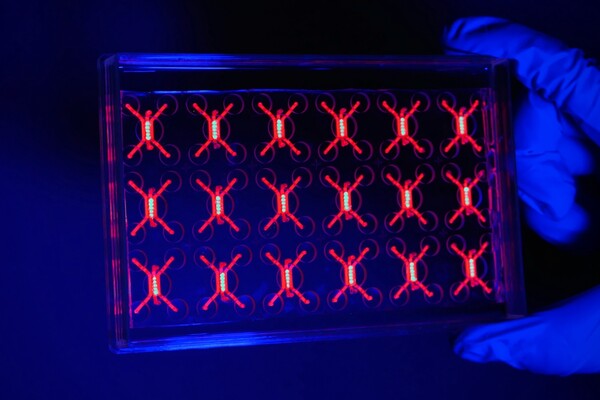
Penn engineers and collaborators have developed a transparent, micro-engineered device that houses a living, vascularized model of human lung cancer—a “tumor on a chip”—and show that the diabetes drug vildagliptin helps more CAR T cells break through the tumor’s defenses and attack it effectively.
Tumor-on-a-chip offers insight into cancer-fighting cells in immunotherapy
Penn engineers and collaborators have built a living tumor on a chip to expose how cancers block immune attacks, and how one existing drug could make immunotherapy like CAR T more effective against solid tumors.
Professor of city and regional planning Erick Guerra recently published a book exploring the economic and societal impacts of American highways. He explains some of the pitfalls associated with an ever-expansive highway system, arguing that spending more on highways might not be the solution to the country’s transportation issues.
Penn urban planner Erick Guerra’s new book, “Overbuilt,” argues that additional spending on building more highways might not be the solution to the country’s transportation issues. In a Q&A, Guerra shares his insights.
Xin Sun prepares samples collected from the Eastern Tropical North Pacific aboard a research vessel. By adding stable isotope tracers to these vials, Sun and her team can track how different microbial groups convert nitrogen compounds into nitrous oxide, revealing how subtle shifts in oxygen and organic matter change the ocean’s chemistry.
Can tiny ocean organisms offer the key to better climate modeling?
In the shadowy layers of the Pacific, microbes decide how much nitrous oxide—a potent greenhouse gas—rises skyward. New research from Penn’s Xin Sun offers an improved understanding of microbial ecology and geochemistry—key to forecasting global emissions in response to natural and man-made climate change.
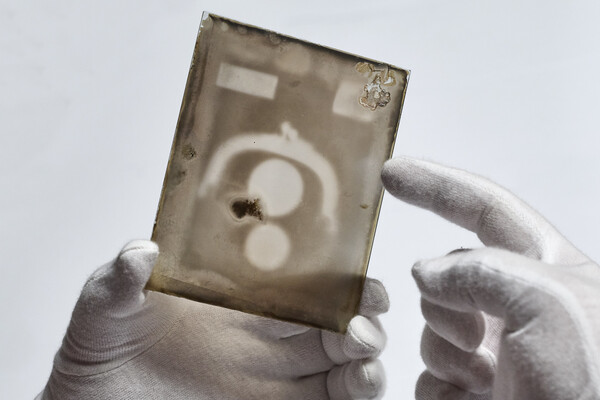
Two X-ray plates from Arthur Goodspeed, believed to have created the world’s first X-ray image, were donated by his family to Penn’s University Archives.