The immune system is often framed as the part of our bodies responsible for fighting infection. But a key part of immunity involves restraining that battle-ready immune cell army so its artillery is only trained upon true threats.
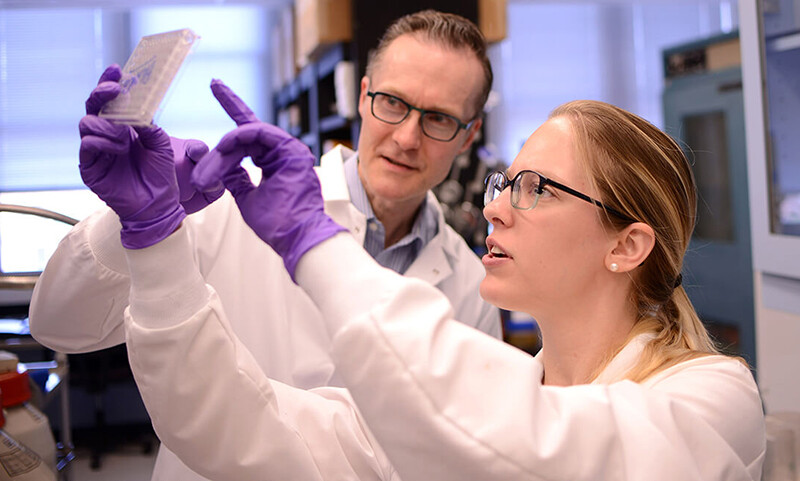
Dr. Oliver Garden and Sabina Hlavaty, a Howard Hughes Medical Institute/Burroughs Wellcome Fund Medical Research Fellow, view a plate of cultured canine bone marrow cells to compare conditions during an experiment. Photo courtesy of Penn Vet News.
This element of immune regulation—and how it can go awry in cancer and autoimmune conditions—is where Oliver Garden, Chair of Penn Vet’s Department of Clinical Sciences and Advanced Medicine and the Corinne R. and Henry Bower Professor of Medicine, rests his scientific attention.
For the first decade of his research career, Garden focused his attention on regulatory T cells (Tregs). These lymphoid cells play a critical role in immunosuppression, and have the potential to reduce or prevent harmful autoimmune and inflammatory immune responses.
Using Tregs from mice, humans, and, most recently, dogs, Garden’s laboratory has identified the critical role of several signaling cascades in the induction, function, and development of Tregs.
In the last decade, Garden’s lab has shifted in focus to another key player in holding the immune response in check: myeloid-derived suppressor cells.
“The current projects in the lab are all about regulation, and how to overcome deranged regulation in autoimmune disease and cancer,” Garden said. “We have a keen interest in Tregs, but we also came to realize that immune regulation is multifactorial, and doesn’t only involve lymphoid cells.”
Novel plant-based approach to a better, cheaper GLP-1 delivery system
Research led by Penn Dental’s Henry Daniell investigates the use of a lettuce-based, plant-encapsulated delivery platform as a new oral delivery of two GLP-1 drugs previously approved by the FDA in injectable form.
No brain, no gain: Neuronal activity enhances benefits of exercise
Research led by Penn neuroscientist J. Nicholas Betley and collaborators finds that hypothalamic neurons are essential for translating physical exertion into endurance, potentially opening the door to exercise-mimicking therapies.
In honor of Valentine's Day, and as a way of fostering community in her Shakespeare in Love course, Becky Friedman took her students to the University Club for lunch one class period. They talked about the movie "Shakespeare in Love," as part of a broader conversation on how Shakespeare's works are adapted.
In Becky Friedman’s English course Shakespeare in Love, undergraduate students analyze language, genre, and adaptation in the Bard’s plays through the lens of love.
Beating the heat: Designing cooling for bodies in motion
Dorit Aviv, director of Weitzman’s Thermal Architecture Lab, studies how humans, technology, and design intersect, paving the way for the development of novel approaches to cooling people efficiently.