Skip to Content Skip to Content

Perelman School of Medicine

Visit the School's Site
Reset All Filters
2793 Results
Smoke safety: What to know and how to keep safe with poor air quality
A person crosses the Schuylkill River on a blue bike. The city skyline behind him is obscured with smoke haze.

A person cycles past the skyline in Philadelphia shrouded in haze, Thursday, June 8, 2023. Intense Canadian wildfires are blanketing the northeastern U.S. in a dystopian haze, turning the air acrid, the sky yellowish gray and prompting warnings for vulnerable populations to stay inside.

(Image: AP Photo/Matt Rourke)

Smoke safety: What to know and how to keep safe with poor air quality

Olajumoke O. Fadugba of the Perelman School of Medicine addresses why smoke irritates the body, why people with allergies and asthma are particularly affected, and how to stay safe. Writer: Kristina García

Kristina Linnea García

Putting biomedical research advances within reach
A medical worker gives a person a Covid vaccine.

Image: Courtesy of Penn Medicine Magazine

Putting biomedical research advances within reach

Treatments and vaccines are only useful in the hands of the people who need them, and Penn Medicine is working toward better access and equity for biomedical innovations.

Karen L. Brooks for Penn Medicine Magazine

Fulbright 2023 U.S. Student Program grants awarded to 29 Penn affiliates
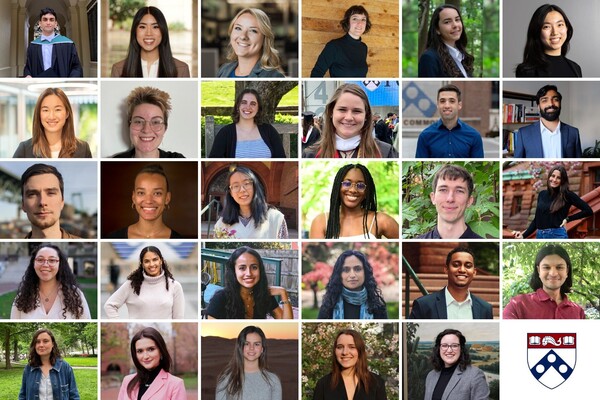
29 people in a grid

Twenty-nine Penn students, recent graduates, and alumni have been offered Fulbright grants for the 2023-24 academic year, from left: (top row) Anuj Amin, Ella Atsavapranee, Rebecca Bean, Rachael (Viola) Bordon, Erin Brennan, Mia Cheung; (second row) Allison Chou, Teresa Christensen, Sabrina de Brito, Ashley Fuchs, Zacharia Hamdi, Nilesh Kavthekar; (third row) Vincent Kelley, Lauren Lamb, Esther Lee, Beyoncé Lightfoot, Colin Lodewick, Lea Mangifesta; (fourth row) Vanessa Martinez Penn, Anya Miller, Marissa Mojena, Priyamvada Nambrath, Trevor Núñez, Sriram Palepu; (bottom row) Kyra Schulman, Laila Shadid, Ingrid Sotelo, Sally Thomas, and Erin Wrightson. 

(Images: Courtesy of the Center for Undergraduate Research and Fellowships) 

Fulbright 2023 U.S. Student Program grants awarded to 29 Penn affiliates

Twenty-nine University of Pennsylvania students, recent graduates, and alumni have been offered Fulbright grants for the 2023-24 academic year to conduct research, pursue graduate degrees, or teach English in more than 20 nations. 

Louisa Shepard

Nanorobotic system presents new options for targeting fungal infections
Before and after fluorescence imaging of fungal accumilations being removed by microrobots.

Candida albicans is a species of yeast that is a normal part of the human microbiota but can also cause severe infections that pose a significant global health risk due to their resistance to existing treatments, so much so that the World Health Organization has highlighted this as a priority issue. The picture above shows a before (left) and after (right) fluorescence image of fungal biofilms being precisely targeted by nanozyme microrobots without bonding to or disturbing the tissue sample.

(Image: Min Jun Oh and Seokyoung Yoon)

Nanorobotic system presents new options for targeting fungal infections

Researchers from Penn Dental and Penn Engineering have developed a nanorobot system that precisely and rapidly targets fungal infections in the mouth.
Folding@home: How you, and your computer, can play scientist
Gregory Bowman kneeling down in front of a server.

Folding@home is led by Gregory Bowman, a Penn Integrates Knowledge Professor who has appointments in the Departments of Biochemistry and Biophysics in the Perelman School of Medicine and the Department of Bioengineering in the School of Engineering and Applied Science.

(Image: Courtesy of Penn Medicine News)

Folding@home: How you, and your computer, can play scientist

Two heads are better than one. The ethos behind the scientific research project Folding@home is that same idea, multiplied: 50,000 computers are better than one.

Alex Gardner

Why climate change might be affecting your headaches
Senior citizen in nature holding their head with a headache.

Image: iStock/interstid

Why climate change might be affecting your headaches

Rising global average temperature and extreme weather events are likely to become more frequent or more intense. Experts suggest that the stress of these events can trigger headaches.

Kelsey Geesler