From framework to actions: Provost John L. Jackson Jr. talks Penn Forward
In a Q&A, Provost John L. Jackson Jr. explains the relationship between the strategic framework In Principle and Practice and Penn Forward—a new University-wide process and action plan that will advance Penn forward for the next decade and beyond.
6 min. read
Provost John L. Jackson Jr.
Key Takeaways
Penn Forward builds on the priority-setting of In Principle and Practice and, says Jackson, “hovers much more closely to the decisions we make day to day.”
Members of the six working groups were selected for content area expertise; their perspectives as faculty, staff, or students; and willingness to engage with different ideas that could be strengthened and operationalized.
The Penn community is encouraged to submit suggestions—especially bold ideas—to individual working groups at upenn.edu/pennforward/suggestions.
Change often comes in stages, and so it goes at Penn as the University advances Penn Forward, a University-wide strategic initiative intended to propel Penn for the next decade and beyond. The initiative addresses critical issues relevant to higher education more broadly, from a rapidly changing research environment to how Penn manages a truly global landscape for education.
Here, Provost Jackson explains the important connection between the priorities of In Principle and Practice and the work of Penn Forward, enduring insights from the Red & Blue Committee, and how the Penn community can be involved in Penn Forward.
What is the relationship between Penn Forward and In Principle and Practice?
In Principle and Practice is still the beacon that determines our most important priorities. In Principle and Practice operates at 50,000 feet; it’s talking in broad terms about the things that are most important to us. Penn Forward is going to take some of those grand themes and bring them down to the brick and mortar. Concretization and operationalization are Penn Forward’s aim.
Penn Forward hovers more closely to the decisions we make day to day about where we’re going to place our resources and making sure that we follow through on the claims we make in In Principle and Practice.
You’ve been involved with In Principle and Practice since it began as the Red & Blue Committee listening initiative. Has it so far accomplished what it set out to do?
I think it has. We did an exhaustive job of making sure the entire community was a part of that Red & Blue Committee process. We met with any group on campus—and off campus—that wanted to meet with us and give us a sense of what they thought Penn’s priorities should be and why.
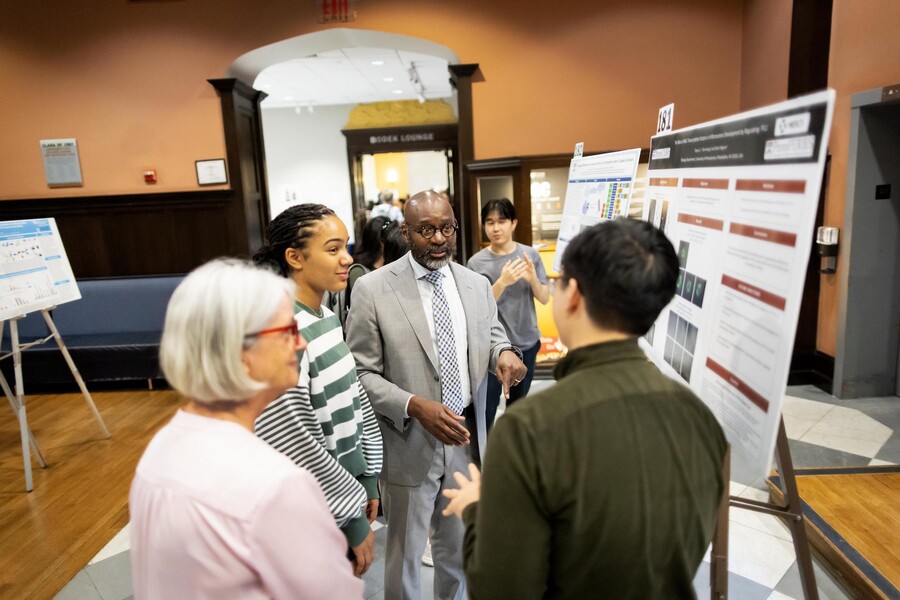
Provost John L. Jackson Jr. at the Fall Research Expo in September 2025.
When we go back—and we did this—and talk to the folks who contributed as a part of that process, and ask them, ‘Do you see a version of what you told us reflected in what came out?’ we keep hearing that they do—across all 12 schools, in other units, even in the community. And so that, for us, was exciting and encouraging—and for me also an example of how and why Penn Forward can build on a process that began well before this semester.
It’s a continuation of the attempt to make sure we’re thinking self-critically about the decisions we’re making, why we’re making those decisions, and how they are predicated on a set of campuswide assumptions about what Penn does well and how we can contribute to the world to make it a better place.
With the time that has passed since those Red & Blue insights, do you feel they still ring true?
Yes. The question becomes how do we continue to follow through on our mission, what our priorities are, even as the landscape has shifted. Some of the processes we use—some of the things we relied on, historically—to help us fund this work are changing. That means we’re going to have to figure things out in a way that isn’t just reactive but forward-looking.
This institution has a long history; we want to make sure it continues to think about itself not just in a year-to-year, semester-to-semester way. A hundred years from now, Penn should have been able to navigate this moment to transform, in ways that allow us to follow through on the things we say are most important. That’s some of what this current moment is demanding, but every moment does in different ways. This one might feel more dramatic and conspicuous, but, at institutions that have been around for as long as Penn has, you’re always going to have to make sure you’re thinking flexibly about how to be committed to your mission while also being responsive to changes in the environment.
Among the working groups, why do you think this is the right group of people to be leading this effort and creating new ideas?
Every person in every one of these groups brings something a little bit different. We wanted to make sure we have faculty members, students, and staff involved. But we also wanted to make sure we took advantage of the fact we have folks at the institution who are content experts in all these areas. If we have a working group about access, we want to have our dean for admissions in the conversation, thinking with others about not just what she already knows in that space, but also how we might tweak or completely reimagine our enrollment management process and systems.
Each individual brings something distinctive and also has demonstrated that they are able to work with folks who might think differently. They are all willing to engage new ideas in ways that can strengthen them and lead to tangible proposals that we might operationalize.
I’m hearing a theme of not letting assumptions hold us back. Does that feel like an accurate representation of what Penn Forward is trying to do?
I think so. We usually take our time with everything. Research takes a long time—it takes patience and care to do good work. And that’s by design. It’s not a bad thing. But at the same time, we don’t want this incrementalist sensibility to stop us from thinking big, ambitious thoughts, to swing for the proverbial fences. It’s putting those things in constructive tension, thoughtful processes and grand goals, that’s going to be the most important way to navigate this current moment. The pandemic was a version of that; we’d been doing online teaching, but it took a global pandemic for us to stand up the entire curricular infrastructure using online technology. We didn’t even know if we could do it, but we did it. And we learned a lot from it.
A big development from the last academic year was the creation of the University Values statement. How has that influenced Penn Forward or grounded some of the thinking around Penn Forward?
That values statement tries to articulate some of what makes Penn distinctive. We’ve talked from the beginning about how the mission of this institution was not just knowledge for knowledge’s sake, but knowledge in service to doing good in the world—that’s from Franklin but more than just Franklin. I love the idea that we know institutions aren’t perfect but are constantly committed to self-improvement. And with all of that, we want to make sure we’re not giving short shrift to the importance of excellence and rigor at every turn.
Why should people be excited about Penn Forward? How would you like to see people get involved?
If you’ve been sitting with a bold idea for what Penn can do, this is the time to make sure someone on these working groups hears about it. This is a moment when—if you have something you’re thinking about that you feel could make Penn better, make the experiences of our faculty and students and staff better—don’t be silent about it! Use Penn Forward to let us know.
Novel plant-based approach to a better, cheaper GLP-1 delivery system
Research led by Penn Dental’s Henry Daniell investigates the use of a lettuce-based, plant-encapsulated delivery platform as a new oral delivery of two GLP-1 drugs previously approved by the FDA in injectable form.
No brain, no gain: Neuronal activity enhances benefits of exercise
Research led by Penn neuroscientist J. Nicholas Betley and collaborators finds that hypothalamic neurons are essential for translating physical exertion into endurance, potentially opening the door to exercise-mimicking therapies.
In honor of Valentine's Day, and as a way of fostering community in her Shakespeare in Love course, Becky Friedman took her students to the University Club for lunch one class period. They talked about the movie "Shakespeare in Love," as part of a broader conversation on how Shakespeare's works are adapted.
In Becky Friedman’s English course Shakespeare in Love, undergraduate students analyze language, genre, and adaptation in the Bard’s plays through the lens of love.
Beating the heat: Designing cooling for bodies in motion
Dorit Aviv, director of Weitzman’s Thermal Architecture Lab, studies how humans, technology, and design intersect, paving the way for the development of novel approaches to cooling people efficiently.