Penn Carey Law professor Leo Katz explains how the selection effect and judicial strategy can make merit-based rulings look indistinguishable from politically motivated or random decisions.
2 min. read
The Journal of Legal Studies has published a new article by Leo Katz, Frank Carano Professor of Law at the University of Pennsylvania, co-authored with Alvaro Sandroni of Northwestern University’s Kellogg School of Management. In “The Judging Game,” Katz and Sandroni develop a game-theoretic model that helps explain why judicial decisions often appear either politically motivated or arbitrary—even in legal systems staffed by rational, competent, and largely impartial judges.
The authors argue that this appearance is the natural result of the selection effect—the tendency for cases with clear outcomes to settle out of court—combined with judges’ rational response to that fact. Litigants tend to settle “easy” cases to minimize litigation costs, meaning that judges mostly decide complex, evenly balanced cases. Under the right conditions, this dynamic makes judges’ decisions observationally indistinguishable from decisions based on political bias or even a coin toss.
“We show that because of the selection effect, a judicial system with competent, motivated, mostly impartial judges will produce decisions that are indistinguishable from decisions based on politics or a coin flip,” says Katz. “They look lawless, but they aren’t. The selection effect that ensures that mostly hard cases proceed to appeal just make it look that way. This is actually good news.”
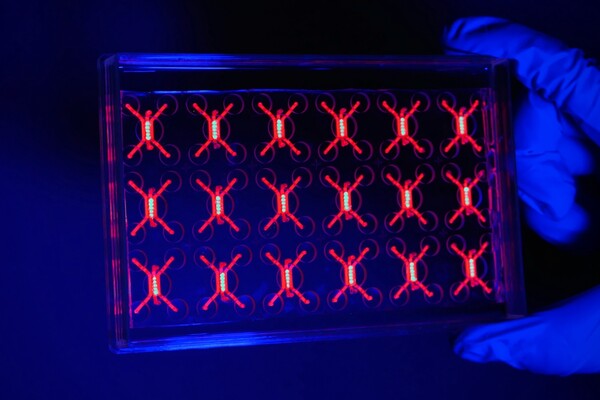
Penn engineers and collaborators have developed a transparent, micro-engineered device that houses a living, vascularized model of human lung cancer—a “tumor on a chip”—and show that the diabetes drug vildagliptin helps more CAR T cells break through the tumor’s defenses and attack it effectively.
Tumor-on-a-chip offers insight into cancer-fighting cells in immunotherapy
Penn engineers and collaborators have built a living tumor on a chip to expose how cancers block immune attacks, and how one existing drug could make immunotherapy like CAR T more effective against solid tumors.
Professor of city and regional planning Erick Guerra recently published a book exploring the economic and societal impacts of American highways. He explains some of the pitfalls associated with an ever-expansive highway system, arguing that spending more on highways might not be the solution to the country’s transportation issues.
Penn urban planner Erick Guerra’s new book, “Overbuilt,” argues that additional spending on building more highways might not be the solution to the country’s transportation issues. In a Q&A, Guerra shares his insights.
Xin Sun prepares samples collected from the Eastern Tropical North Pacific aboard a research vessel. By adding stable isotope tracers to these vials, Sun and her team can track how different microbial groups convert nitrogen compounds into nitrous oxide, revealing how subtle shifts in oxygen and organic matter change the ocean’s chemistry.
Can tiny ocean organisms offer the key to better climate modeling?
In the shadowy layers of the Pacific, microbes decide how much nitrous oxide—a potent greenhouse gas—rises skyward. New research from Penn’s Xin Sun offers an improved understanding of microbial ecology and geochemistry—key to forecasting global emissions in response to natural and man-made climate change.
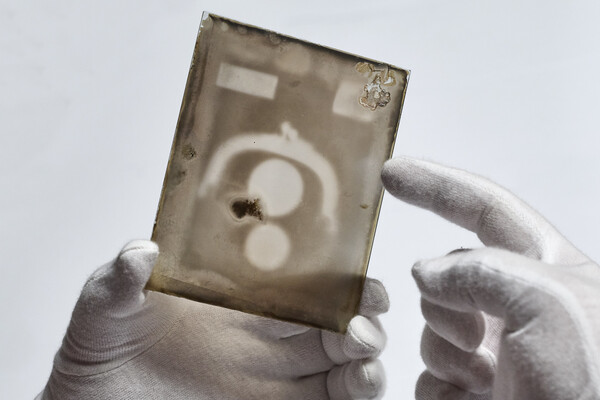
Two X-ray plates from Arthur Goodspeed, believed to have created the world’s first X-ray image, were donated by his family to Penn’s University Archives.