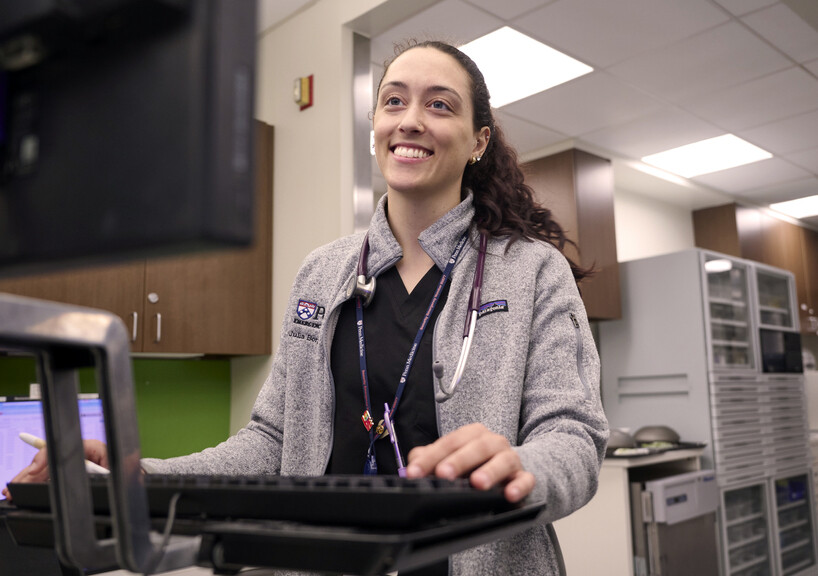
An innovative Penn Medicine program shows the impact of offering certain patients acute care in the comfort of their homes instead of being admitted to the hospital.
2 min. read
Deep in the heart of Penn Presbyterian Medical Center, in a dimly lit room there is a cubicle lined with cases of soup and protein drinks. For a period of time over the last year, advanced practice provider Julia Borgesi can be found most mornings sitting in that cubicle looking at a pair of monitors on morning rounds for the Practical Alternatives to Hospitalization (PATH) program.
For some patients, there are advantages that go beyond the comfort and convenience of staying at home. When seeing a patient in their home setting, a member of the PATH team like Julia Borgesi (pictured) can identify potential issues that may be contributing to poor health outcomes.
(Image: Courtesy of Penn Medicine News)
“Can we have her recheck her oxygen … do we think his weight is accurate … I’ll have the meds couriered over today …”
A team of a half a dozen nurses and social workers sound off from a virtual meeting each morning. Borgesi tunes in, asking and answering questions while clicking and scrolling through the charts of the patients under the team’s care on her second monitor. They form a virtual hospital unit of about 10 to 15 patients, but not actually located in the hospital. All of these patients are already back in their own homes. (The supplies surrounding Borgesi’s desk are care package items she provided to newly enrolled patients.) In the PATH program, Borgesi is the air traffic controller pulling everything together to ensure all of these patients receive acute care similar to what is typically provided in a hospital, but in the comfort of their own homes.
“Our goal is to replace all or part of what would normally be a medical admission, either an observation stay or an admission stay, move that into the home setting, and follow patients for up to two weeks,” says emergency medicine physician Angela Cai,medical director of the PATH program.
After a successful nine-month pilot of PATH, Penn Medicine is now gearing up for a new, specialized model of providing acute care at home starting in early 2026. The idea of PATH was built in response to an urgent crisis affecting hospitals across the country: Emergency departments are overflowing, and hospitals are at capacity. This means that some people wait for hours to be seen, and if they require hospitalization, hours to receive an inpatient bed.
Penn Medicine at Home has been delivering care to patients across the region for years, continually advancing into more areas of acute care, and with a single electronic health record fully integrated with the rest of the health system. Penn Medicine at Home therefore provided a structure of providers at the ready to partner with hospital-based teams through PATH.
Novel plant-based approach to a better, cheaper GLP-1 delivery system
Research led by Penn Dental’s Henry Daniell investigates the use of a lettuce-based, plant-encapsulated delivery platform as a new oral delivery of two GLP-1 drugs previously approved by the FDA in injectable form.
No brain, no gain: Neuronal activity enhances benefits of exercise
Research led by Penn neuroscientist J. Nicholas Betley and collaborators finds that hypothalamic neurons are essential for translating physical exertion into endurance, potentially opening the door to exercise-mimicking therapies.
In honor of Valentine's Day, and as a way of fostering community in her Shakespeare in Love course, Becky Friedman took her students to the University Club for lunch one class period. They talked about the movie "Shakespeare in Love," as part of a broader conversation on how Shakespeare's works are adapted.
In Becky Friedman’s English course Shakespeare in Love, undergraduate students analyze language, genre, and adaptation in the Bard’s plays through the lens of love.
Beating the heat: Designing cooling for bodies in motion
Dorit Aviv, director of Weitzman’s Thermal Architecture Lab, studies how humans, technology, and design intersect, paving the way for the development of novel approaches to cooling people efficiently.