Prevention, protection, and trust for children’s health
In Lancaster County, ChildProtect community clinics have provided free vaccines against preventable diseases for 30 years—with an added dose of trust.
2 min. read
For about 20 years, Barb Harvey has been providing potent shots in the arm for members of the Lancaster community to protect them from preventable diseases—and the first shot, before any vaccine, is always trust and information.
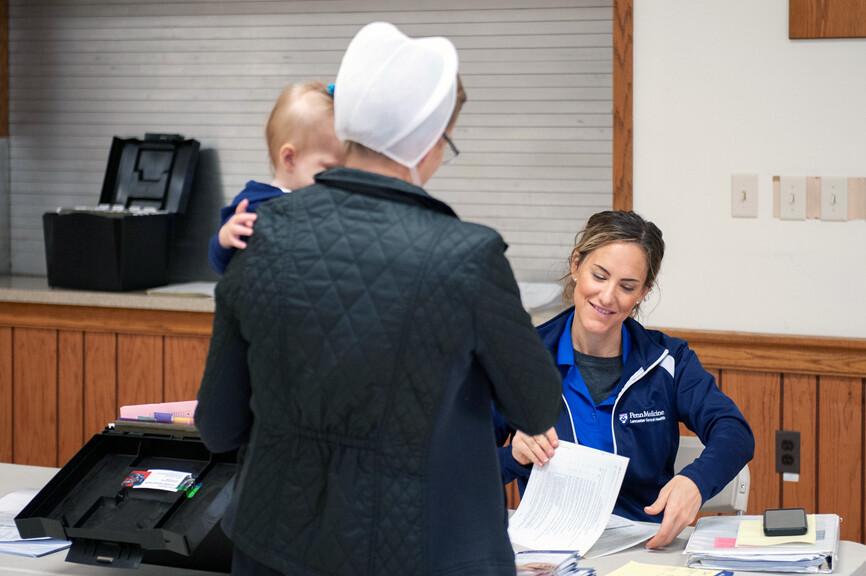
Jennifer N. Carter, a registered nurse at Penn Medicine Lancaster General Health, checks paperwork and discusses vaccination with patients.
(Image: Courtesy of Penn Medicine News)
Harvey is the lead clinical nurse for the Penn Medicine Lancaster General Health ChildProtect vaccination program, which provides free vaccinations for uninsured children across Lancaster County—usually at the remote, rural community hubs where people naturally gather.
Since the program’s inception in 1991 in response to an outbreak of rubella (German measles), ChildProtect has vaccinated about 80,000 children against preventable disease.
Each clinic location is different—a representation of the diverse communities found within Lancaster County. Some clinics, like the one in New Holland, Pennsylvania, mostly serve Amish and Mennonite groups (collectively known as the Plain community), and others serve recent immigrants from a predominantly Spanish-speaking population.
During any given ChildProtect vaccine clinic, a team of five or six ChildProtect nurses arrives at a community firehouse and starts their day setting up signage, welcoming desks, patient seating, and vaccination stations. They are usually greeted by crying children who are not thrilled about receiving their vaccinations.
The nurses who sign up to work at ChildProtect clinics go through additional training that other nurses do not receive. They have to be willing to work with sometimes needle-shy children, work long days from set-up to tear down, and travel to various clinic sites.
“Active listening, non-judgement, and an understanding tone encourage vaccinations—we deliver facts without promoting fear,” Harvey says.
Novel plant-based approach to a better, cheaper GLP-1 delivery system
Research led by Penn Dental’s Henry Daniell investigates the use of a lettuce-based, plant-encapsulated delivery platform as a new oral delivery of two GLP-1 drugs previously approved by the FDA in injectable form.
No brain, no gain: Neuronal activity enhances benefits of exercise
Research led by Penn neuroscientist J. Nicholas Betley and collaborators finds that hypothalamic neurons are essential for translating physical exertion into endurance, potentially opening the door to exercise-mimicking therapies.
In honor of Valentine's Day, and as a way of fostering community in her Shakespeare in Love course, Becky Friedman took her students to the University Club for lunch one class period. They talked about the movie "Shakespeare in Love," as part of a broader conversation on how Shakespeare's works are adapted.
In Becky Friedman’s English course Shakespeare in Love, undergraduate students analyze language, genre, and adaptation in the Bard’s plays through the lens of love.
Beating the heat: Designing cooling for bodies in motion
Dorit Aviv, director of Weitzman’s Thermal Architecture Lab, studies how humans, technology, and design intersect, paving the way for the development of novel approaches to cooling people efficiently.