Several researchers from Penn Medicine’s Department of Neurology are featured throughout the Franklin Institute’s Body Odyssey exhibit.
1 min. read
A cavernous, walk-through human heart has entertained 70 years of curiosity, from school trips to international visitors. The Franklin Institute’s Giant Heart is an iconic Philadelphia experience that allows visitors to learn the inner workings of one of the body’s most important muscles from the outside, while weaving through its larger-than-life walls.
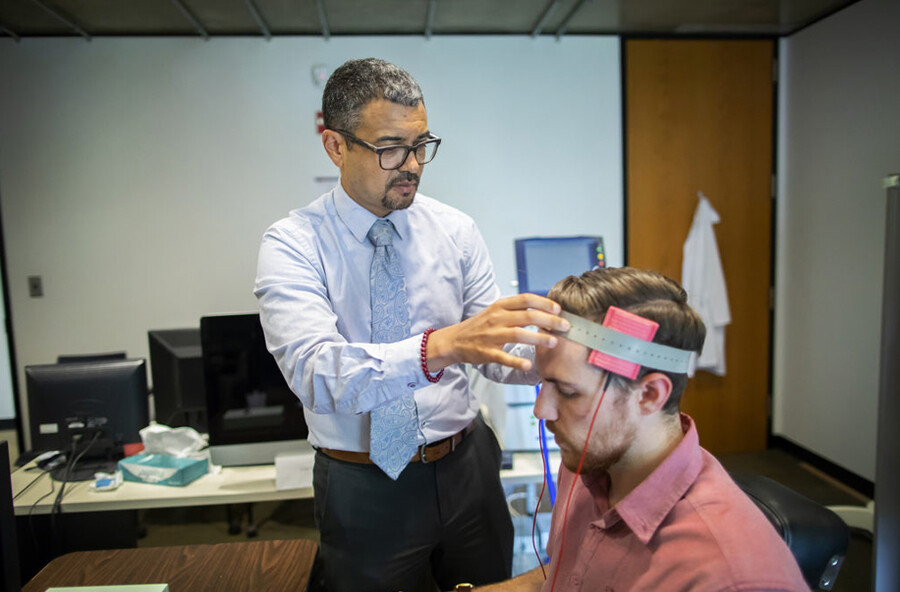
Roy Hamilton, a professor of neurology, psychiatry, and physical medicine and rehabilitation, and director of the brainSTIM Center in the Perelman School of Medicine, adjusts a transcranial electric stimulation device on a study participant. The device is identical to the one featured in the exhibit.
(Image: Courtesy of Penn Medicine News)
In 2024, the Giant Heart temporarily closed before reopening to the public six months later as part of its Body Odyssey exhibit. The updated exhibit includes several researchers from Penn Medicine’s Department of Neurology, highlighting futuristic devices and unique career paths.
The new exhibit prioritizes looking to the future of health and technology. “We wanted to explore where biotechnology is today, where it’s heading in the future, and how it can change our health choices and decisions,” says Jayatri Das, chief bioscientist and director of Science Content at the Franklin Institute, and a fellow at Penn’s Center for Neuroscience and Society. “What’s incredible is that these amazing advances in science, medicine, and technology aren’t just happening around the world, they’re happening right here in Philadelphia, and we want to celebrate that.”
In addition to larger-than-life organs and hands-on simulations of robotic surgery and operating a prosthetic hand, the exhibit pays homage to the medical firsts at Penn Medicine that have continued to push the boundaries of science and medicine. From establishing the first hospital in the United States over 270 years ago, to opening the nation’s first medical school over 260 years ago, through more recent breakthroughs like CAR T cell therapy, gene therapy, and the Nobel Prize-winningmRNA vaccine technology, the exhibit illuminates the role of the historic institution in Philadelphia and the world throughout the exhibit with videos, images, and real technology developed by Penn Medicine researchers.
Nanoparticle blueprints reveal path to smarter medicines
New research involving Penn Engineering shows detailed variation in lipid nanoparticle size, shape, and internal structure, and finds that such factors correlate with how well they deliver therapeutic cargo to a particular destination.
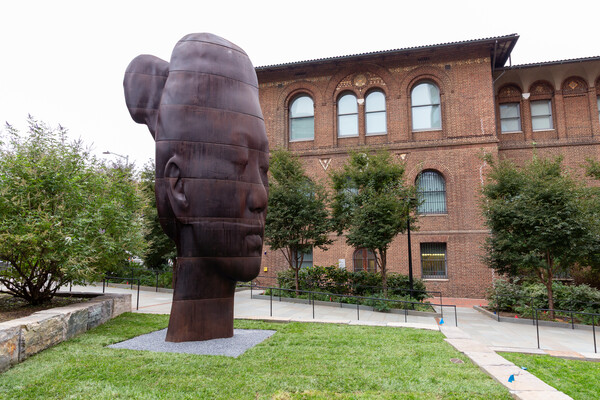
A generous gift from alumni Glenn and Amanda Fuhrman brings the work of internationally acclaimed artist Jaume Plensa to the University of Pennsylvania. The latest addition to the Penn Art Collection expands Philadelphia's public art.
A massive chunk of ice, a new laser, and new information on sea-level rise
For nearly a decade, Leigh Stearns and collaborators aimed a laser scanner system at Greenland’s Helheim Glacier. Their long-running survey reveals that Helheim’s massive calving events don’t behave the way scientists once thought, reframing how ice loss contributes to sea-level rise.