Researchers from Penn have found new cost-effective ways to make a great cup of pour-over coffee using fewer beans. Their findings could potentially provide insights into similar systems such as waterfalls and surface erosion.
4 min. read
In the Arnold Mathijssen lab, researchers used a gooseneck kettle, coffee grinder, and a pour-over setup alongside precise measurements and high-speed analysis to study the fluid dynamics and mechanics of coffee brewing to uncover ways to maximize flavor with fewer grounds. The findings could help researchers understand fluid dynamics.
(Image: Courtesy of Ernest Park)
The cost of raw arabica beans, the core component of most coffee, has spiked in recent years due to four consecutive seasons of adverse weather. Climate change has added further strain, threatening the delicate temperature balance required by the Coffea arabica plant. This growing pressure has inspired physicists at the University of Pennsylvania to ask: Can we make great coffee with fewer beans?
“There’s a lot of research on fluid mechanics, and there’s a lot of research on particles separately,” says Arnold Mathijssen, assistant professor in the School of Arts & Sciences. “Maybe this is one of the first studies where we start bringing these things together.”
Their findings, published in the journal Physics of Fluids, provide a scientific approach to improving extraction efficiency so fewer coffee grounds can go further without diminishing overall quality.
“We tried finding ways where we could use less [or] as little coffee as possible and just take advantage of the fluid dynamics of the pour from a gooseneck kettle to increase the extraction that you get from the coffee grounds—while using fewer grounds,” says coauthor Ernest Park, a graduate researcher in the Mathijssen Lab.
The experiment required making the invisible visible, explains coauthor Margot Young, a graduate researcher in the Mathijssen Lab.
A high-speed camera catches water penetrating the simulated coffee bed. By modeling how the jet interacts with the grounds, the team found the most efficient flow pattern for extracting flavor with fewer beans.
“Coffee’s opacity makes it tricky to observe pour-over dynamics directly, so we swapped in transparent silica gel particles in a glass cone,” Park explains.
A laser sheet and high-speed camera allowed them to watch water streams create “miniature avalanches” of particles—revealing the flow’s inner workings. Water poured from a height produces the avalanche effect that stirs the bed of particles and enhances extraction.
A key factor in this process is laminar, or smooth and nonturbulent flow—made possible by a gooseneck kettle, even with a gentle pour-over flow. “If you were just to use a regular water kettle, it’s a little bit hard to control where the flow goes,” says Park. “And if the flow isn’t laminar enough, it doesn’t dig up the coffee bed as well.”
The team discovered that when water is poured from a height, it creates a stronger mixing effect.
“When you’re brewing a cup, what gets all of that coffee taste and all of the good stuff from the grounds is contact between the grounds and the water,” explains Young. “So, the idea is to try to increase the contact between the water and the grounds overall in the pour-over.”
They found that if poured from too great a height, the water stream breaks apart into droplets, carrying air with it into the coffee cone, which can actually decrease extraction efficiency.
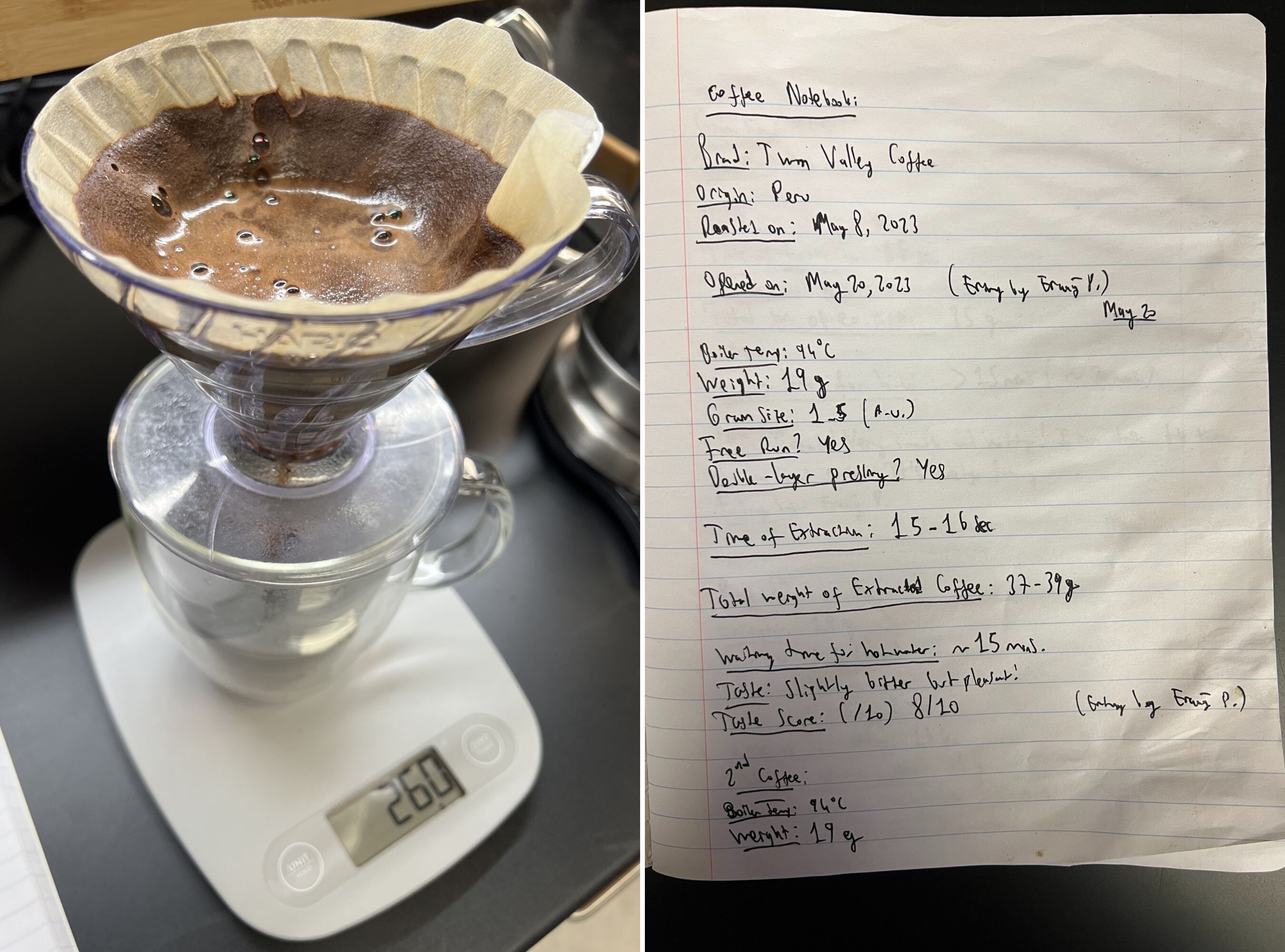
To pinpoint pour-over variables affecting taste, the team recorded each brew’s temperature, weight, grind size, and extraction time—then rated the results for flavor. Precision scales and detailed lab notes were key to translating fluid dynamics into a better cup of coffee.
(Image: Courtesy of Ernest Park)
The researchers conducted additional experiments with real coffee grounds to measure the extraction yield of total dissolved solids. Their results confirmed that the extraction of coffee can be tuned by prolonging the mixing time with slower but more effective pours that utilize avalanche dynamics.
For thicker water flow, they found that higher pours resulted in stronger coffee, confirming their observations about increased agitation with higher pour heights. When using a thinner water jet, the extraction remained consistently high across different pour heights, possibly due to the longer pouring time required to reach the target volume.
Broad implications that extend beyond the kitchen
The study is a love letter to coffee—and it’s also a window into the team’s broader research. “We weren’t just doing this for fun,” Mathijssen says. “We had the tools from other projects and realized coffee could be a neat model system to explore deeper physical principles.”
RELATED
Those principles extend well beyond the kitchen, notes Young. “This kind of fluid behavior helps us understand how water erodes rock under waterfalls or behind dams,” she says. Even wastewater treatment and filtration systems involve similar dynamics, Mathijssen adds.
The project also reflects ongoing research in the lab, as Park is working on microscale active surfaces that use rotating magnetic fields to clean biofilms from medical devices.
Young, meanwhile, is investigating ultra-fast biological flows, using the same high-speed imaging setup to study how tiny vortices generated by lung cilia help clear pathogens.
“You can start small, like with coffee,” Mathijssen says. “And end up uncovering mechanisms that matter at environmental or industrial scales.”
Arnold Mathijssen is an assistant professor in the Department of Physics & Astronomy in the School of Arts & Sciences at the University of Pennsylvania.
Ernest Park is a Ph.D. candidate in the School of Arts & Sciences.
Margot Young is a Ph.D. candidate in the School of Arts & Sciences.
The research was supported by the Charles E. Kaufman Foundation (Award KA2022-129523).
Novel plant-based approach to a better, cheaper GLP-1 delivery system
Research led by Penn Dental’s Henry Daniell investigates the use of a lettuce-based, plant-encapsulated delivery platform as a new oral delivery of two GLP-1 drugs previously approved by the FDA in injectable form.
No brain, no gain: Neuronal activity enhances benefits of exercise
Research led by Penn neuroscientist J. Nicholas Betley and collaborators finds that hypothalamic neurons are essential for translating physical exertion into endurance, potentially opening the door to exercise-mimicking therapies.
In honor of Valentine's Day, and as a way of fostering community in her Shakespeare in Love course, Becky Friedman took her students to the University Club for lunch one class period. They talked about the movie "Shakespeare in Love," as part of a broader conversation on how Shakespeare's works are adapted.
In Becky Friedman’s English course Shakespeare in Love, undergraduate students analyze language, genre, and adaptation in the Bard’s plays through the lens of love.
Beating the heat: Designing cooling for bodies in motion
Dorit Aviv, director of Weitzman’s Thermal Architecture Lab, studies how humans, technology, and design intersect, paving the way for the development of novel approaches to cooling people efficiently.