Replicating fetal bone growth process could help heal large bone defects
To treat large gaps in long bones, like the femur, which result from bone tumor removal or a shattering trauma, researchers at Penn Medicine and the University of Illinois at Chicago developed a process that partially recreates the bone growth process that occurs before birth. A bone defect of more than two centimeters is considered substantial, and current successful healing rates stand at 50% or less, with failure often resulting in amputation. The team hopes that their method, which they’ve developed in rodent models to mimic the process of rapid fetal bone growth, can substantially improve success rates. Their findings are published in Science Translational Medicine.
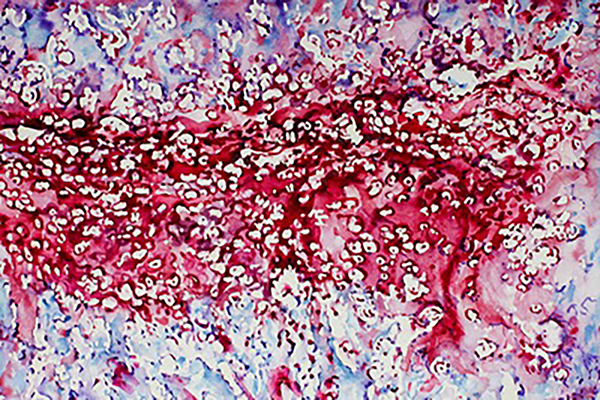
A watercolor image depicting the embryonic bone development process, endochondral ossification, featuring cartilage and bone. (Image: Joel Boerckel/Penn Medicine News)
“When bones are originally formed in the embryo, they’re first generated from cartilage, like a template,” says senior author Joel Boerckel, an assistant professor of orthopaedic surgery and bioengineering. “In order to regenerate bone within defects that otherwise won’t heal in grown people, we are seeking to recreate the embryonic bone development process.”
To do that, the researchers’ process begins with the delivery of specially engineered stem cells (called a condensation of mesenchymal cells) to the rodents’ bone defect, which sparks endochondral ossification, the specific term for embryonic bone development.
In Senegal, the ambitious Dakar Greenbelt project seeks to create an extensive network of ecological infrastructure in and around the city to sustainably address environmental concerns and enhance urban life. With support from David Gouverneur and Ellen Neises, Ph.D. candidate Rob Levinthal in the Weitzman School of Design led two courses that included a field trip to Dakar, that culminated in students presenting their visions for parts of the Greenbelt.
From a desert to an oasis: Penn engages in ambitious greening effort in the Sahel
Students from the Weitzman School of Design journeyed to Senegal to help with a massive ecological and infrastructural greening effort as part of their coursework. The Dakar Greenbelt aims to combat desertification and promote sustainable urban growth.
As part of an undergraduate course, Penn faculty and students curated an Arthur Ross Gallery exhibition of works from the Neumann family’s extensive collection of modern and contemporary art.
The University’s nexus for technology transfer supports researchers in their innovative efforts, from CAR T to mRNA advancements that have dramatically reshaped the world.