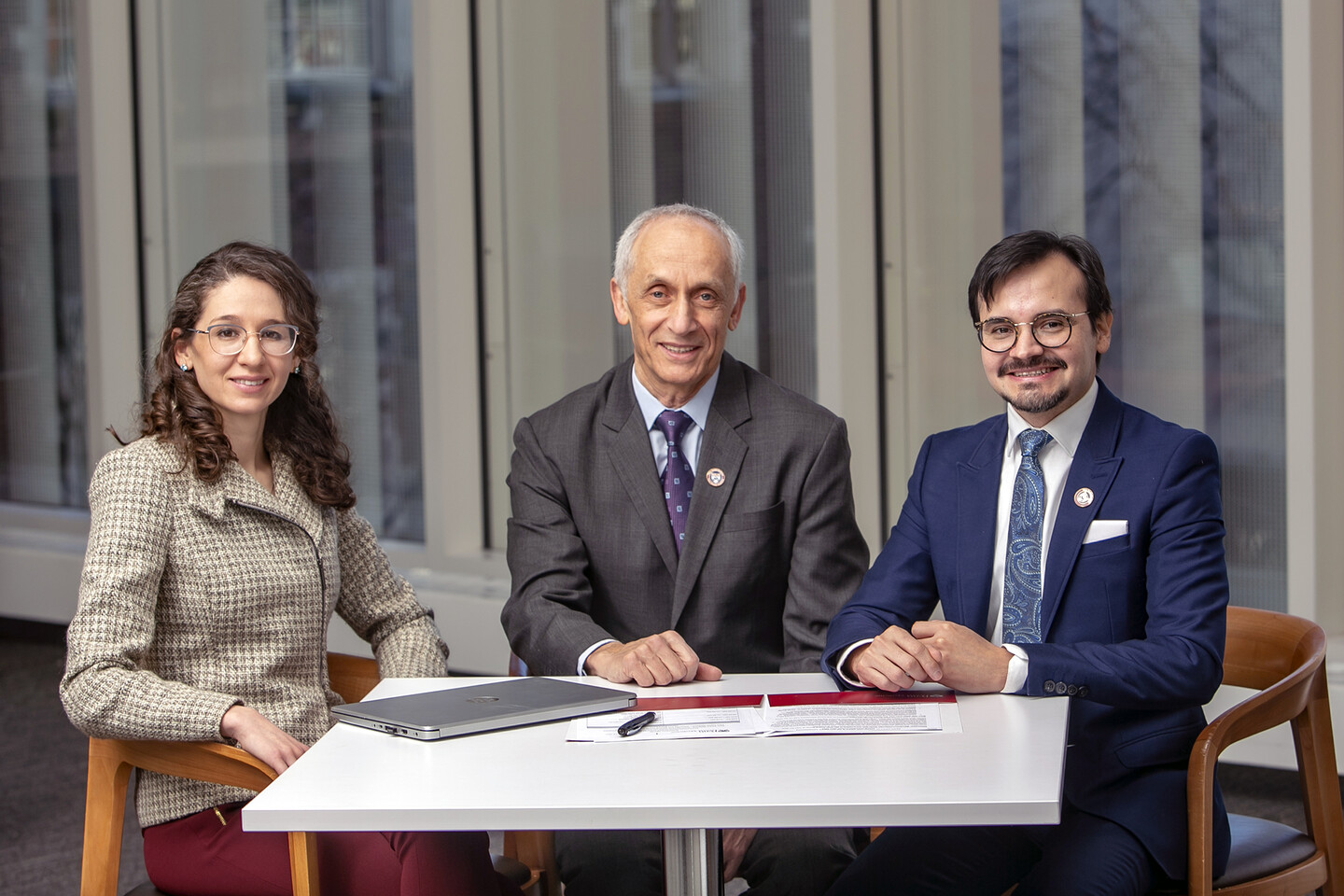
(Left to right) Olivia Urquhart, Michael Glick, and Alonso Carrasco-Labra of Penn Dental’s Center for Integrative Global Oral Health (CIGOH).
(Image: Kevin Monko)
Oral health care providers and patients will soon receive more frequent, evidence-informed recommendations to advance oral and overall health with the establishment of the ADA Living Guideline Program.
This pioneering collaboration between the American Dental Association (ADA) and the Center for Integrative Global Oral Health at Penn’s School of Dental Medicine (Penn Dental Medicine) is the first and only known living guideline program dedicated to oral health.
“Oral disease is estimated to affect almost half the world’s population, and the number of cases is growing faster than the population worldwide,” says Ashraf Fouad, chair of the ADA Council on Scientific Affairs and professor and chair at the University of Alabama at Birmingham School of Dentistry. “The ADA Living Guidelines Program will provide dentists and other healthcare professionals continually updated, evidence-based information to help improve the oral health of their patients.”
Its first focus will be an update of a 2017 ADA guideline on the evaluation of potentially malignant disorders and oral squamous cell carcinoma in the oral cavity. The first recommendation is expected to publish digitally later this year in The Journal of the American Dental Association and on ADA.org.
Guideline topics are selected and prioritized by an advisory group composed of representatives from the ADA Council on Scientific Affairs and several other governmental and professional dental organizations.
“This initiative builds upon previous foundational work on guideline development at the American Dental Association and leverages artificial intelligence (AI) and other emerging technologies to enable continuous and rapid incorporation of scientific findings from the biomedical literature into new and existing guidelines,” says principal investigator Alonso Carrasco-Labra, associate professor and director of the Cochrane Oral Health Collaborating Center at Penn Dental Medicine.
Guidelines contain evidence-informed recommendations formulated by independent panels designed to assist patients, oral health providers, and health care professionals as a resource when making informed care decisions.
Living guidelines uphold the methodological rigor of traditional guidelines but are updated as soon as new evidence emerges and is carefully reviewed. This enhancement of the traditional guideline process, which usually updates every 3-5 years, allows patients, the profession, policymakers and others to adopt the information more quickly.
“We are proud to bring this important service to our profession and look forward to improving the oral health of millions of patients through these guidelines,” says Penn Dental Medicine’s Morton Amsterdam Dean Mark S. Wolff.
For more information on current guidelines, visit ADA.org/guidelines.
Novel plant-based approach to a better, cheaper GLP-1 delivery system
Research led by Penn Dental’s Henry Daniell investigates the use of a lettuce-based, plant-encapsulated delivery platform as a new oral delivery of two GLP-1 drugs previously approved by the FDA in injectable form.
No brain, no gain: Neuronal activity enhances benefits of exercise
Research led by Penn neuroscientist J. Nicholas Betley and collaborators finds that hypothalamic neurons are essential for translating physical exertion into endurance, potentially opening the door to exercise-mimicking therapies.
In honor of Valentine's Day, and as a way of fostering community in her Shakespeare in Love course, Becky Friedman took her students to the University Club for lunch one class period. They talked about the movie "Shakespeare in Love," as part of a broader conversation on how Shakespeare's works are adapted.
In Becky Friedman’s English course Shakespeare in Love, undergraduate students analyze language, genre, and adaptation in the Bard’s plays through the lens of love.
Beating the heat: Designing cooling for bodies in motion
Dorit Aviv, director of Weitzman’s Thermal Architecture Lab, studies how humans, technology, and design intersect, paving the way for the development of novel approaches to cooling people efficiently.