Penn Medicine’s first living donor uterus transplant
Cheryl Cichonski-Urban donated her uterus to Chelsea Jovanovich through Penn Medicine’s Uterus Donation program. In May, Jovanovich gave birth to a baby boy.
Chelsea Jovanovich’s 12-week ultrasound. Because of a congenital disorder called Mayer-Rokitansky-Küster-Hauser Syndrome, Jovanovich did not have a uterus. Through the first-ever living donor uterus donation at Penn, she received one from Cheryl Cichonski-Urban.
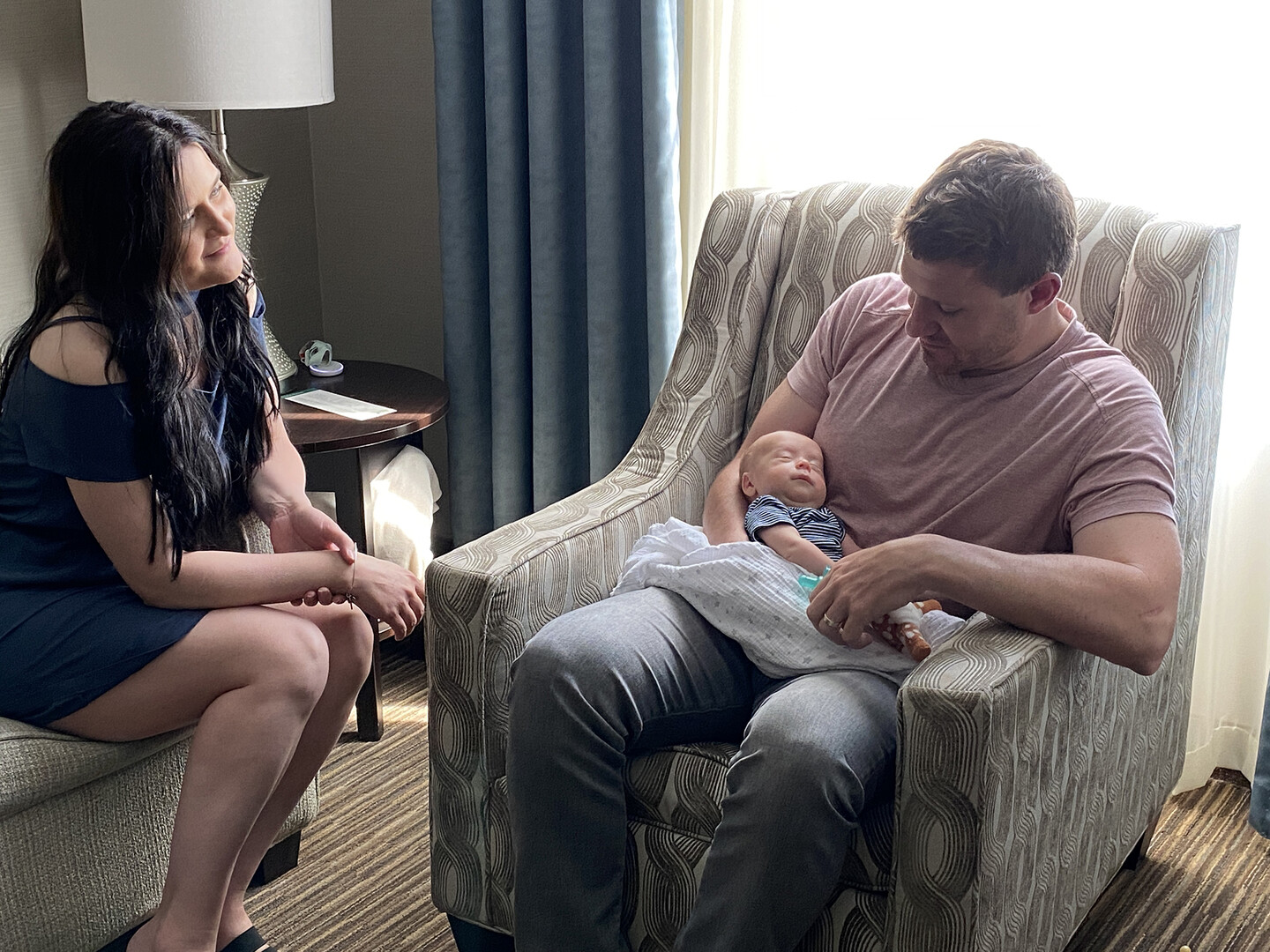
As proud new mom, Chelsea Jovanovich tenderly placed her newborn son into Cheryl Cichonski-Urban’s arms, the two women marveled at baby Telden’s angelic features, sweet disposition, and one other remarkable detail that two moms don’t typically share: The uterus where Telden spent months growing inside Jovanovich’s body is the same uterus that brought Urban’s children into the world about a decade before. It was a profound moment that marked a special bond between the two prior strangers involved in Penn Medicine’s first-ever living donor uterus donation.
After having her own two kids, Urban, who is from Bucks County, Pennsylvania, never gave too much thought to her uterus again until one day in June of 2019 when she said she saw a story about uterus donation on the local news.
“When I heard [this donor’s] story, I was blown away. I needed to find out more,” Urban says. “Whether it be faith, stars aligning, or whatnot, something drew me to this story. I felt it in my heart that this was something I was meant to do.”
Urban, from Bucks County, Pennsylvania, felt an immense pull to donate her uterus after hearing about the stories of transplants at Penn in 2019.
She was so inspired by the story, she decided right then and there she wanted to donate her own uterus. With the support of her daughter, son, and her husband, Brian, Urban signed up online for Penn Medicine’s Uterus Donation program the very next day.
More than 2,000 miles away in Billings, Montana, Jovanovich was also looking at the Penn Medicine Uterus donation website. After years of heartbreaking fertility news, she was hoping to be accepted as a recipient.
What these women didn’t know at the time was they would go on to be linked forever by a selfless gift that would allow Jovanovich and her husband to have the baby they had long hoped for. When she was 15, Jovanovich learned from her doctor that she had Mayer-Rokitansky-Küster-Hauser (MRKH) Syndrome, a congenital disorder in which women are born without a uterus. Women with the condition suffer from Uterine Factor Infertility (UFI), a previously irreversible form of female infertility that affects as many as 5 percent of reproductive-aged women worldwide. A person with UFI cannot carry a pregnancy either because she was born without a uterus, like Jovanovich, or had the organ removed for medical reasons. Individuals may also have UFI because they have a uterus, but pregnancy is not possible due to fibroids, scar tissue, or other conditions.
“It was a lot harder on me emotionally as I got into my child-bearing years,” Jovanovich says, recalling the devastating diagnosis. “Your friends are having babies, and you can’t. It was pretty hard and I went through some rough patches.”
Whether it be faith, stars aligning, or whatnot, something drew me to this story. I felt it in my heart that this was something I was meant to do.
Cheryl Cichonski-Urban, who donated her uterus to Chelsea Jovanovich though Penn Medicine’s Uterus Donation program
She and her husband Jake had even gone down the surrogacy route, only for it to not work out at the last moment. Feeling out of options, Jovanovich learned about uterus donation from her doctor and searched programs online, but it felt like a moonshot.
“Even though I felt like this was something completely out of reach for me I applied anyway. I never thought I’d be accepted,” she says.
As it turns out, Jovanovich was accepted into the program, and Urban was accepted as a donor. After rigorous testing, Urban found out there was a patient waiting for a uterus, and that she was an exact match. She went ahead with the donation having no idea who the recipient was, with the surgeries taking place in February of 2020, right before the world shut down due to the COVID-19 pandemic.
Baby Telden was born in May 2021, the first grandchild on Jovanovich’s side of the family. His arrival—which came 15 months after Jovanovich underwent the transplant surgery—marked a joyful end to a long and difficult journey for his parents.
Kathleen E. O'Neill, an assistant professor of obstetrics and co-principal investigator of Penn Medicine’s Uterus Transplantation for Uterine Factor Infertility (UNTIL) trial, worked with the Jovanovich family throughout the whole process.
“Women with UFI have limited pathways to parenthood. My goal was to provide women with UFI an additional option in uterus transplant. Moreover, uterus transplant is the only option that allows women with UFI the opportunity to carry and deliver their own babies,” O’Neill says. “Once the participant heals from their surgery, a single embryo is placed into the uterus. If the participant becomes pregnant, she is monitored closely by a team of obstetricians who specialize in high-risk pregnancies. This program is a team effort and success required over 100 people from seemingly every part of Penn Medicine.”
This program is a team effort and success required over 100 people from seemingly every part of Penn Medicine.
Kathleen E. O'Neill, an assistant professor of obstetrics and co-principal investigator of Penn Medicine’s Uterus Transplantation for Uterine Factor Infertility trial
For this case, O’Neill worked closely with Nawar Latif, surgical director of the Living Donor Uterus Transplant Program and co-principal investigator of the Uterus Transplant trial, who performed this first-of-its-kind of surgery at Penn Medicine to remove Urban’s uterus, providing her with intensive recovery care in the weeks that followed.
“It was a huge milestone for me personally and for Penn Medicine. That moment was a culmination of countless hours of preparation and training. The feeling of responsibility towards the donor, recipient, and the entire program was tremendous. I felt anxious, but confident that the transplant process would be successful,” Latif says. “Being one of two gynecologic oncologists in the country who perform this kind of surgery is very special.”
A living donor uterus transplant is still a very rare surgery, with only 20 having been performed in the United States as of April 2021.
Jovanovich recovers following the 12-hour uterus transplant surgery, performed in February of 2020 at the Hospital of the University of Pennsylvania.
Latif used a minimally invasive robotic approach, after observing similar surgeries performed in other countries and cities, and undergoing multiple training and rehearsal sessions ahead of time.
Latif had performed dozens of robotic radical hysterectomies before (a surgery to remove the uterus, cervix, and part of the vagina), but to perform the living donor surgery, he had to deconstruct and rebuild the entire approach to this kind of hysterectomy and to map the entire vascular anatomy of the donor.
“Cheryl is the ultimate most altruistic person I have ever met. Her interest to help others and advance science was a clear drive for her,” he says. “She never wavered during the long process of planning, surgery and healing. She’s a super woman.”
Urban said meeting with the doctors reinforced her decision. “Once I met Dr. O’Neill and Dr. Latif, they totally gained my trust and I 100 percent put my faith in them.”
With the surgeries a success, Jovanovich and her husband stayed in the Philadelphia area for the next step in their journey. They learned the embryo had successfully implanted, and with a little help from science, were officially pregnant.
Urban didn’t know who would receive her uterus when she donated it last year. She met Jovanovich in person for the first time in May of this year. “It’s amazing how we click,” Urban says. “Two strangers who instantly became soul sisters.”
Almost a year after the transplant, with a baby boy on the way, Jovanovich reached out to Urban through their social workers to thank her for her gift. Since that day, the two began talking more regularly—Urban joined the Jovanoviches at their virtual gender reveal, baby shower, and the two women met in person for the first time in May of 2021.
“She and I went from communicating through our social workers, to sending emails, to trading cell numbers. It’s amazing how we click. Two strangers who instantly became soul sisters,” Urban says.
On May 18, 2021, Jovanovich gave birth to a healthy baby boy, the child they had both dreamed about, and the first grandchild on her side of the family. A few weeks later, Urban and her husband, Brian, arrived to meet the Jovanovich family for a very emotional reunion, and to see baby Telden for the first time.
“Thank you for everything,” Jovanovich said through tears as she hugged the couple.
Despite the discomfort that comes with major surgery, it’s been a journey Urban describes fondly.
“It’s been like a fairytale,” she says. “It’s so unbelievable. I sit, think about it, and I can’t believe it happened. I can’t believe it worked.”
“Thank you for everything,” Jovanovich said as she hugged Brian Urban. It was the first time she had met the husband of the woman who had made it possible for her to get pregnant with her son.
Telden sleeps soundly in the arms of his father, Jake, as Jovanovich watches on. The couple hopes to have a second child using the same donated uterus.
Nanoparticle blueprints reveal path to smarter medicines
New research involving Penn Engineering shows detailed variation in lipid nanoparticle size, shape, and internal structure, and finds that such factors correlate with how well they deliver therapeutic cargo to a particular destination.
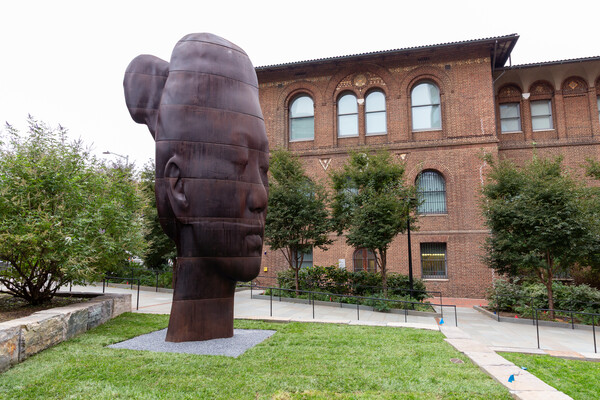
A generous gift from alumni Glenn and Amanda Fuhrman brings the work of internationally acclaimed artist Jaume Plensa to the University of Pennsylvania. The latest addition to the Penn Art Collection expands Philadelphia's public art.
A massive chunk of ice, a new laser, and new information on sea-level rise
For nearly a decade, Leigh Stearns and collaborators aimed a laser scanner system at Greenland’s Helheim Glacier. Their long-running survey reveals that Helheim’s massive calving events don’t behave the way scientists once thought, reframing how ice loss contributes to sea-level rise.