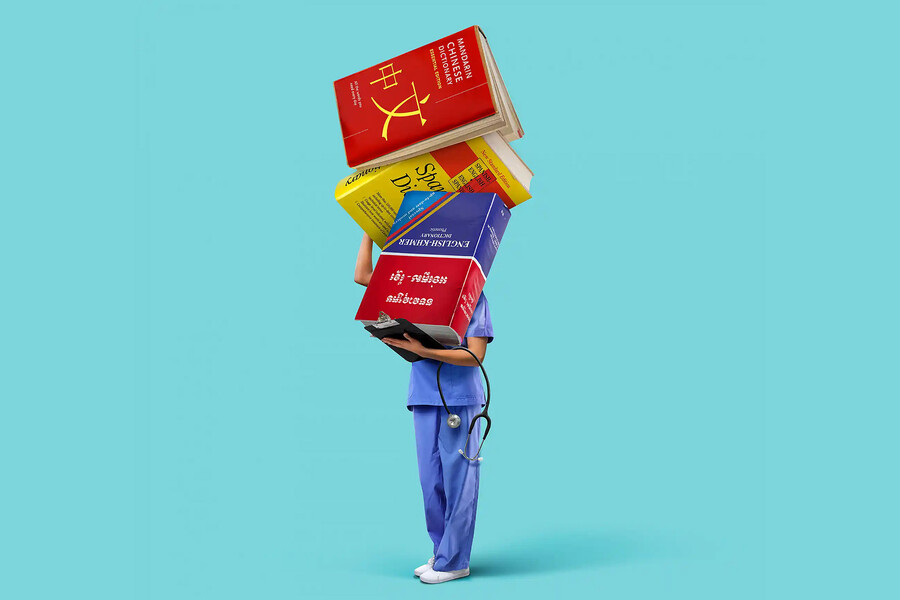
When communication barriers impede care, Penn nurses play a role in bridging language and cultural gaps.
2 min. read
A particular patient in the emergency room at the Hospital of the University of Pennsylvania wasn’t assigned to resource nurse Monica Phann, but colleagues had asked for her help because the man and his wife had limited English proficiency, and they couldn’t immediately locate a translator. Phann grew up speaking Khmer with her parents and grandparents in South Philadelphia.
“When I stepped in, they let go of all their formalities and [the patient was] finally able to say, ‘yes, I don’t feel good, and I need to be able to have someone understand the pain that I’m in,’” Phann recalls.
With her as a go-between, the hospital team was able to run the appropriate tests and quickly diagnose the patient with lung cancer. He started radiation treatment within a week. Though the diagnosis was unsettling, Phann knew she had made a positive impact on his course of care.
“When there’s a language barrier, patients aren’t able to fully express what they’ve been feeling. It was really empowering to see how eliminating that barrier allowed this patient to then get further care,” Phann says. “It speaks to how powerful it is to have bilingual or multilingual nurses when other resources aren’t available. We need more of us at the bedside.”
Around the country, Penn Nursing alumni are using multilingualism to improve patient outcomes in hospitals, doctor’s offices, and community health settings. They reduce longer lengths of stay and readmissions and increase patient satisfaction. They foster trust with patients and their families, and serve as strong advocates for multilingual patients and those with limited English proficiency.
“We live in a multilingual world. I say this to colleagues in the United States and in Latin America. We have to develop those skills,” says School of Nursing professor and Margaret Bond Simon Dean of Nursing Antonia M. Villarruel.
Federal law requires free translation services be offered to those who need it—in person or remotely through, for example, a videoconference on a tablet. And even multilingual providers call on certified medical interpreters to navigate complex topics. However, Villarruel says, when a nurse converses and tends to basic needs in the patient’s native language, “there’s a benefit to that one-on-one connection. To be able to say ‘hi, how are you’ humanizes care.”
Bilingual nurse scientists also contribute with more inclusive research. For decades, studies left out people who aren’t fluent in English. Penn Nursing faculty and alumni are addressing that gap, designing solutions with everyone in mind.
Still, multilingual day-to-day communication is valuable, says Phann. “You’re not always going to be able to predict that you need a translator or an interpreter at the bedside. When I started working in the health care system, I realized that my languages were a huge bonus … and needed in this world.”
Nanoparticle blueprints reveal path to smarter medicines
New research involving Penn Engineering shows detailed variation in lipid nanoparticle size, shape, and internal structure, and finds that such factors correlate with how well they deliver therapeutic cargo to a particular destination.
A generous gift from alumni Glenn and Amanda Fuhrman brings the work of internationally acclaimed artist Jaume Plensa to the University of Pennsylvania. The latest addition to the Penn Art Collection expands Philadelphia's public art.
A massive chunk of ice, a new laser, and new information on sea-level rise
For nearly a decade, Leigh Stearns and collaborators aimed a laser scanner system at Greenland’s Helheim Glacier. Their long-running survey reveals that Helheim’s massive calving events don’t behave the way scientists once thought, reframing how ice loss contributes to sea-level rise.