Philly high schoolers imagine their futures through a Penn GSE summer program
The Academy at Penn, a five-year program in partnership with the nonprofit Foundations, Penn Graduate School of Education, and the School District of Philadelphia, kicked off this summer with programming that empowered adolescents to assess their skills and imagine what’s possible for their careers.
4 min. read
Adina Goldstein, top left, alongside Philadelphia high school students, examines a spider during a session with the School of Veterinary Medicine.
During one of three sessions of open gym at Pottruck in July, a 6’5” rising sophomore from Furness High School—aspiring to play basketball in college—shot hoops full-court with a group of Penn students. Caroline Watts, director of the Office for School and Community Engagement (OSCE) at the Graduate School of Education, watched on the sidelines as she saw the connective tissue of a new five-year program, the Academy at Penn, begin to form.
“What stands out to me [from this summer] is all the connections made across groups, among people who didn’t know each other—and kids who weren’t even in the program,” says Watts, who leads Penn GSE’s involvement in the program.
The Academy at Penn is a five-year program in partnership with the national nonprofit Foundations, Inc., Penn Graduate School of Education, the School District of Philadelphia, and the Consortium for Policy Research in Education, funded by an $8 million gift from philanthropist Robert Schwartz. This summer, a team of support staff and graduate students from GSE kicked off the Academy at Penn with an intensive four-week summer program that engaged 50 rising second-years from School of the Future and Furness High School. The responsive partnership program, designed with a high staff-to-student ratio, applies a holistic structure that weaves together academic preparation, career exploration, and personal growth—emphasizing well-being while identifying and strengthening students’ existing skillsets.
Students get to know their strengths in a ‘test kitchen’
Summer activities varied: The students participated in job shadowing at Urban Outfitters’ headquarters in the Navy Yard; received academic instruction in math, language arts, and science; conducted a budgeting exercise incorporating real-life scenarios; toured La Salle and Swarthmore campuses; engaged in team-building exercises during a field trip to the Poconos; and learned about veterinary medicine through a hands-on presentation from Penn Vet. Students completed a final project designing a VR gallery space, sharing their summer experiences in collaboration with the Penn GSE VR Lab. Their home base for the summer program was at Penn GSE.
At the core of these activities is an intention to aid students in understanding their strengths and interests, then mapping those skills onto potential college or career paths.
“The goal is to provide each student who participates the holistic supports that meet their individual needs, so that they graduate from high school with a pathway to college or to a career that is meaningful to them and their goal,” explains Watts.
She likens the summer experience to a “test kitchen,” through which students can try new activities and explore subjects that they may take an interest in during the academic year with more depth.
As part of a session with the School of Veterinary Medicine, high school students involved with the Academy at Penn learned about guest speaker (pictured) Anwar Abdul-Qawi's choice of career as a nature photographer, quizzing students on whether select photos were taken in urban or rural areas.
“I tell everyone it’s not about moving a needle right now,” adds Saida Harpi, associate director for collaborative partnerships, engagement, and inclusion at OSCE, who led the design of the summer program. “We’re not trying to increase a math score right now; we’re not trying to make sure they have colleges picked. We want them to take this time to get to know themselves so that they can start making informed decisions.”
One aim, she says, is to empower students to make decisions they can sustain and feel OK with later—and resiliently pivot when needed.
Adina Goldstein, a doctoral candidate in teacher education who joined the OSCE team as the site director for the summer program, echoes this.
“We do see in research that programs that just focus on academics or just focus on college readiness, often are very successful in helping students get into college but have not been shown to be that successful with helping students succeed in college,” Goldstein says. “And so, with that in mind, what we’re trying to do is look more holistically at what college, career, post-secondary readiness means.”
A ‘dream space’ where students can imagine futures
Harpi refers to the program, abstractly, as “a dream space” for students to imagine futures for themselves. The concept partly draws from a framework of possibility mentoring, or possibility development, which was conceived by Penn GSE’s Michael Nakkula, a professor of practice and chair of the Human Development and Quantitative Methods Division. The program is designed to work with students who are not the highest-achieving or lowest-performing in academics. Instead, the program welcomes a middle group.
It's just one variable among many in the program’s structure.
“Something that’s also really novel is how … social and emotional well-being is integrated with the program,” adds Goldstein. “It’s happening all the time and it’s not just ‘Today we’re doing this for college and career readiness; this is for academic enrichment; this is for social and emotional well-being’—it’s really all integrated and those pieces will be integrated into those schools on Saturdays [during the school year].”
During a July session of the Academy at Penn, high school students visited the School of Veterinary Medicine at Hill Pavilion to discuss careers in veterinary medicine.
Foundations will oversee the school day program during the academic year and Penn GSE will manage summer and Saturday components, while working on implementation together.
Fifty new students will be added to the cohort next summer, with a developmental progression in the program for each new summer as the cohorts advance. Each version of the summer program adapts to the needs of students both new and existing—eventually totaling 200 supported students by the end of the five-year program cycle. CPRE will examine data on an ongoing basis to create recommendations for workable models elsewhere in the country.
In the meantime, the students from Furness and School of the Future will experience everything from seminars about entrepreneurship to internships. The program is just getting started.
"They’re going to be seeing a lot of us until they graduate,” Watts says.
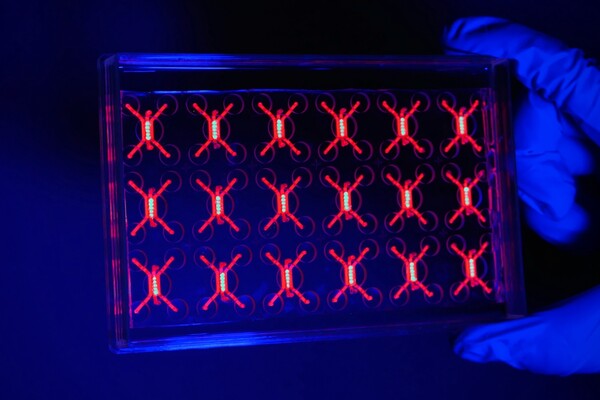
Penn engineers and collaborators have developed a transparent, micro-engineered device that houses a living, vascularized model of human lung cancer—a “tumor on a chip”—and show that the diabetes drug vildagliptin helps more CAR T cells break through the tumor’s defenses and attack it effectively.
Tumor-on-a-chip offers insight into cancer-fighting cells in immunotherapy
Penn engineers and collaborators have built a living tumor on a chip to expose how cancers block immune attacks, and how one existing drug could make immunotherapy like CAR T more effective against solid tumors.
Professor of city and regional planning Erick Guerra recently published a book exploring the economic and societal impacts of American highways. He explains some of the pitfalls associated with an ever-expansive highway system, arguing that spending more on highways might not be the solution to the country’s transportation issues.
Penn urban planner Erick Guerra’s new book, “Overbuilt,” argues that additional spending on building more highways might not be the solution to the country’s transportation issues. In a Q&A, Guerra shares his insights.
Xin Sun prepares samples collected from the Eastern Tropical North Pacific aboard a research vessel. By adding stable isotope tracers to these vials, Sun and her team can track how different microbial groups convert nitrogen compounds into nitrous oxide, revealing how subtle shifts in oxygen and organic matter change the ocean’s chemistry.
Can tiny ocean organisms offer the key to better climate modeling?
In the shadowy layers of the Pacific, microbes decide how much nitrous oxide—a potent greenhouse gas—rises skyward. New research from Penn’s Xin Sun offers an improved understanding of microbial ecology and geochemistry—key to forecasting global emissions in response to natural and man-made climate change.
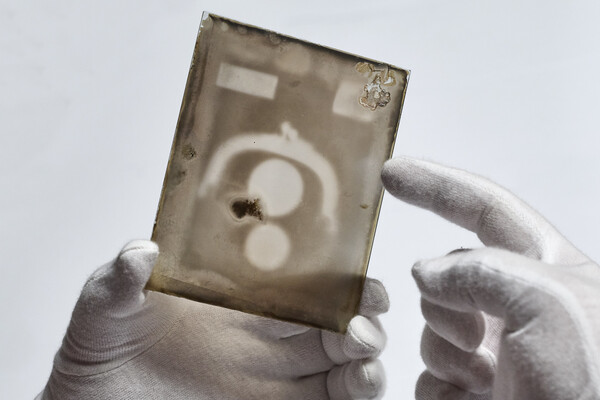
Two X-ray plates from Arthur Goodspeed, believed to have created the world’s first X-ray image, were donated by his family to Penn’s University Archives.