Penn Physicist Andrea Liu and collaborators modeled the behavior of tissue during a stage of fly development and found, surprisingly, it doesn’t fluidize as it shrinks but stays solid. Their approach could offer insights physical systems with complex functionality.
Drosophila melanogaster, the fruit fly, has long been a model species for biologists seeking to understand the molecular mechanisms of animal function and how novelty may arise in organisms. Theoretical physicist Andrea Liu of the School of Arts & Sciences is conducting research on the insect, along with biology and experimental biophysics collaborators at Duke University. Their research has opened the door to an approach that could offer not only a new understanding of how biological function emerges but also suggest a new class of systems in condensed matter physics.
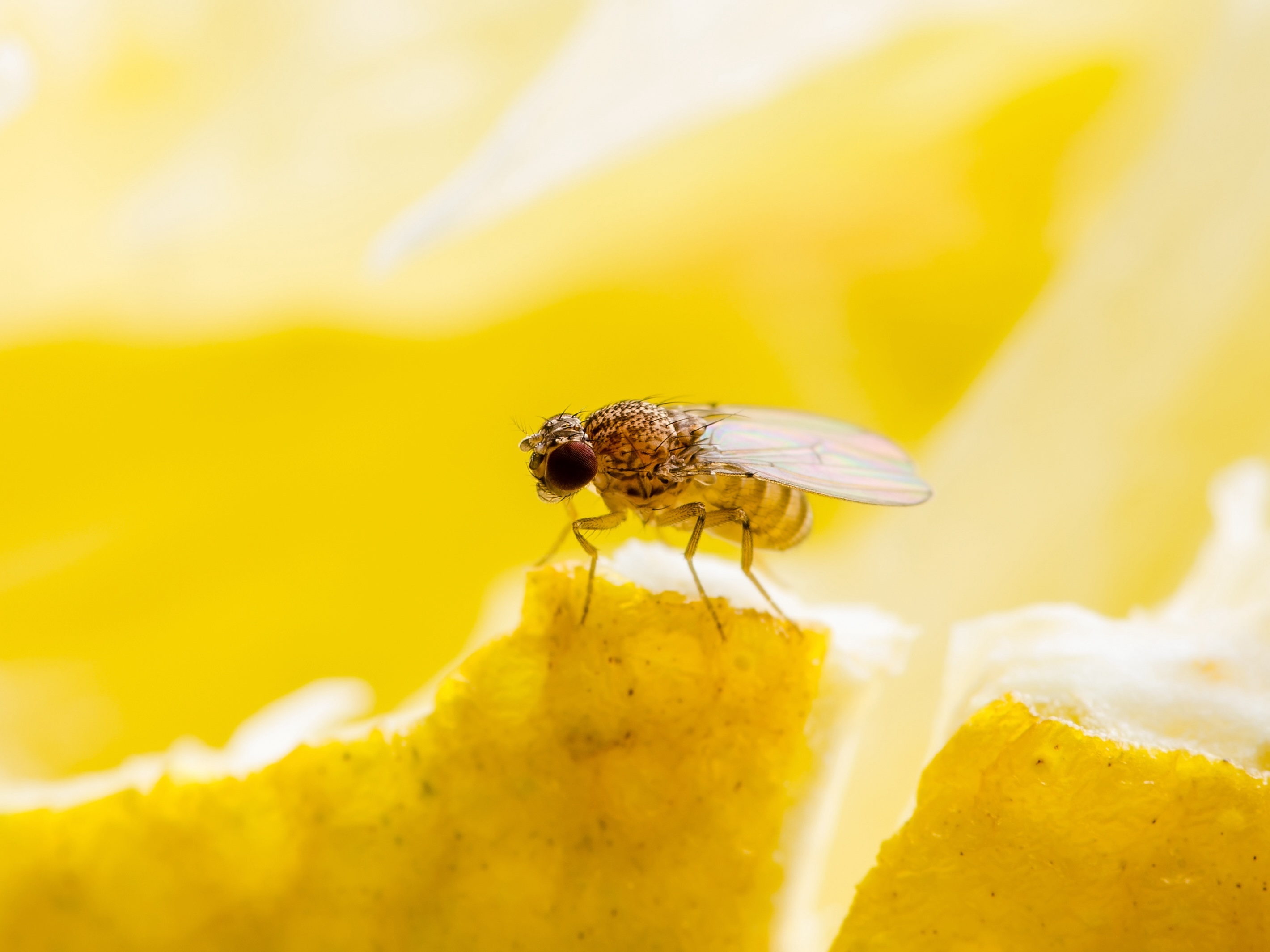
(Image: iStock / nechaev-kon)
During the last century, biologists have extensively studied Drosophila melanogaster, the common household fruit fly. It’s become one of the most popular model organisms, but not because scientists have been determined to rid kitchen fruit bowls of these summertime nuisances. It’s because their biology is highly conserved and offers invaluable clues about how multicellular organisms all the way to humans function and evolve.
Their appeal lies in their simplicity: a small species with a well-studied genome that is highly fertile, inexpensive, and easy to observe over multiple generations. In many ways, fruit flies have become a convenient lens through which scientists can explore the complexities of life.
Now, in a paper published in the Proceedings of the National Academy of Sciences, researchers led by Andrea Liu, a theoretical physicist at the University of Pennsylvania, and Dan Kiehart and Christoph Schmidt from Duke University have accurately modeled a particular developmental process in Drosophila melanogaster wherein a tissue shrinks dramatically while driving the lateral epidermis—the tissue surrounding it—to stretch and close a gap in the developing embryo. This kind of tissue movement was expected to cause the cells to flow and exchange places, turning the tissue into a fluid. Surprisingly, the team found that it did not. Instead, the tissue stayed an elastic solid, and the approach used to determine how may prove fruitful for a new form of condensed matter physics.
“During the dorsal closure process, tissue, called amnioserosa, is shrinking like mad, and by all accounts it should turn into a fluid,” Liu says. “But it doesn’t. The cells stay locked in place with their neighbors, and we wanted to understand why.”
So how does this relate to cutting-edge physics? Liu and her colleagues saw a surprising connection to the work that earned last year’s Nobel Prize in Physics.
Tunable interactions
“It all harkens back to the Ising model,” Liu says, referring to a foundational model in statistical physics originally developed to “describe the behavior of magnetic spins that can point either up or down.” In its simplest form, the model shows how neighboring spins interact and influence each other to create large-scale magnetic properties, such as whether a material becomes magnetized.
John Hopfield, one of last year’s Nobel laureates, took this model a major step further by introducing tunable interactions between the spins, says Liu. In Hopfield’s version, the interactions between spins weren’t fixed but could adjust individually. He used this mathematical model to study how neurons in the brain might adjust their connections to learn and store memories.
“Hopfield, essentially, applied physics to neuroscience and created a subfield of the discipline, as well as the basis of neural networks,” Liu says about the seminal work that’s laid the foundation for artificial intelligence. “He showed that, by allowing the interactions between neurons to be individually adjustable, you could build a model of how the brain learns. So, we introduced tunable interactions among cells to see how a tissue of cells might remain rigid.”
Liu and her group have been pursuing the idea of tunable interactions in other systems as well, collaborating with Doug Durian from Penn’s Physics and Astronomy departments and Marc Miskin from the School of Engineering and Applied Science to build electrical networks that can perform computational tasks. Their circuits, made from networks with tunable interactions in the form of adjustable resistors, function as analog neural networks, learning tasks like classification on their own, without the need for digital processors. The same principles of tunable interactions that allow neurons to learn are applied in these mechanical networks, where resistors adjust their connections to solve problems in real time.
“The resistors tune themselves using a rule based on our theoretical work,” Liu says. “This allows the circuit to change in response to inputs or stimuli to learn a task by itself. It’s a completely different way to think about computation, and it ties into what we’re seeing with biological tissues.”
The amnioserosa puzzle
The researchers explain that the amnioserosa, a one-cell-thick epithelial layer that plays a crucial role during dorsal closure, covers a gap on the dorsal side of the embryo and shrinks providing forces that contribute to closing the gap. The tissue eventually disappears as it gets absorbed into the embryo’s interior.
“Dan and his colleagues had this beautiful experimental data and with Christoph and his student, co-lead author Daniel Haertter, developed machine learning strategies to monitor the behavior assessed by 20 measurable parameters of every one of the approximately 200 cells in the tissue. Haertter’s data established, without a doubt that remarkably, the cells don’t change neighbors, essentially, the tissue wasn’t fluidizing,” Liu says. “But according to the standard vertex model, it should have been.”
The vertex model, implemented here by co-lead author Indrajit Tah, is a common tool used in biophysics to describe how cells within a tissue interact. It treats cells as polygons that can change shape and size based on the forces acting on them. The model predicts that, as a tissue becomes more deformed, it should transition from a solid state to a fluid state, where cells begin to rearrange.
“It took a lot of quality discussion time to get the physicists and the biologist on the same wavelength and agree on what is meant by such a phase transition. Although cells in the amnioserosa adhere tightly to each other, what is important here is the long-time behavior. The sticky bonds between the cells release and reform on a rapid time scale. That can, in principle, allow cells to slip past each other on long enough time scales, and exactly that was not happening,” notes Schmidt.
However, Tah and Haertter noticed something unusual: The perimeter of the cells in the amnioserosa was shrinking over time. This wasn’t just a random observation; it turned out to be the key to solving the puzzle.
Tah modified the traditional vertex model by allowing the preferred perimeter of the cells—the target size and shape that cells naturally try to maintain—to shrink linearly over time. “Shrinking preferred perimeter essentially tunes the interactions between cells,” Liu explains. “It’s like adjusting the connections in a neural network.”
This modification allowed the model to capture the tissue’s behavior with remarkable accuracy. The team was able to predict changes in cell shape, orientation, and even junction tension, properties that were later confirmed through laser ablation experiments performed by co-author Janice Crawford in the Kiehart lab. These experiments involved cutting cell junctions with a laser and measuring how quickly the cells recoiled, providing a way to infer the tension along the junctions.
“It is remarkable that a simple modification of the tried-and-true vertex model for cell behaviors during cell sheet morphogenesis, a process that characterizes key biological movements, including palate formation, neural tube formation, and wound healing in vertebrates, could accurately account for cell movements in the amnioserosa during dorsal closure,” Kiehart says. “Understanding how perimeter change is regulated, be it in an active or passive way, is an interesting, extant biological question that analysis of the genes that contribute to successful closure may well answer.”
“It was an absolute game changer to be able to apply the machine learning algorithms that Daniel Haertter developed and applied the beautiful movies from the Kiehart lab,” Schmidt adds. “The super-fast evaluation of huge amounts of data made it possible to reach this detailed quantitative understanding of the process of dorsal closure. These approaches will have an immense impact on biology.”
A new way to look at condensed matter
Liu believes this work points to a new category of condensed matter, one in which interactions between particles, or cells, are individually tunable rather than fixed.
“In conventional condensed matter physics, you can’t and don’t change interactions. They are what they are,” Liu says. “But in biological systems, interactions are dynamic.”
Liu describes this new class of matter with a twist on a famous phrase by Nobel laureate Philip Anderson: “Many more is more different.”
“In traditional condensed matter systems, adding more particles doesn’t fundamentally change the system’s behavior,” Liu says. “But in systems with tunable interactions, scaling up can produce entirely new, emergent properties. The behavior of a system with a million interacting units can be vastly different from one with thousands.”
Beyond fruit flies, Liu envisions applying this concept to a variety of living and non-living systems, such as how tunable effective interactions in filament networks maintain the rigidity of the cell cytoskeleton.
Andrea J. Liu is the Hepburn Professor of Physics in the School of Arts & Sciences at the University of Pennsylvania.
Daniel P. Kiehart is professor of biology and dean of natural sciences emeritus at Duke University.
Christoph F. Schmidt is the Hertha Sponer Distinguished Professor of Physics at Duke.
Other authors include Janice M. Crawford of Duke University, Indrajit Tah, now at the Central Glass & Ceramic Research Institute in Kolkata, India, and Daniel Haertter now at the University Medical Center in Göttingen, Germany.
Marc Miskin, an assistant professor of electrical and systems engineering at the University of Pennsylvania, contributed insights from his work on mechanical networks.
This research was supported by the National Institutes of Health (R35GM127059 and 1-U01-CA-254886-01), National Science Foundation (DMR-MT-2005749), and Simons Foundation (#327939). Additional support came from the Isaac Newton Institute for Mathematical Sciences and the Flatiron Institute.
In Senegal, the ambitious Dakar Greenbelt project seeks to create an extensive network of ecological infrastructure in and around the city to sustainably address environmental concerns and enhance urban life. With support from David Gouverneur and Ellen Neises, Ph.D. candidate Rob Levinthal in the Weitzman School of Design led two courses that included a field trip to Dakar, that culminated in students presenting their visions for parts of the Greenbelt.
From a desert to an oasis: Penn engages in ambitious greening effort in the Sahel
Students from the Weitzman School of Design journeyed to Senegal to help with a massive ecological and infrastructural greening effort as part of their coursework. The Dakar Greenbelt aims to combat desertification and promote sustainable urban growth.
As part of an undergraduate course, Penn faculty and students curated an Arthur Ross Gallery exhibition of works from the Neumann family’s extensive collection of modern and contemporary art.
The University’s nexus for technology transfer supports researchers in their innovative efforts, from CAR T to mRNA advancements that have dramatically reshaped the world.