May grad looks to further climate research at Penn with Ben Franklin Fellowship
Lillian Miller, a May graduate from the College, will begin graduate studies in the laboratory of Irina Marinov this summer, where she is leveraging big data to tackle ocean and climate-focused research.
5 min. read
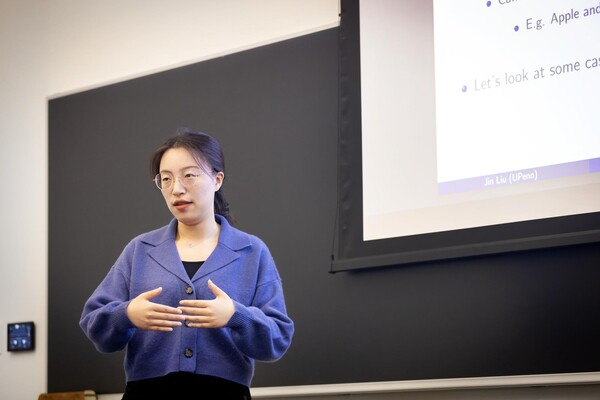
Lillian Miller (left) graduated as a chemistry and environmental scieces double major in May. This summer, she returns to begin her graduate training in Irina Marinov’s (right), where researchers use big data and computational techniques to make better climate models.
Key Takeaways
May graduate Lillian Miller from Collegeville, Pennsylvania, finished up her undergraduate degree in the College of Arts and Sciences conducting computational ocean and climate research under the supervision of Irina Marinov.
Miller will continue her journey at Penn this summer, as a graduate student in the Department of Earth and Environmental Sciences, supported by a Ben Franklin Fellowship.
Miller will also incorporate science communications in her graduate training to find better ways to reach broader audiences in communicating and explaining the work she and her colleagues do.
From digging up little sand crabs at the beach and going to her local creek to play with macroinvertebrates as a child to working as an environmental educator at the Perkiomen Watershed near her hometown, fourth-year College of Arts and Sciences student Lillian Miller has always nurtured a love of the natural world—hardly surprising, then, that she knew she’d “likely end up doing environmental stuff” when she grew up.
Lillian Miller is a climate scientist in training. She graduated in May and will return this summer to work in the Water Center at Penn and continue her research ahead of her return this fall as a graduate student Irina Marinov’s lab.
Miller, who is a chemistry and environmental sciences double major from Collegeville, Pennsylvania, graduated this week but will continue her climate research and begin her graduate studies this summer under the guidance of associate professor in the Department of Earth and Environmental Sciences Irina Marinov.
“I’m so happy she decided to stay here,” says Marinov. “It’s rare to have a Penn undergraduate stay for a Ph.D. with us, and Lillian has been such a great addition to my lab and department. Her planned research on improving our understanding of the Southern Ocean carbon cycle, coupled with her enthusiasm for developing climate science communication skills, is both timely and vital.”
Miller’s Ph.D. thesis will specifically address ocean carbon cycling, combining her expertise in chemistry, climate science, and earth and environmental science. “The question guiding my thesis is about the Southern Ocean’s role in carbon uptake,” Miller explains. “It’s known to be highly efficient at absorbing human-generated carbon, a crucial process for mitigating climate change impacts. Understanding whether this efficiency will increase or decrease over time is essential to tackling climate change.”
The power of phytoplankton
Recent estimates suggest that the Southern Ocean plays a central role in mitigating global warming, accounting for ~40% of the ocean’s human-generated CO2 absorption and 60-90% of the ocean heat trapped by greenhouse gases. Part of Miller’s research will focus on refining these estimates and working with climate model output to understand ocean carbon chemistry and phytoplankton dynamics, the tiny ocean plants that account for 50% of Earth’s photosynthesis and significantly influence oceanic carbon storage.
“Many of the current models aren’t correctly capturing how much carbon the phytoplankton are taking up, especially for the Southern Ocean,” Miller says. “And so, you really need to understand that rate to understand how much carbon is moving between the atmosphere and our oceans, which, in turn, helps us better understand and tackle climate change.”
“Iron is a limiting nutrient for phytoplankton in the North Pacific because it’s scarce relative to nitrate,” explains Marinov. “In the North Atlantic, it comes primarily with the winds from the Sahara Desert blowing into the ocean, while in the Northeast Pacific, iron is more scarce. We wanted to see if these known observations and impacts on plankton line up with the output of the latest climate models.”
Marinov and Miller primarily use computational tools to analyze predictive climate models and massive environmental data sets. The two are excited to report that they and several Penn collaborators have a paper under review that compares the distribution of phytoplankton and the flow of ocean nutrients in the North Pacific Ocean and North Atlantic. For her research contributions, Miller received the Rose Award from the Penn Center for Undergraduate Research and was inducted into Phi Beta Kappa this past month at Penn.
Training a computational scientist
To handle complex datasets, Miller and her team leverage supercomputing platforms, including the National Center for Atmospheric Research (NCAR ) supercomputer and the former Google Cloud infrastructure Pangeo. Miller initially faced a steep learning curve, especially with coding, but overcame these challenges through coursework and collaborative research.
“I’m not trying to undersell myself, but I was not very good,” she chuckles. “Coding and working with big datasets was really intimidating at first, but taking Dr. Marinov’s Global Climate Change Class really motivated me to develop these skills, as it showcased how important of a tool it can be in addressing climate change.”
Irina Marionov is a climate scientist and a associate professor in the Department of Earth and Environmental Sciences School of Arts & Sciences at the University of Pennsylvania.
Once her interest was piqued, Miller signed up for Arnold Mathijssen’s class in computational physics, which helped bolster her abilities as a coder and “establish a theoretical knowledge base” across disciplines.
This experience culminated in Miller becoming a teaching assistant (TA) in Marinov’s Climate Big Data class, where they’ve been working to make coding and climate data analysis far more accessible and have students work on research projects in the style of a “research incubator,” as Marinov puts it.
Marinov has students from diverse academic backgrounds working in groups to learn computational skills and analyze large climate data sets. A unique feature is the focus on “long-term code and project continuity,” Marinov says. “We require students to produce well-documented, shareable work that future classes and students can build upon, which contrasts with the typically individualistic nature of computational courses.” Marinov is grateful for support for this work from Penn Global, the Penn Perry World House, a NASA grant, and NSF, which sponsors the NCAR supercomputer access for their students. Miller was also funded by the Vagelos MLS program.
Climate science communication
Next year, when Miller is a TA for the class once again, she will use the class and experience of working across domains and communicating climate with non-climate scientists as a testbed for one of Marinov’s goals for Miller’s doctoral training: developing effective science communication skills as a scientist to better explain climate change for diverse audiences far and wide.
“And I think it’s really just important to hear people’s points, and you can’t cut people off, saying ‘Climate change exists’ over and over,” says Miller. “We need to listen before we can make our point, and we cannot be hostile.”
Miller believes that the advice to work through existing community structures of trust when going into communities and sharing how climate change is important is one of the most profound she’s received. She explains that working to gain trust in communities through community anchors like the local watershed or local church is one of the best ways to communicate climate.
Over the summer, Miller will partner with Penn’s Environmental Innovations Initiative and the Water Center, contributing to public outreach programs designed to enhance environmental education and climate policy awareness among diverse communities and among Philadelphia high school students.
“I’m also looking forward to being able to integrate all that policy and climate communications work more into my research. It’s something I haven’t done, but I’m really excited to get going with all that,” Miller says.
Nanoparticle blueprints reveal path to smarter medicines
New research involving Penn Engineering shows detailed variation in lipid nanoparticle size, shape, and internal structure, and finds that such factors correlate with how well they deliver therapeutic cargo to a particular destination.
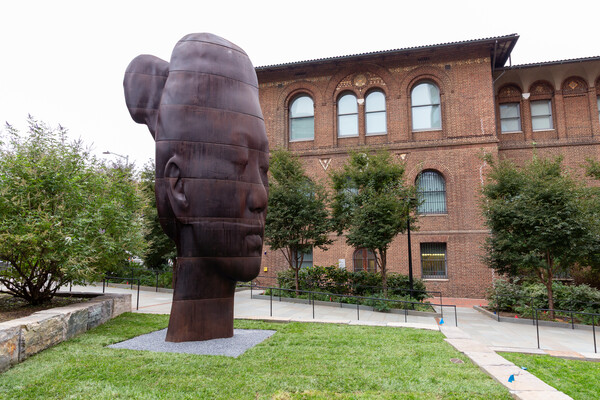
A generous gift from alumni Glenn and Amanda Fuhrman brings the work of internationally acclaimed artist Jaume Plensa to the University of Pennsylvania. The latest addition to the Penn Art Collection expands Philadelphia's public art.
A massive chunk of ice, a new laser, and new information on sea-level rise
For nearly a decade, Leigh Stearns and collaborators aimed a laser scanner system at Greenland’s Helheim Glacier. Their long-running survey reveals that Helheim’s massive calving events don’t behave the way scientists once thought, reframing how ice loss contributes to sea-level rise.