Penn researchers developed a system that allows light to be guided through a tiny crystal, undeterred by bumps, bends, and back-reflections. Their findings pave the way for robust, controllable light-based chips, smarter routing for data links, and more stable lasers.
3 min. read
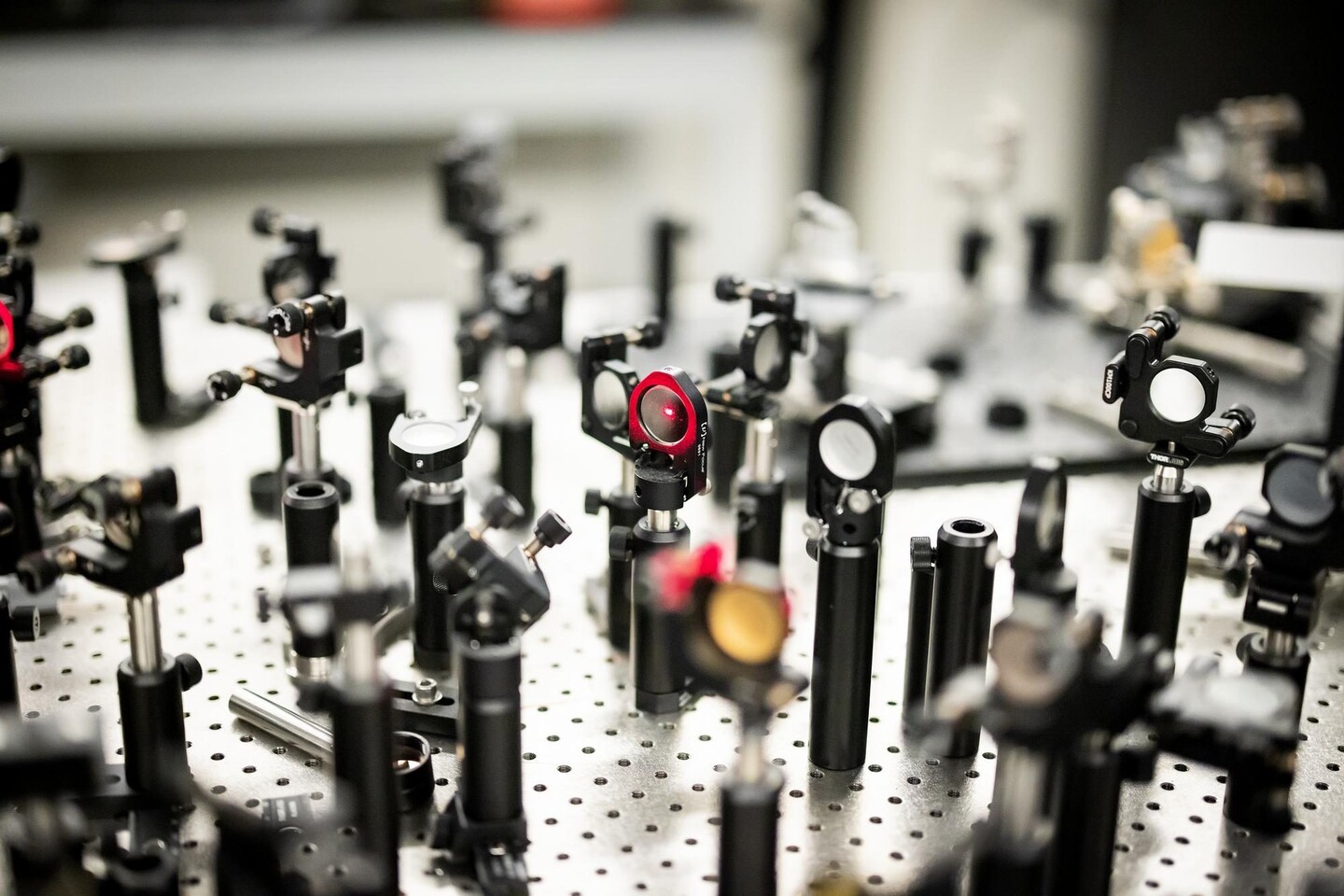
Bo Zhen (right) and postdoctoral researcher Li He developed a system for guiding light through tiny crystals in ways that allow it to navigate undeterred by bumps and defects. Their work could lead to sturdier lasers, faster data links, and light-based chips that don’t get tripped up by imperfections.
Key Takeaways
Penn researchers built a light-based crystal “tunnel” that forces light to move one way, even around bumps, bends, and defects.
By driving the crystal with circularly polarized light, the team created a protected topological channel that keeps light on course.
The discovery points toward sturdier lasers, smarter optical chips, and future devices that could safeguard quantum information.
Relaying a message from point A to B can be as simple as flashing a thumbs-up at a stranger in an intersection, signaling them to proceed—nonverbal, clear, and universally understood. But light-based communication is rarely that straightforward.
Photons, tiny particles of light, are fragile and unpredictable. Unlike electrons, which must be conserved in circuits, photons can scatter, split, merge into different colors, or be absorbed, meaning that the number of photons in a system isn’t fixed, even while the energy they carry remains the same. This makes guiding them through fiber optics or photonic chips—optical mazes—far trickier than steering electrons through copper wires, because light signals can scatter into dead ends or vanish before reaching their destination.
Engineers often respond by obsessively refining every imperfection, polishing the maze to perfection. However, this approach can be exhausting and never fully addresses these limitations.
“What if, instead of fighting the flaws, you could change the rules of the maze itself—reshaping the landscape on the fly so light has no choice but to keep going forward,” asks Bo Zhen, a physicist at Penn’s School of Arts & Sciences.
Now, in a study published in Nature Nanotechnology, Zhen and his colleagues have built a “secret tunnel” for photons that guarantees a beam can make it from A to B without getting stuck in traffic or lost along the way.
Their approach paves the way for chips that route light one-way around defects, optical isolators that don’t need bulky magnets, and lasers that emit light only in a forward direction, immune to destabilizing reflections. Robust photonic highways like these could reshape telecommunications, sensing, and quantum technologies—fewer wrong turns, fewer detours, and far less baggage.
The project started in 2018, when first author Li He arrived in Zhen’s lab to begin postdoctoral training. Working with Zhen and Penn physicist Eugene Mele—best known for helping discover electronic topological insulators—He proposed using polarized light on a photonic crystal, a semiconductor punctured with a regular array of holes, to create a stable topological state.
The aim was to reshape how light moves inside, forming a one-way path along the edges where light travels only travels forward, explains He. This “secret tunnel,” or chiral edge states, retains light’s one-way character despite small bumps or defects.
Zhen’s custom-built ultrafast laser system, assembled during the pandemic after shipping delays left half the components stranded at John F. Kennedy International Airport and the only technician who could calibrate it stuck in Lithuania.
Their 2019 theoretical proposal in Nature Communications, showed that photons could be shepherded much like electrons in exotic quantum materials.
“Back then, it was just equations; the math told us it was possible but making it real meant designing the right material and driving it in just the right way,” says He. “And theory doesn’t always agree with practice.”
The experiment demanded two ultrafast lasers—one to drive the crystal and one to probe it—which Zhen ordered from Europe at the start of 2020, just as COVID-19 closures tightened borders and throttled supply chains.
“For a while, it felt like everything that could go wrong did,” Zhen laughs. “Our fancy new laser showed up in 12 boxes and the delivery truck only brought us six. Then the person who could make it work was stuck in Lithuania. We were sitting here with half a laser and no instruction manual.”
With help from collaborators at University of California Santa Barbara, they had a stable device by 2022.
Their work showed that with linear polarization, the crystal stayed gapless, its internal bands crossing like indifferent pedestrians. With circular polarization, the bands twisted open a full gap, marked by the unmistakable topological signature: a Chern number of one (C=1), a distinct characteristic indicating an open one-way channel.
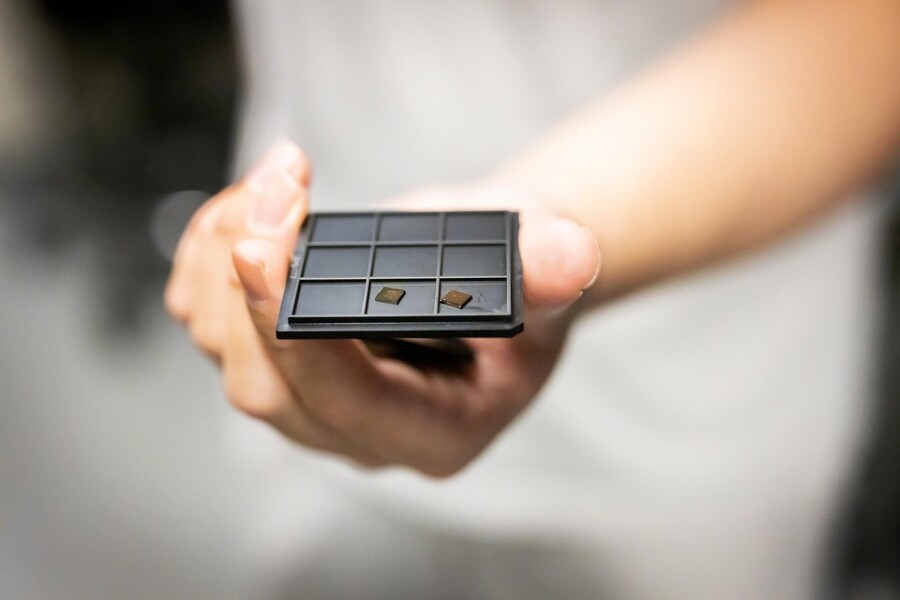
A member of the team holds a tiny patterned semiconductor crystal (aluminum gallium arsenide photonic crystal), the platform that enabled Zhen, Li, and their collaborators to guide light in one direction even around bends and defects.
From their laser spectra—detailed energy footprints—the team reconstructed the band structure, confirming they had pushed the system such that the crystal was rhythmically driven in time, creating new protected routes within the energy gaps.
“It was a Eureka moment—the plots on our screen matched the topological band diagram we had dreamed about,” says He. “Suddenly, this wasn’t just a route on a map; we were walking the road.”
In nonlinear optical material, two photons of one color can merge into a single photon of a different color, or a single photon can split into several. “Pump in one blue photon, watch two red photons come out—connections and transfers that electronics simply don’t allow,” Zhen says. “That freedom means photonic systems aren’t bound by the same constraints as electronics, and this new topological phase of light hands over a fresh rulebook for device design.”
Zhen says the team is already marching ahead, pushing the concept into three-dimensional crystals, scaling it to microwave frequencies where components are larger and easier to handle, and exploring whether the effect can shelter fragile quantum states of light.
“We’ve shown it’s possible,” Zhen says. “Now the goal is to see whether this approach can protect quantum information or create new classes of optical devices.”
Bo Zhen is the Jin K. Lee Presidential Associate Professor in the Department of Physics and Astronomy in the School of Arts & Sciences at the University of Pennsylvania.
Li He is a postdoctoral researcher in the Zhen Lab in Penn Arts & Sciences. He will be departing from Penn to join Montana State University as an Assistant Professor, starting this December.
Eugene Mele is the Christopher H. Browne Distinguished Professor of Physics in the Department of Physics and Astronomy in Penn Arts & Sciences.
Other authors include Jicheng Jin and Jian Lu of Penn Arts & Sciences and John E. Bowers, Lin Chang, and Chen Shang of the University of California Santa Barbara.
The research was supported by the U.S. Office of Naval Research (grant N00014-21-1-2703), the Army Research Office (award contract W911NF-19-1-0087 and through the Institute for Soldier Nanotechnologies W911NF-13-D-0001), the Department of Advanced Research Projects Agency (agreement HR00112220013), the Department of Energy (grants DE-FG02-84ER45118 and DE FG 02 ER84-45118), the National Science Foundation (grants DMR-1720530 and DMR-1838412), and the Air Force Office of Scientific Research (award number FA9550-18-1-0133).
Novel plant-based approach to a better, cheaper GLP-1 delivery system
Research led by Penn Dental’s Henry Daniell investigates the use of a lettuce-based, plant-encapsulated delivery platform as a new oral delivery of two GLP-1 drugs previously approved by the FDA in injectable form.
No brain, no gain: Neuronal activity enhances benefits of exercise
Research led by Penn neuroscientist J. Nicholas Betley and collaborators finds that hypothalamic neurons are essential for translating physical exertion into endurance, potentially opening the door to exercise-mimicking therapies.
In honor of Valentine's Day, and as a way of fostering community in her Shakespeare in Love course, Becky Friedman took her students to the University Club for lunch one class period. They talked about the movie "Shakespeare in Love," as part of a broader conversation on how Shakespeare's works are adapted.
In Becky Friedman’s English course Shakespeare in Love, undergraduate students analyze language, genre, and adaptation in the Bard’s plays through the lens of love.
Beating the heat: Designing cooling for bodies in motion
Dorit Aviv, director of Weitzman’s Thermal Architecture Lab, studies how humans, technology, and design intersect, paving the way for the development of novel approaches to cooling people efficiently.