Through Penn First Plus, students unlock potential and purpose
Providing first-generation and limited-income students with a comprehensive array of support, Penn First Plus equips undergraduates for success during and after their time at Penn.
5 min. read
Penn First Plus is a hub for supporting first-generation and limited-income undergraduates.
Coming to Penn as a first-generation student, Mayokun Omitogun of Stafford, Virginia, faced a whirlwind of challenges: She sought personalized guidance, hadn’t yet declared a major, and felt out of the loop on the unspoken nuances of college. When she got involved with Penn First Plus in the fall of her first year, Omitogun felt she truly began acclimating to the University experience.
Penn First Plus, the University’s hub for supporting first-generation and limited-income undergraduates, offers a comprehensive array of programming, academic advising, and professional development opportunities that expand access to Penn resources, drive career readiness, and promote well-rounded college experiences. Omitogun, now a third-year neuroscience major on a pre-medicine track in the College of Arts & Sciences, also minoring in Africana Studies with a career goal to become a psychiatrist, has benefited from Penn First Plus in numerous ways.
“I credit Penn First Plus with helping me understand the nuances of college that nobody would have really suspected that I didn’t know,” she says.
Through one-on-one guidance, Marc Lo, the inaugural executive director of Penn First Plus, empowered Omitogun to envision a fulfilling career and optimize her academic potential. Counseling specifically geared toward first-generation and limited-income students is one way Penn First Plus equips its participants for success during and after their time at Penn.
This fall, Lo and colleagues are expanding Penn First Plus programs, launching a training series for faculty and staff, expanding a mentorship program, implementing new faculty engagement programs, and collaborating with alumni on career trips.
I credit Penn First Plus with helping me understand the nuances of college that nobody would have really suspected that I didn’t know.
Third-year student Mayokun Omitogun
“Working with a student population who so very clearly wants to use their time at Penn to improve the world is not only incredibly rewarding, but also aligns really well with the ethos of the University’s founder and our commitment to education and research for the social good,” says Lo.
Support at every stage of the Penn journey
Penn First Plus was established in 2018, though similar work began decades beforehand. The College Achievement Program (PennCAP) launched in 1978, and initially provided support for various student populations across the University. Penn expanded its grant-based financial aid in 2014, enabling its first-generation and limited-income student population to grow to nearly one in four.
This fall’s expanded Penn First Plus initiatives join programs that support students at every stage of their college journey. Among these are the Pre-First Year Program (PFP), PennCAP—which merged with Penn First Plus in 2022—the Gateway Student Mentorship Program, and faculty engagement initiatives.
Offered in the four weeks prior to New Student Orientation, PFP is a rigorous summer program that serves between 160 to 180 students. It combines classroom instruction with workshops, seminars, field trips, and counseling. “While clearly qualified and capable of succeeding at Penn,” Lo explains, students in these communities “may have not had access in high school to some of the same curricula at the same pace as they’ll experience at Penn.”
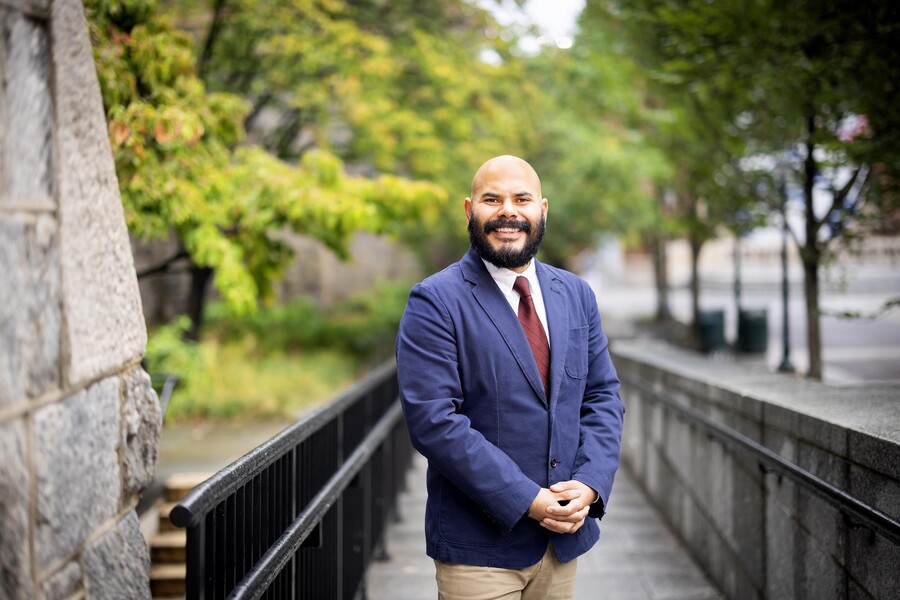
Enmanuel Martínez, a 2011 alumnus who now serves as the associate director of scholarly and professional development at Penn First Plus.
Enmanuel Martínez, a 2011 alumnus who participated in an earlier iteration of PennCAP as a student and now serves as the associate director of scholarly and professional development at Penn First Plus, recalls the life-changing impact that PennCAP had on his college experience.
PennCAP “gave me the license to advocate for myself and to not go about this journey on my own,” says Martínez, a first-generation college student whose parents emigrated from the Dominican Republic. PennCAP advisors and workshops were pivotal in equipping Martínez to make informed decisions about his major and more easily navigate college life.
“The conversations [with PennCAP staff and peers] were kind of testing grounds for thinking things through,” adds Martínez.
In recent years, PennCAP has nearly reached capacity, going from 550 to 700 students involved. More broadly, the Penn First Plus student population has increased by 45% since the center’s inception in 2018. Lo attributes much of this growth to “Penn’s commitment to its robust financial aid policies, especially grant-based aid,” that make up the recently expanded Quaker Commitment.
Mentorship, community, and faculty engagement
Faculty engagement initiatives are the “connective tissue of Penn First Plus,” says Lo.
Marc Lo, the inaugural executive director of Penn First Plus
Opportunities include faculty-led panels on building relationships with professors; workshops on best practices for email communication with faculty; and seminars on topics like financial literacy and navigating young adulthood. Penn is unique among peer institutions with a team of faculty helping them with these projects, led by the Bozza Family Faculty Co-Directors, Diana Robertson of the Wharton School and Fayyaz Vellani of the School of Arts & Sciences (SAS), and working group leads Florian Schwarz, also of SAS, and Aleksandra Vojvodicof of the School of Engineering and Applied Science.
In the Gateway Student Mentorship Program (GSM), student-mentors are paired with mentees. These mentors are then connected with faculty who provide coaching and oversee their progress.
As a first-year, Omitogun was paired with a GSM mentor also on a pre-medicine track. Inspired by her positive experiences, Omitogun became a mentor herself.
“If I didn’t have my mentor, I know I definitely wouldn’t be the person that I am today,” Omitogun says. “I really hope that I can do that for these students.”
Preparing students to improve society
The new training series for faculty and staff is designed to increase mindfulness on social class differences in academic advising. Lo says 97% of participants have demonstrated learning takeaways, making the program a top priority.
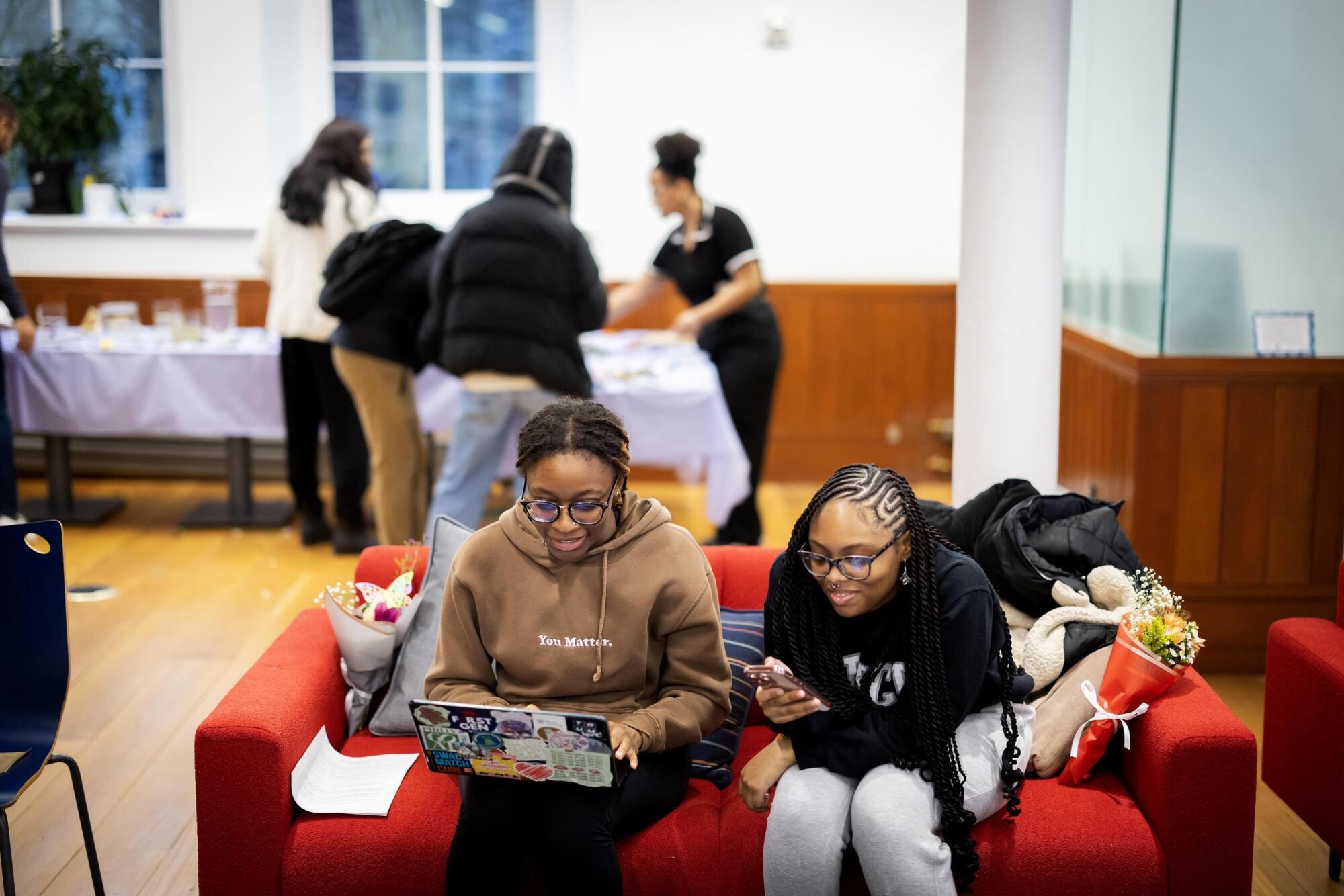
Undergraduates can study, connect, and socialize at the Penn First Plus office.
They are also expanding GSM capacity, implementing new faculty engagement programs, and partnering with the Provost’s Office to find opportunities for students to learn efficient and ethical use of AI. Martínez is collaborating with alumni to facilitate “career launch trips” where students visit companies—led by Penn alums from first-generation and limited-income backgrounds—and network with potential employers.
“Our undergraduate students are so eager and excited to network and connect with alumni,” says Martínez.
As Omitogun works toward graduating in 2027 and a career in mental health care, she exemplifies the ways Penn First Plus prepares students to help improve society. Lo notes that 92% of Penn First Plus-affiliated students solidify their post-graduation career plans within four months of graduation, with many entering care-oriented, human-centered professions that enable them to give back to their communities.
The value of a Penn education, Lo says, is about how it “contributes to your life and empowers you to make the lives of others better.”
Marc Lo (left) and Enmanuel Martínez (center) speaking with Mayokun Omitogun (right)
Novel plant-based approach to a better, cheaper GLP-1 delivery system
Research led by Penn Dental’s Henry Daniell investigates the use of a lettuce-based, plant-encapsulated delivery platform as a new oral delivery of two GLP-1 drugs previously approved by the FDA in injectable form.
No brain, no gain: Neuronal activity enhances benefits of exercise
Research led by Penn neuroscientist J. Nicholas Betley and collaborators finds that hypothalamic neurons are essential for translating physical exertion into endurance, potentially opening the door to exercise-mimicking therapies.
In honor of Valentine's Day, and as a way of fostering community in her Shakespeare in Love course, Becky Friedman took her students to the University Club for lunch one class period. They talked about the movie "Shakespeare in Love," as part of a broader conversation on how Shakespeare's works are adapted.
In Becky Friedman’s English course Shakespeare in Love, undergraduate students analyze language, genre, and adaptation in the Bard’s plays through the lens of love.
Beating the heat: Designing cooling for bodies in motion
Dorit Aviv, director of Weitzman’s Thermal Architecture Lab, studies how humans, technology, and design intersect, paving the way for the development of novel approaches to cooling people efficiently.