Bringing together passions for nursing, community, and policy
Growing up in rural Alaska shaped Charlotte Brown’s interest in health care access, while being a Perry World House Student Fellow and Benjamin Franklin Scholar expanded her horizons.
5 min. read
Charlotte Brown recalls a childhood climbing up and falling out of trees, picking blueberries in the mountains and currants in the woods, and paddling down her backyard creek on snow sleds with her three younger brothers—“lots of just being outside, being happy, being rained on,” she says.
The fourth-year School of Nursing student grew up surrounded by community in Wasilla, Alaska. (“I like to call it rural-ish, because in Alaska, it is a booming metropolis of 9,000 people, but my friends at Penn have felt like it was less of a raging city,” she jokes.) Her father is a pastor, and without extended family nearby, “I had adopted aunties and uncles and grandmas in the church who would take care of us.” There were always people in her home, and her mother always had coffee, cookies, and tea out to share.
Brown has a vivid memory of the moment at her 8th-grade graduation when the students who maintained a 4.0 grade point average were asked to stand. She looked around and noticed a correlation: Those standing had stable and supportive home lives—with community around them and enough to eat.
“That was something that really gripped me, and I think that’s part of why I chose nursing. I’ve always loved science, and I’ve always loved people, and nursing is a great way to do both of those things,” she says. “I wanted to be able to look at how the systems that are shaping my community affected the health and well-being of my community.”
Brown says she loves Alaska yet “wanted to get out, see something new, breathe some different air for a little bit.”
Raised in rural Alaska, Charlotte Brown grew up around a lot of natural beauty. Here, she is fossil hunting in the mountains with her family near their home.
(Image: Courtesy of Charlotte Brown)
She describes culture shock upon stepping onto campus—the ease of purchasing fresh fruit, for instance—but she quickly jumped in, making a practice of stepping out of her dorm room door without a plan and walking somewhere new in Philadelphia every week. Stepping beyond Penn’s campus also took her to North Philadelphia, where she spent a year and a half tutoring local elementary and middle school students through the EpiphAcademy program housed at Epiphany Fellowship Church.
Diving in
In her second year at Penn, Brown got involved in the Philadelphia Alliance for Labor Support (PALS), a nonprofit group of doulas founded by Penn Nursing students in 1998. Her main role has been treasurer for the organization, which holds subsidized trainings for community members who want to become doulas.
“Charlotte has a rare ability to balance academic excellence with deep emotional intelligence, allowing her to connect meaningfully with patients, peers, and faculty,” says Holly Harner, faculty sponsor of PALS and the Afaf I. Meleis Director of the Center for Global Women’s Health at Penn Nursing. “Charlotte’s passion for nursing extends well beyond the classroom. Whether assisting patients in high-acuity hospital settings or working with underserved communities, she brings the same level of professionalism, empathy, and drive.”
Brown reflects on a unique beyond-the-classroom experience the summer after her second year: working as a death investigation intern for the York County Coroner’s Office in South Carolina, where she attended scene calls, took forensic photos, and helped with next-of-kin notifications, supporting families through next steps.
Brown says in studying to become a nurse, it was important to her to be able to step into situations where people are grieving and to have empathy—while also learning how to leave the work behind at the end of the day.
As a Benjamin Franklin Scholar Brown has been able to step outside the nursing curriculum. Taking courses on ancient-to-modern literary theory and water and urban sustainability has been fantastic, she says.
“Charlotte Brown is a renaissance student of nursing,” says Professor Sarah H. Kagan, director of the Benjamin Franklin Scholars in Nursing program. “She embodies what it is to be a Benjamin Franklin Scholar in Nursing with her appetite for a wide range of subjects and her ability to diverge from the group to take different paths as she learns and imagines her part in our shared future of health and well-being.”
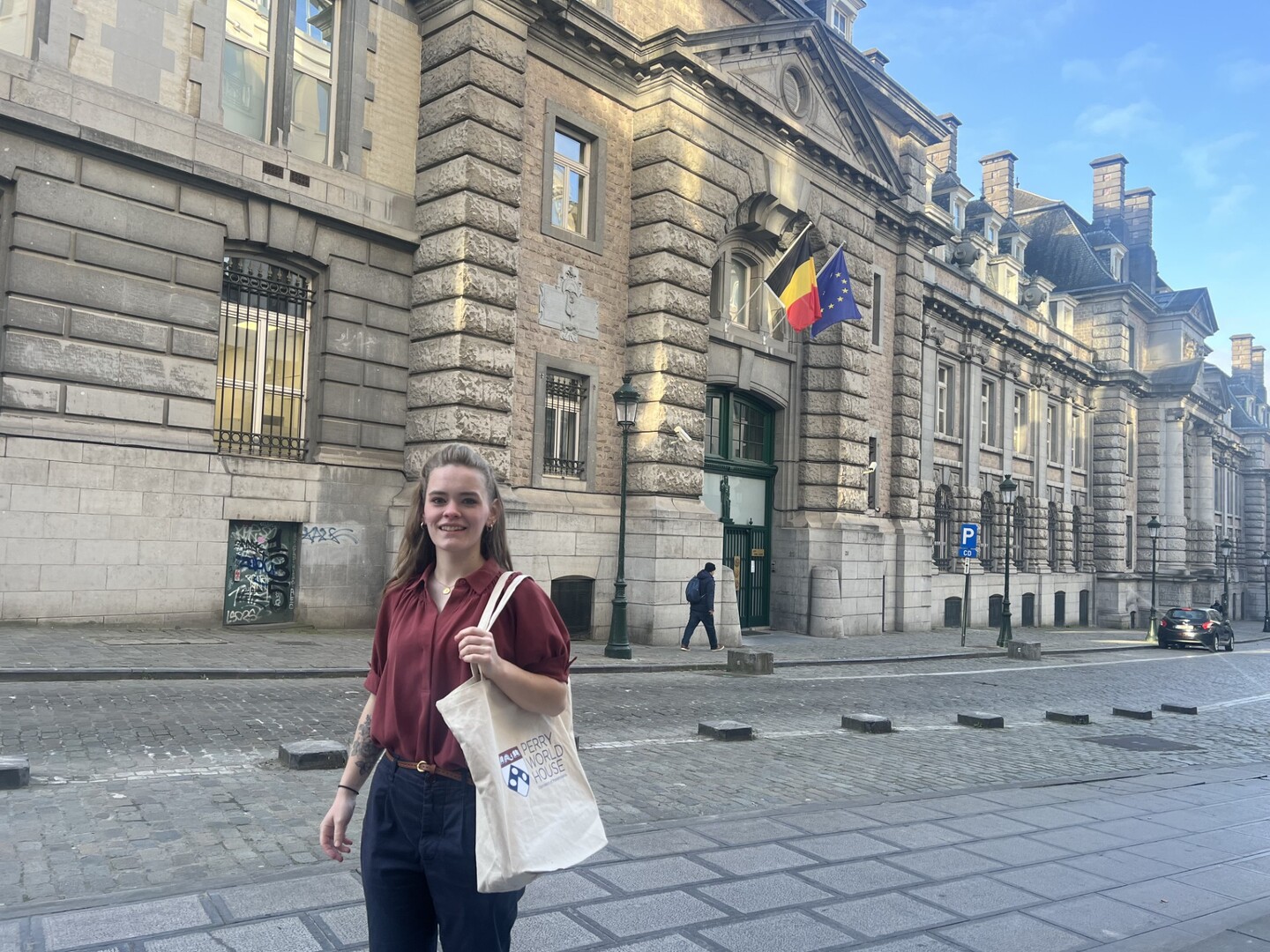
Charlotte Brown visited the Belgian Ministry of Foreign Affairs in Brussels during a trip with Perry World House over spring break.
(Image: Courtesy of Charlotte Brown)
Brown has also expanded her horizons through the Perry World House Student Fellows Program; she was accepted in her third year and describes it as her favorite thing she has done at Penn. “When I first joined the program, I felt very out of my depth,” she says. “I was like, I’m a nursing student; I haven’t learned anything about this social policy stuff, but I’m really interested, and I want to learn.”
Whether through traveling to The Hague and Brussels for spring break, learning how to incorporate sustainability into architecture, or attending an event with the former mayor of Bogotá, Colombia, on equality and sustainability in cities, Brown has connected the opportunities afforded through Perry World House back to nursing.
“I really believe that every single policy is a health policy, or it should be,” she says. “I think we need nurses in political spheres to be able to say, ‘I’m working with people who this policy is very practically hurting. This policy is preventing my community from getting housing; it’s preventing kids from being fed and staying safe and staying with their families.’”
Looking ahead
Brown says she hopes to move to Washington, D.C., after graduating, “to keep my toes in the policy world a little bit.” She is currently doing her clinical rotation in the emergency room at Penn Presbyterian Medical Center and would like to continue working in an ER.
Long term, she wants to move into a community health role and would love to return to Alaska. “All my family is there, and there are so many people there who poured into me all throughout my childhood and got me to where I am today, and I would love to be able to go back and give back to my community there,” Brown says. “There are a lot of really lovely things about my community, but there are also a lot of things that are hard, that are tough.”
Food is expensive because everything must be barged in or driven up the ALCAN, a long highway that goes through Canada. Most Alaskans must travel to Seattle if they get really sick, Brown says, recalling a family member who was not able to find an endocrinologist in the state.
She observed these issues growing up but says being at Penn taught her about social determinants and made her realize that health care access issues in Alaska aren’t normal—they’re not everyone’s experience growing up.
“I would love to be able to go back and try to step into that gap—to bring more health care and more ideas,” she says.
“I'm looking forward to seeing what Charlotte will do next,” Kagan says. “She’s often surprised and delighted me over the past four years. I think that the best is yet to come as she embarks on her career and further study.”
Novel plant-based approach to a better, cheaper GLP-1 delivery system
Research led by Penn Dental’s Henry Daniell investigates the use of a lettuce-based, plant-encapsulated delivery platform as a new oral delivery of two GLP-1 drugs previously approved by the FDA in injectable form.
No brain, no gain: Neuronal activity enhances benefits of exercise
Research led by Penn neuroscientist J. Nicholas Betley and collaborators finds that hypothalamic neurons are essential for translating physical exertion into endurance, potentially opening the door to exercise-mimicking therapies.
In honor of Valentine's Day, and as a way of fostering community in her Shakespeare in Love course, Becky Friedman took her students to the University Club for lunch one class period. They talked about the movie "Shakespeare in Love," as part of a broader conversation on how Shakespeare's works are adapted.
In Becky Friedman’s English course Shakespeare in Love, undergraduate students analyze language, genre, and adaptation in the Bard’s plays through the lens of love.
Beating the heat: Designing cooling for bodies in motion
Dorit Aviv, director of Weitzman’s Thermal Architecture Lab, studies how humans, technology, and design intersect, paving the way for the development of novel approaches to cooling people efficiently.