An ‘illuminating’ design sheds light on cholesterol
By building light-controlled cholesterol ‘look-alikes,’ a Penn-led team creates new tools to track and tune an essential molecule, uncovering selective inhibitors for elusive transport proteins and pointing toward smarter drug delivery.
3 min. read
Key Takeaways
Cholesterol is essential for cell membranes and hormone production, despite its link to heart disease.
Researchers have developed photocholesterols—light-sensitive cholesterol ‘look-alikes’—to allow for toggling cholesterol-dependent processes on and off.
This light-based activation enables more control for advancing therapies and drug delivery systems.
The discovery of inhibitors for transport proteins ORP1 and ORP2 offers new paths to understanding cholesterol balance.
High levels of cholesterol are linked to heart disease, stroke, and many other health problems. However, this complex and vital fatty, water insoluble molecule—a lipid—is found in every cell of the body and is not all bad news. It also regulates crucial processes that science has yet to map.
“Cholesterol helps build membranes and serves as the starting point for important hormones like estrone and testosterone, so it shapes many aspects of our health and disease,” says Michael Zott, a Beckman Postdoctoral Fellow at the University of Pennsylvania. Studying its behavior is tricky because it is tiny and hard to track, Zott says.
While high levels of cholesterol are linked to heart disease, stroke, and other health problems, this complex and vital molecule is found in every cell of the body and regulates crucial processes. By building light-controlled molecules that look and act like cholesterol, PIK Professor Dirk Trauner (left) and his team have created a new set of tools allowing the researchers to toggle cholesterol’s biological activity on or off, paving the way for advanced therapeutics.
These constraints mean scientists often rely on “functional derivatives,” or molecules designed to mimic cholesterol but which include chemical tags so they can be seen and tracked.
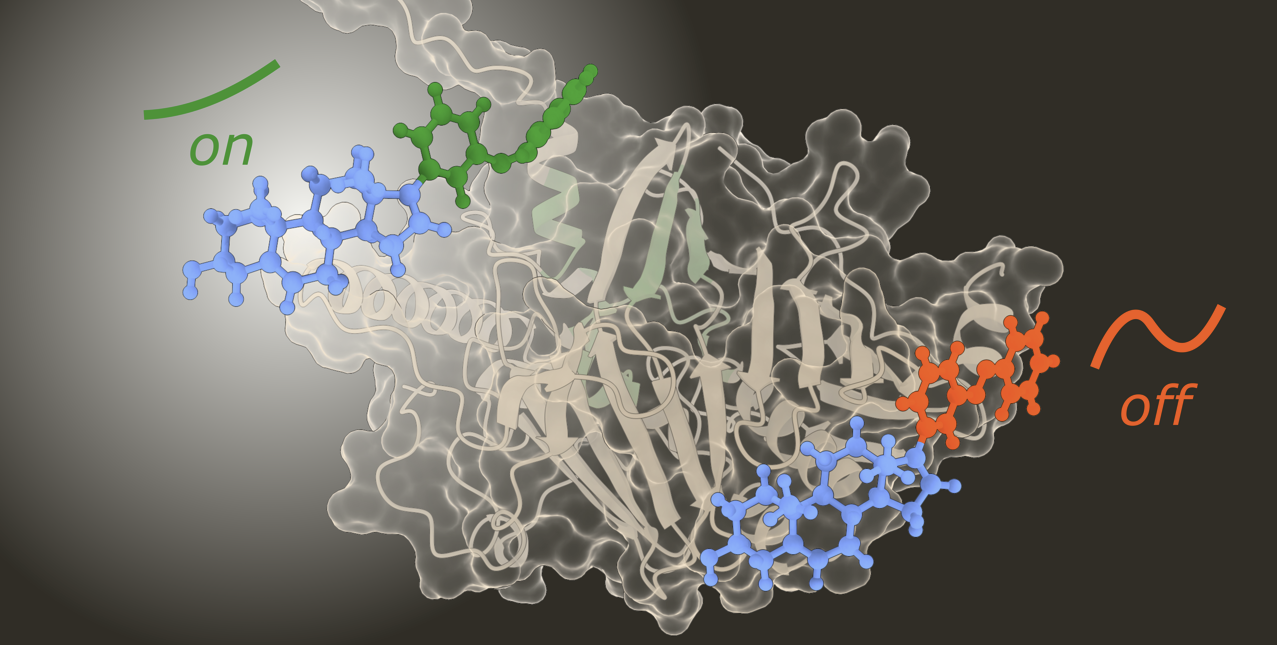
In a paper published in the Journal of the American Chemical Society, Zott and a collaborate team led by his postdoctoral adviser Dirk Trauner have designed a new set of cholesterol proxies with light-sensitive compounds attached. Called “photocholesterols,” these molecules change shape when exposed to light, allowing the researchers to toggle cholesterol’s biological activity on or off.
This light-based system paves the way for advanced therapeutics, allowing drugs to be activated deep within the body where traditional controls fail. The team’s ultimate goal is to enable wavelengths of light that can penetrate through the skin to reach organs targeted for medicine.
Michael Zott, a Beckman Postdoctoral Fellow in the Trauner Research Group at Penn.
“The nice thing about using light to trigger these geometric changes in molecules we study is that certain forms of it can penetrate tissues quite deeply” says Trauner, co-senior author of the paper and a Penn Integrates Knowledge University Professor in the School of Arts & Sciences and the Perelman School of Medicine. “This allows for what we usually call spatiotemporal control. A person could take the medicine systemically, and then we could activate it at a precise time in a precise place using a focused beam of light to turn the molecule on in only a certain location.”
They found that the photocholesterols they created did not behave identically.
“While we initially aimed to make a molecule that would work in every possible application—a ‘pan cholesterol’ mimic—we came upon a powerful, fortuitous result,” Zott says.
Instead of behaving identically, some photocholesterols strongly preferred certain transport proteins over others, and one candidate turned out to be possibly the first selective inhibitor of two poorly understood sterol transport proteins: ORP1 and ORP2.
“The work has already led to new discovery,” says co-senior author of the paper Luca Laraia of the Technical University of Denmark. “We now have the first ‘photoswitchable’ inhibitors of ORP1 and ORP2—proteins we know play a critical role in cholesterol balance but whose function we haven’t fully elucidated. This will significantly help us understand their biological roles.”
“By finding molecules that are selective for them, that means we can begin to develop tools to turn them off or turn on, selectively,” adds Zott, “and that will help us uncover what their function is down the line.”
Light-activated control over “lookalikes” of essential biological molecules like cholesterol, a project developed within Dirk Trauner's lab. The core technique involves inserting a “photo switch” molecule into a lipid, allowing researchers to alter the molecule’s shape—and thus its biological behavior—using different wavelengths of light.
For future work, the team plans to leverage the precision of light to map when and where key sterol transport proteins move cholesterol within complex cellular models under normal and disease-like conditions.
They also plan to adapt the same computational design strategy to build light-controlled versions of other lipids, with the long-term goal of optimizing lipid nanoparticle formulations for applications like light-controlled mRNA delivery and designing systemic therapies that can be activated locally using focused beams of light, providing precise spatiotemporal control.
“Cholesterol is at the center of biology and underlies cutting-edge tools like the lipid nanoparticles used in modern vaccine technology,” says Zott. “By making a light-controlled version, we can begin to investigate, and potentially improve, all of these crucial processes.”
Dirk Trauner is the George A. Weiss University Professor, and a Penn Integrates Knowledge Professor with joint appointments in the Department of Chemistry in the School of Arts & Sciences and the Department of Systems Pharmacology and Translational Therapeutics in the Perelman School of Medicine at the University of Pennsylvania.
Michael D. Zott is a Beckman Postdoctoral Fellow in the Trauner Lab at Penn.
Luca Laraia is a professor in the Department of Chemistry at the Technical University of Denmark.
Other authors include Antonia Behnsen and Benjamin C. Lester of Penn Arts & Sciences and Laura Depta of the Technical University of Denmark.
This research received support from the Arnold & Mabel Beckman Foundation, the National Institutes of Health (Grant R01-GM126228), the Novo Nordisk Foundation (Grants NNF19OC0055818, NNF19OC0058183, NNF21OC0067188), and the Carlsberg Foundation (Grant CF19-0072).
Novel plant-based approach to a better, cheaper GLP-1 delivery system
Research led by Penn Dental’s Henry Daniell investigates the use of a lettuce-based, plant-encapsulated delivery platform as a new oral delivery of two GLP-1 drugs previously approved by the FDA in injectable form.
No brain, no gain: Neuronal activity enhances benefits of exercise
Research led by Penn neuroscientist J. Nicholas Betley and collaborators finds that hypothalamic neurons are essential for translating physical exertion into endurance, potentially opening the door to exercise-mimicking therapies.
In honor of Valentine's Day, and as a way of fostering community in her Shakespeare in Love course, Becky Friedman took her students to the University Club for lunch one class period. They talked about the movie "Shakespeare in Love," as part of a broader conversation on how Shakespeare's works are adapted.
In Becky Friedman’s English course Shakespeare in Love, undergraduate students analyze language, genre, and adaptation in the Bard’s plays through the lens of love.
Beating the heat: Designing cooling for bodies in motion
Dorit Aviv, director of Weitzman’s Thermal Architecture Lab, studies how humans, technology, and design intersect, paving the way for the development of novel approaches to cooling people efficiently.