‘Leukemia-on-a-chip’ could transform CAR T blood cancer treatments
In a collaborative effort with NYU, Penn researchers have helped pioneer a novel 3D platform that mimics the human bone marrow and immune environment, enabling more predictive testing of cancer immunotherapy success in patients, including CAR T cell therapies.
3 min. read
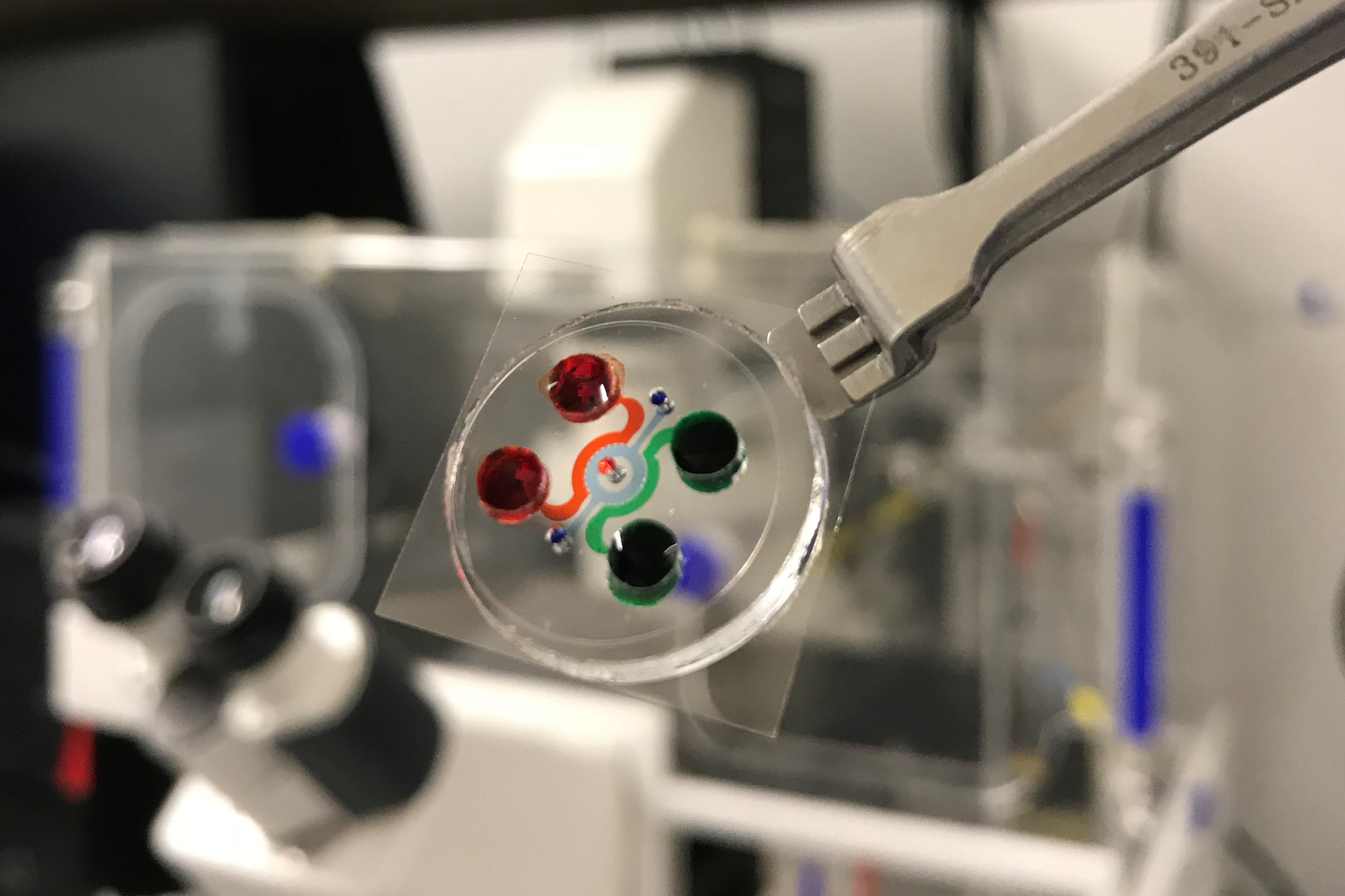
The actual chip of human leukemia bone marrow where chambers and channels were filled with food dyes.
(Image: NYU Tandon Applied Micro-Bioengineering Laboratory/Courtesy of Weiqiang Chen)
Chimeric antigen receptor (CAR) T cell therapy represents a breakthrough in cancer treatment. By harnessing the body’s immune system, CAR T therapy provides a powerful, personalized treatment option that can be particularly effective for treating blood cancers like leukemia—potentially offering patients a second chance at life when other treatments have failed.
However, despite its potential, nearly half of patients with leukemia relapse, and many experience serious side effects. Scientists have struggled to improve these treatments, in part because conventional testing methods fall short.
Now, a collaborative multidisciplinary team of researchers from the Perelman School of Medicine at the University of Pennsylvania and the Tandon School of Engineering at New York University has developed a miniature device that could transform how blood cancer treatments are tested and tailored for patients.
The team’s microscope slide-sized “leukemia-on-a-chip,” is the first laboratory device to successfully combine both the physical structure of bone marrow and a functioning human immune system—an advance that could dramatically accelerate new immunotherapy development. The results are published in Nature Biomedical Engineering.
“This device addresses a significant gap in preclinical research, offering an advanced tool for studying CAR T cell therapy’s dynamic and multifaceted responses to leukemia,” says co-senior author Saba Ghassemi, an assistant professor of pathology and laboratory medicine at Penn Medicine. “Its ability to model these processes in real time opens the door for more accurate predictions of clinical outcomes, ultimately helping to refine treatments before they are tested in patients.”
“We can now watch cancer treatments unfold as they would in a patient, but under completely controlled conditions without animal experimentation,” adds co-senior author Weiqiang Chen, a professor at NYU Tandon.
This innovation comes at a particularly timely moment, as the FDA recently announced a plan to phase out animal testing requirements for monoclonal antibodies and other drugs, releasing a comprehensive roadmap for reducing animal testing in preclinical safety studies.
The new device recreates three regions of bone marrow where leukemia develops: blood vessels, surrounding marrow cavity, and outer bone lining. When populated with patient bone marrow cells, the system begins to self-organize, with cells producing their own structural proteins like collagen, fibronectin, and laminin, creating not only the physical structure but, most importantly, retaining the complex immune environment of the tissue.
The whole scanning of the bone marrow niche on-chip. Structural components of bone marrow are in red (vascular network) and yellow (endosteal region) with leukemia cells sparsely distributed throughout the niche in green.
(Image: NYU Tandon Applied Micro-Bioengineering Laboratory/Courtesy of Weiqiang Chen)
“By mimicking the bone marrow stroma and immune niches in three dimensions, the device allows us to observe CAR T cell behavior and efficacy in a setting that closely mirrors the complexities of a real human body,” Ghassemi explains. “It incorporates vascular networks to support realistic immune interactions, providing a level of precision and insight that traditional 2D cell culture models or animal studies cannot achieve.”
Using advanced imaging techniques, the researchers watched individual immune cells as they moved through blood vessels, recognized cancer cells, and eliminated them, a process previously impossible to witness with such clarity in a living system. The team could track precisely how fast the CAR T cells traveled while hunting down cancer cells, revealing that these engineered immune cells move with purpose when searching for their targets, slowing down when they detect nearby cancer cells to engage and destroy them.
“We observed immune cells patrolling their environment, making contact with cancer cells, and killing them one by one,” Chen says.
The researchers also discovered that engineered immune cells activate other immune cells not directly targeted by the therapy, a “bystander effect” that may contribute to both treatment effectiveness and side effects.
By manipulating the system, the team recreated common clinical scenarios seen in patients: complete remission, treatment resistance, and initial response followed by relapse. Their testing revealed that newer “fourth generation” CAR T-cells with enhanced design features performed better than standard versions, especially at lower doses.
The leukemia device has another advantage. It can be assembled in half a day and supports two-week experiments, while animal models require months of preparation.
“This technology could eventually allow doctors to test a patient’s cancer cells against different therapy designs before treatment begins,” Chen explains. “Instead of a one-size-fits-all approach, we could identify which specific treatment would work best for each patient.”
“This work represents a true multidisciplinary collaboration, underscoring the importance of expertise across diverse fields,” adds Ghassemi. “By combining bioengineering with immunology, we’ve created a coherent model that not only mirrors the complex interactions of CAR T cells within the human leukemia niche but also offers a tool to test interventional strategies and the corresponding responses over time, bringing us closer to personalized, precision therapies for leukemia and other cancers.”
Saba Ghassemi is an assistant professor in the Department of Pathology and Laboratory Medicine at the Perelman School of Medicine at the University of Pennsylvania.
Weiqiang Chen is a professor of mechanical and aerospace engineering at the Tandon School of Engineering at New York University.
Other authors are Xiangyi Fang (also of the School of Engineering and Applied Science), Shadab Kazmi, and Nandana Mukherjee of the Perelman School of Medicine at the University of Pennsylvania; Iannis Aifantis, Ruiqi Chen, Lunan Liu, Chao Ma, Jie Tong, and Huishu Wang of New York University; and Matthew T. Witkowski of the University of Colorado.
The work was supported by the Alex’s Lemonade Stand Cancer Research Foundation, American Society of Hematology (Restart Award), Cancer League of Colorado Research (no. 222549), Cancer Research Institute (Irvington Postdoctoral Fellowship no. CRI4018), Children’s Oncology Group Foundation, Curing Kids Cancer, Jeffrey Pride Foundation for Pediatric Cancer Research, Leukemia & Lymphoma Society (TRP no. 6580-20 and the Career Development Program), National Institutes of Health (no. R35GM133646), National Institutes of Health/National Cancer Institute (K22 award [no. 1K22CA258520-01], P001CA229086, R01CA252239, R01CA228135, R01CA242020, and O1CA266212), National Science Foundation (no. CBET 2103219), Office of the Assistant Secretary of Defense for Health Affairs (Peer Reviewed Cancer Research Program no. W81XWH-20-1-0417), and St. Baldrick’s Foundation (Scholar Award).
Novel plant-based approach to a better, cheaper GLP-1 delivery system
Research led by Penn Dental’s Henry Daniell investigates the use of a lettuce-based, plant-encapsulated delivery platform as a new oral delivery of two GLP-1 drugs previously approved by the FDA in injectable form.
No brain, no gain: Neuronal activity enhances benefits of exercise
Research led by Penn neuroscientist J. Nicholas Betley and collaborators finds that hypothalamic neurons are essential for translating physical exertion into endurance, potentially opening the door to exercise-mimicking therapies.
In honor of Valentine's Day, and as a way of fostering community in her Shakespeare in Love course, Becky Friedman took her students to the University Club for lunch one class period. They talked about the movie "Shakespeare in Love," as part of a broader conversation on how Shakespeare's works are adapted.
In Becky Friedman’s English course Shakespeare in Love, undergraduate students analyze language, genre, and adaptation in the Bard’s plays through the lens of love.
Beating the heat: Designing cooling for bodies in motion
Dorit Aviv, director of Weitzman’s Thermal Architecture Lab, studies how humans, technology, and design intersect, paving the way for the development of novel approaches to cooling people efficiently.