Using a novel approach, Penn Vet’s Chris Lengner and M. Andrés Blanco and colleagues have identified two genes that suppress colorectal cancer metastasis.
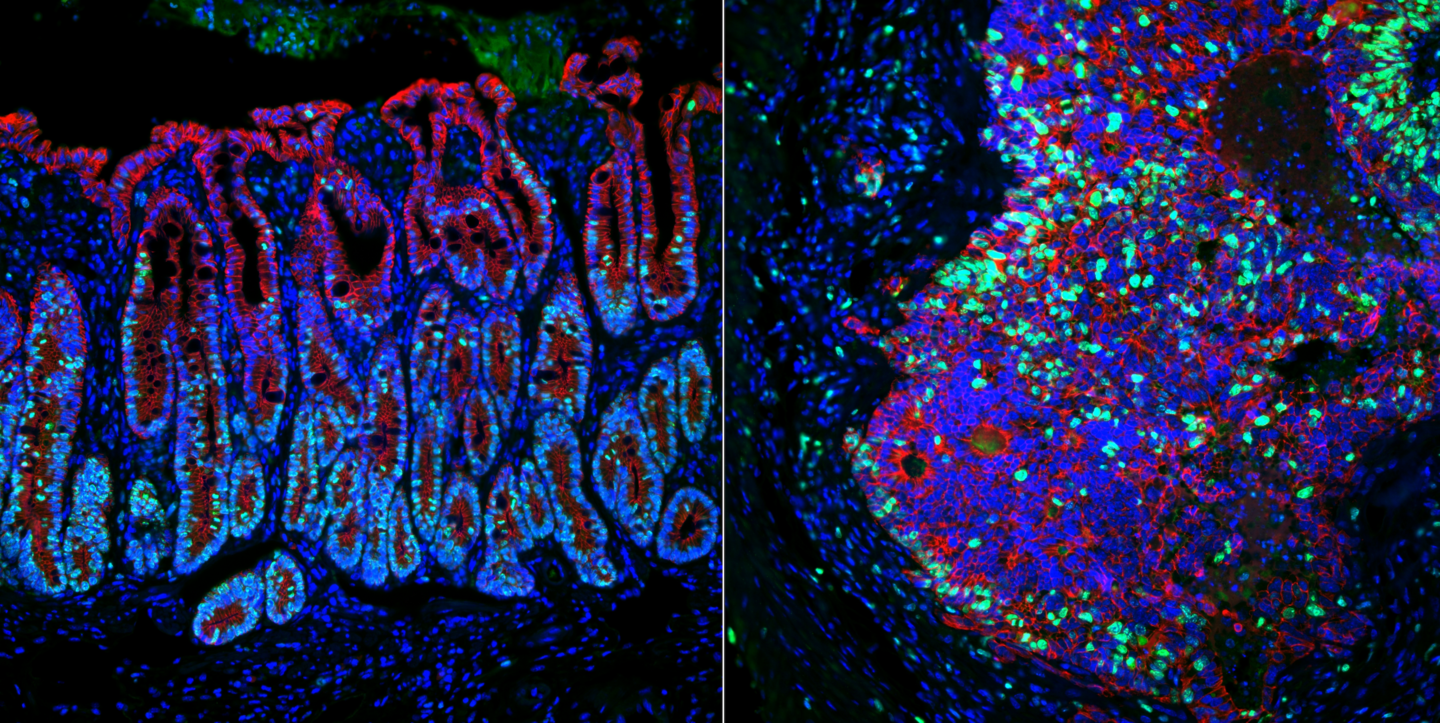
Histopathology tissue sections of the normal colon (left) showing highly organized cell-cell junctions (red) and proliferative zones (green) in colonic crypts. In contrast, a colon adenocarcinoma (right) is highly disorganized, with inconsistent cell junctions that can ultimately contribute to metastatic dissemination.
(Image: Maggie Robertson)
Cancer is a leading cause of death worldwide, and among all cancers, colorectal cancer ranks second in mortality, responsible for more than 900,000 deaths in 2020.
In the U.S., rates of colorectal cancer are rising—especially in younger people. Despite advances in targeted and immunotherapies, patients with metastatic disease face poor prognoses. Understanding the molecular pathways underlying colorectal cancer metastasis could lead to better treatments and therapies.
When colon cancer is caught early enough, the survival rates are very high, says Lengner. “But once it metastasizes, five-year survival rates are below 10%.”
“Metastasis is the almost universal killer in cancer. With a couple of exceptions, it's what kills cancer patients,” agrees Blanco. “When we did this study, we were looking to solve this metastasis puzzle and gain some insights into the biology of cancer spread beyond colorectal cancer.”
The team used the gene-editing technology CRISPR with a “library”—a set of RNA guides that target specific genes—to systematically turn off around 1,500 genes broadly involved in cancer. They then assessed the impact of these gene disruptions by measuring metastasis in preclinical models (“screening”).
Looking for the genes responsible for something like colorectal cancer metastasis can feel like trying to find “a needle in a haystack,” says Blanco. “Screening is a quick method that lets you very efficiently check every single piece of hay in the haystack to find that needle.”
The team identified Ctnna1 and Bcl2l13 as “bona fide metastasis suppressors.”
“CTNNA1, or alpha-catenin, acts through what we call traditional metastasis mechanisms, meaning that it regulates how cells crawl into and invade surrounding tissues,” Blanco says. “It helps keep cells locked in, touching their neighbors closely. When we knock it out, the cells tend to crawl, moving away from their neighbors.”
BCL2L13, or BCL-Rambo, on the other hand, regulates a specific type of cell death. Colorectal cancer originates from epithelial cells, which are normally connected to each other in a tissue layer. “If a cell detaches from that layer, that triggers cell death,” says Blanco. “BCL2L13 is one of the genes that helps to promote that process.” That’s good, he explains, because it prevents these cells from surviving in the wrong place.
Lengner notes that metastatic cells may suppress BCL2L13 in order to survive once they’ve left their primary tumor.
This study also introduces a novel approach for investigating the genetic basis of metastasis.
CRISPR has been “transformative” in cancer biology; however, most screens have been performed in tumor cell lines that often do not accurately model primary human cancers—let alone metastasis, says Lengner, adding that cancer research has been moving away from cell lines towards in vivo studies and organoid models.
In this study, they chose to combine these approaches—introducing mutations to create a colon “tumoroid,” or lab-grown tumor, and then evaluating metastasis in an in vivo model—demonstrating proof of principle that large-scale genetic screening can be performed in tumor-organoid models in vivo.
“We wanted to use a well-defined model that had the most common mutations that drive disease in humans,” Lengner says. “And then we wanted to ask, okay, if you have these pretty stereotypic mutations that drive the initiation of cancer, can we then identify what pushes it over the edge to metastasis?”
And to answer this question, they combined a number of approaches. Researchers have run screens in organoids—miniature lab-grown organs—in vitro and have done similar screens using lab-grown cells, called cell lines, in vivo, says Blanco. But very few studies have conducted screens using organoids in vivo.
“And in colorectal cancer? Maybe not any—and certainly not in metastatic colorectal cancer,” says Lengner. “The other thing that’s unique is that we put the “tumoroid” into its native tissue and then watched it metastasize to its native metastatic destination.” This approach allowed them to investigate the genes underlying both primary tumor growth and metastasis in a preclinical model that is comparable to human colorectal cancer.
Next steps include screening for genes that promote metastasis. “Thinking therapeutically, you’d rather find genes that promote metastasis rather than suppress it. Those would be genes you’d want to target,” says Blanco.
“In theory, we can push through this again with a CRISPR activation library or another ‘druggable’ target library,” says Lengner. “We’ve worked through the methodology.” He adds that it was the combining of the tools from his lab with those from Blanco’s that made this study possible.
M. Andrés Blanco is an assistant professor in the Department of Biomedical Sciences in the School of Veterinary Medicine at the Unviersity of Pennsylvania.
Christopher J. Lengner is the Harriet Ellison Woodward Professor in Penn Vet’s Department of Biomedical Sciences.
Other authors are Stephanie Adams-Tzivelekidis, Igor E. Brodsky, María F. Carrera Rodríguez, Zvi Cramer, Kayla Durning, Olivia Hanselman, Melissa S. Kim, Austin C. King, Nicolae Adrian Leu, Ning Li, Rina Matsudas, Diego Mendez, Keara Monaghan, Ricardo Petroni, Joshua H. Rhoades, Joshua Rico, Yuhua Tian, and Xin Wang of Penn Vet; Jonathan Heintz of the Perelman School of Medicine; and Anil Rustgi and Alice E. Shin of Columbia University Vagelos College of Physicians and Surgeons.
This work was supported by the following: NIH F31CA250267 (Z.C.), NIH NRSA F31AI160741 (R.M.), a Calico Labs sponsored research agreement (C.J.L. and M.A.B.), NIH/NCI R01 CA168654 (C.J.L.), and NIH/NCI R01 CA279317 (M.A.B.).
Novel plant-based approach to a better, cheaper GLP-1 delivery system
Research led by Penn Dental’s Henry Daniell investigates the use of a lettuce-based, plant-encapsulated delivery platform as a new oral delivery of two GLP-1 drugs previously approved by the FDA in injectable form.
No brain, no gain: Neuronal activity enhances benefits of exercise
Research led by Penn neuroscientist J. Nicholas Betley and collaborators finds that hypothalamic neurons are essential for translating physical exertion into endurance, potentially opening the door to exercise-mimicking therapies.
In honor of Valentine's Day, and as a way of fostering community in her Shakespeare in Love course, Becky Friedman took her students to the University Club for lunch one class period. They talked about the movie "Shakespeare in Love," as part of a broader conversation on how Shakespeare's works are adapted.
In Becky Friedman’s English course Shakespeare in Love, undergraduate students analyze language, genre, and adaptation in the Bard’s plays through the lens of love.
Beating the heat: Designing cooling for bodies in motion
Dorit Aviv, director of Weitzman’s Thermal Architecture Lab, studies how humans, technology, and design intersect, paving the way for the development of novel approaches to cooling people efficiently.