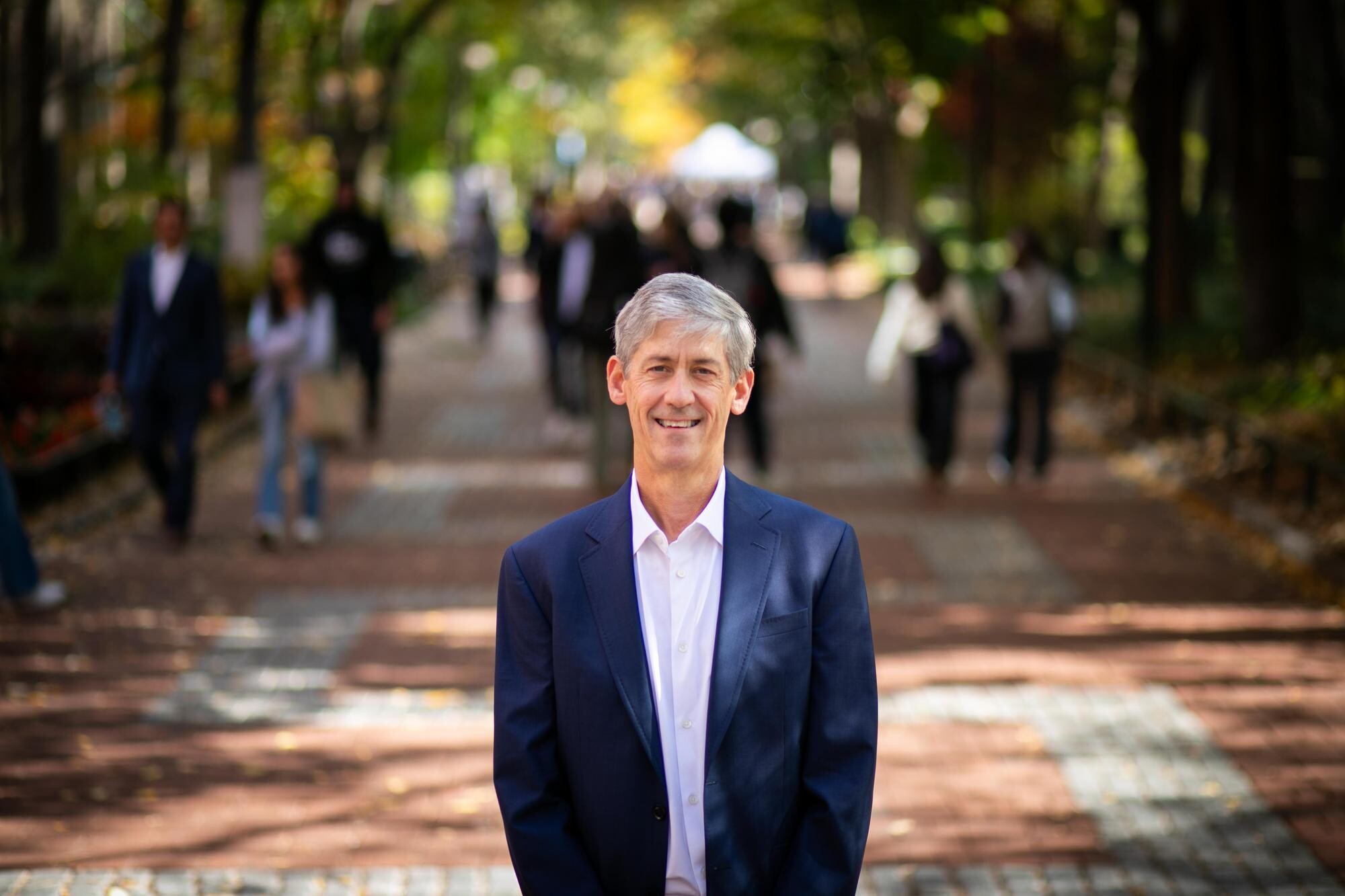
Tom Murphy is leading Operational Transformation at Penn. Here’s his approach
In a Q&A, Tom Murphy, who leads the Operational Transformation working group, one of six Penn Forward teams, discusses his approach to leading change in non-academic areas of Penn.
5 min. read
Tom Murphy, senior vice president and chief transformation officer, is chair of the Operational Transformation working group for Penn Forward, Penn’s strategic initiative to reshape how the University fulfills its missions of education, research, and service in a rapidly changing world.
Key Takeaways
Tom Murphy is chair of Operational Transformation, one of six Penn Forward working groups and a University-wide effort to reimagine Penn's administrative model to more efficiently manage the scale and complexity of non-academic services—specifically administrative functions in finance, human resources, information technology, and research administration.
Since July, the Operational Transformation team has met with more than 200 people, including 50 school and center leaders and 150 subject matter experts.
The working group will deliver a final planning report to its executive sponsors on Dec. 5. That report will include specific recommendations for each of the four administrative functions.
By his own admission, Tom Murphy’s brain never stops. He has, he quips, “busy-brain.” So, as a leader—senior vice president and chief transformation officer—he finds creative ways to focus his thoughts.
“When I’m on my bike, it’s my meditation time for problem-solving and I’m able to think freely in a way I normally don’t. Walking on campus, for me, has that same impact,” Murphy says. “Just walking up Locust Walk, over to the BioPond, and looking at sculptures—it allows me to slow things down and absorb what I’m learning, come back, and be a little more specific with the way I’m thinking.”
As chair of the Operational Transformation working group for Penn Forward, Murphy leads a team of 12 with a charge to redesign and simplify Penn’s non-academic services—specifically in finance, human resources, information technology, and research administration—as well as position administrative staff for opportunities ahead. It is one of six Penn Forward working groups collaborating this fall to put forward proposals that are bold, implementable, and challenge longstanding assumptions.
You’ve been at Penn for 12 years, but you haven’t always worked in higher education, having held leadership positions at companies ranging from AmerisourceBergen to Royal Caribbean. How did you adapt?
I asked a lot of questions and spent a lot of time getting to know people on campus in my first six months. Because of Penn’s unique culture and operating model, it was important that I not try to apply my experience in public companies. It was important that I adapt to Penn, not the other way around.
So, you’re no stranger to listening?
The only way to be successful is to listen more than you talk. I’m still trying to find that balance. [Laughs]
The other five pillars of Penn Forward I’m coordinating with [Senior Vice President for Strategic Initiatives] David Asch are amazing. I’m working with some of the most incredible academic leaders on campus, and I’m learning an unbelievable amount in areas I never imagined I would have any engagement with. It’s like starting a new job. This fresh understanding of the University that I thought was pretty rich after 12 years—I was just scratching the surface.
How is this working and what have you done to get feedback or solicit these big ideas?
We have a mighty team of very focused people from various divisions and schools, and a great consulting organization that has done a lot of this work in higher education at our peer level.
With vice deans of finance and administration alone, we’ve met with each three times in the last two months for input and continue to do so. In all, we’ve met with over 200 people, including 50 school and center leaders and 150 subject matter experts who manage operations in some of these environments. We also launched the Operational Transformation website, which has an email address for people to submit ideas and suggestions. We have received hundreds of responses, including those from the Penn Forward website’s suggestion form.
When we have a final report, we’ll ask, ‘Does this make work more efficient for our staff?’ ‘Are we ready, culturally?’ ‘Do we have the resources necessary to do the work?’ There are filters that these recommendations will go through.
How do you think about Operational Transformation’s work as part of the larger Penn Forward initiative?
I think it really starts with understanding what we’re trying to solve for and recognizing the concerns that schools and centers have about transforming the service model. Trying to understand what those areas of concern are, where the friction is, and what hot buttons may move the dial —where are you struggling? Where can we improve? What we can’t do is approach this as ‘we know best, and we’re going to do this huge thing, with a scope that’s untenable, and puts demands on the institution that we can’t accommodate.’
We really need to narrow that down to where the greatest opportunities are, and to do that we have to listen to and align with what the leaders and administrative staff across schools, centers, and central offices are telling us. And then take that input and look at it from a transformational perspective, because our charter is to transform the service model that supports the academic and research enterprise in a way that drives efficiency and equals or improves service quality to enable faster innovation.
And where is Operational Transformation in this process now?
We are delivering our final planning report to the sponsors on Dec. 5. That will include specific recommendations for each of the four administrative functions.
While this planning phase has focused on the ‘what,’ our design phase will focus on the ‘how’ and start to identify dependencies, synergies, and specific models to achieve the recommendations. And that’s when we’re going to be drawing many more people from schools and centers who have expertise in these spaces. That’s the matrix approach to leading transformative change that has proven successful. And of course, engage and communicate over and over, as transparently as possible.
What have you learned about Penn in this process?
RELATED
Penn is a huge, sprawling enterprise. I’ve worked in a Fortune 10 company, and I’m used to huge, decentralized companies. Penn is so unique in so many ways that all I have learned over 12 years barely scratches the surface. That’s been both amazing and humbling.
I would also say there’s a willingness from the schools and centers to engage with a level of enthusiasm and open-mindedness I did not expect. What I’m hearing is yes, this is going to be really hard, disruptive, anxiety-inducing, ‘But let’s talk about how we can do this together.’ And that’s just so encouraging that there are possibilities in front of us that not just work well but really meet the goals of the transformation, so that the community comes back and says, ‘Yeah, that was difficult, we weren’t sure it could work—but wow, we are in a better place.’ If we hear that, then we’ve succeeded.
Anything you’d like to add?
I love Penn, and while I was really looking forward to retirement, I am re-energized by this program and the opportunity to play a small role in Penn’s future.
Novel plant-based approach to a better, cheaper GLP-1 delivery system
Research led by Penn Dental’s Henry Daniell investigates the use of a lettuce-based, plant-encapsulated delivery platform as a new oral delivery of two GLP-1 drugs previously approved by the FDA in injectable form.
No brain, no gain: Neuronal activity enhances benefits of exercise
Research led by Penn neuroscientist J. Nicholas Betley and collaborators finds that hypothalamic neurons are essential for translating physical exertion into endurance, potentially opening the door to exercise-mimicking therapies.
In honor of Valentine's Day, and as a way of fostering community in her Shakespeare in Love course, Becky Friedman took her students to the University Club for lunch one class period. They talked about the movie "Shakespeare in Love," as part of a broader conversation on how Shakespeare's works are adapted.
In Becky Friedman’s English course Shakespeare in Love, undergraduate students analyze language, genre, and adaptation in the Bard’s plays through the lens of love.
Beating the heat: Designing cooling for bodies in motion
Dorit Aviv, director of Weitzman’s Thermal Architecture Lab, studies how humans, technology, and design intersect, paving the way for the development of novel approaches to cooling people efficiently.